

A South Korean court sentenced former President Yoon Suk Yeol to life imprisonment Thursday for orchestrating a failed insurrection through his shocking declaration of martial law and deployment of military forces to surround the National Assembly, concluding the nation’s most severe constitutional crisis in decades with an unprecedented judicial rebuke of presidential overreach.
Judge Jee Kui-youn of the Seoul Central District Court determined that Yoon committed rebellion by illegally mobilizing military and police forces in a calculated attempt to seize the opposition-controlled legislature, arrest political leaders, and establish unchecked authoritarian power for what the court characterized as “a considerable” duration.
The life sentence represents the harshest punishment imposed on a former South Korean president since military dictator Chun Doo-hwan received a death sentence in 1996 for his 1979 coup and the 1980 Gwangju massacre that left more than 200 pro-democracy protesters dead or missing. Chun’s sentence was subsequently reduced to life imprisonment before a 1997 presidential pardon secured his release.
Yoon’s bewildering martial law declaration on December 3, 2024—the first such emergency decree in more than four decades—evoked traumatic memories of South Korea’s authoritarian past when military-backed governments routinely proclaimed emergency measures enabling soldiers, tanks, and armored vehicles to occupy streets, schools, and public spaces to suppress dissent.
As lawmakers frantically converged on the National Assembly building upon learning of Yoon’s decree, his martial law command issued a proclamation asserting sweeping powers including suspending all political activities, controlling media and publications, and authorizing arrests without judicial warrants—provisions fundamentally incompatible with South Korea’s democratic constitution.
The constitutional crisis lasted approximately six hours before a sufficient quorum of lawmakers successfully breached a military blockade surrounding the Assembly building and unanimously voted to nullify the martial law measure, exercising their constitutional authority to override presidential emergency declarations.
Yoon faced suspension from office on December 14, 2024, following his impeachment by the National Assembly. The Constitutional Court formally removed him from the presidency in April 2025, completing his political downfall. He has remained incarcerated since last July while confronting multiple criminal prosecutions, with the rebellion charge carrying the most severe potential punishment under South Korean law.
Judge Jee’s verdict emphasized that Yoon’s decision to dispatch military forces to the National Assembly constituted the decisive evidence establishing his actions amounted to rebellion rather than merely an ill-conceived exercise of executive authority.
“This court finds that the purpose of (Yoon’s) actions was to send troops to the National Assembly, block the Assembly building and arrest key figures, including the National Assembly speaker and the leaders of both the ruling and opposition parties, in order to prevent lawmakers from gathering to deliberate or vote,” Jee declared in his ruling. “It’s sufficiently established that he intended to obstruct or paralyze the Assembly’s activities so that it would be unable to properly perform its functions for a considerable period of time.”
The court’s determination that Yoon harbored intent to disable democratic institutions for an extended period proved critical in distinguishing his conduct from constitutionally permissible emergency measures. Prosecutors presented evidence demonstrating Yoon planned to maintain military control over the legislature beyond the immediate crisis he claimed justified the decree.
Yoon Kap-keun, an attorney representing the former president, angrily rejected the conviction as illegitimate, accusing Judge Jee of issuing a “predetermined verdict” based exclusively on prosecution arguments while ignoring defense evidence. “The rule of law has collapsed,” the lawyer declared, though he indicated the defense team would consult with their client before determining whether to pursue an appeal.
Yoon Suk Yeol told the court during proceedings that his martial law declaration was intended merely to elevate public consciousness about how opposition lawmakers were paralyzing state governance, and that he remained prepared to respect parliamentary authority if legislators voted against the measure. This defense proved unpersuasive to judges who found his deployment of military forces to prevent such voting fundamentally contradicted his professed respect for democratic processes.
Prosecutors argued convincingly that Yoon’s actions transparently aimed to disable the legislature and prevent lawmakers from exercising their constitutional prerogative to nullify his decree—conduct that exceeded any executive authority even under legitimate martial law circumstances.
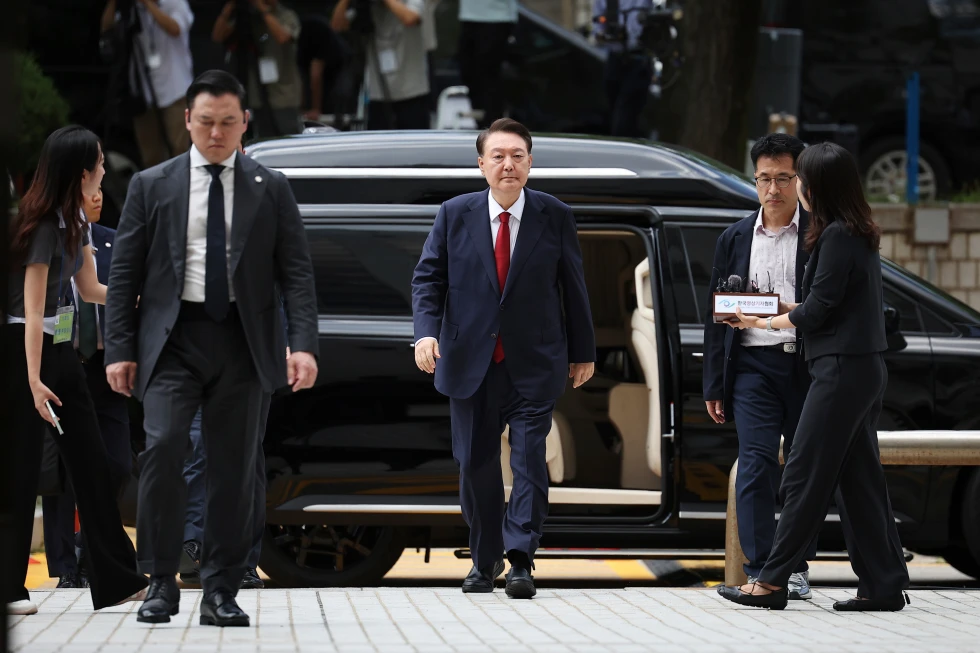
The sentencing proceeding occurred amid intense security precautions as hundreds of police officers established perimeters around the Seoul judicial complex. Yoon’s supporters rallied outside, their anguished cries intensifying as the prison transport vehicle carrying the former president passed. A counter-demonstration of Yoon’s critics gathered nearby, some brandishing signs demanding capital punishment for what they characterized as treasonous conduct.
Authorities reported no major confrontations between opposing demonstrator groups following the verdict’s announcement, though tensions remained elevated as South Korea continues processing the political trauma of witnessing a sitting president attempt to overthrow constitutional governance.
Special prosecutors had requested the death penalty for Yoon, arguing his assault on democratic institutions constituted an existential threat to South Korea’s hard-won democracy that warranted the ultimate sanction. However, most legal analysts anticipated a life sentence given that his poorly conceived power seizure resulted in no fatalities and collapsed within hours due to swift legislative and military resistance.
South Korea has not executed a death row prisoner since 1997, establishing what observers widely interpret as a de facto moratorium on capital punishment amid sustained advocacy for formal abolition. The nation’s evolving away from executions made a death sentence politically and judicially unlikely despite prosecutors’ impassioned arguments about the severity of Yoon’s crimes.
The court simultaneously convicted and sentenced numerous former military and police officials who participated in enforcing Yoon’s martial law decree. Former Defense Minister Kim Yong Hyun received a 30-year prison term for his central role planning the measure and mobilizing military units to occupy the National Assembly grounds—conduct the court characterized as deliberate betrayal of his oath to defend the constitution.
Last month, Yoon received a separate five-year sentence for resisting lawful arrest, fabricating the martial law proclamation’s legal justifications, and circumventing constitutionally mandated procedures requiring full Cabinet deliberation before declaring emergency measures. That conviction addressed procedural violations distinct from the substantive rebellion charges adjudicated in Thursday’s life sentence verdict.
The Seoul Central Court has additionally convicted two members of Yoon’s Cabinet in related proceedings. Prime Minister Han Duck-soo received a 23-year prison sentence for attempting to legitimize the decree by coercing Cabinet approval through a hastily convened meeting, falsifying official records, and committing perjury during subsequent investigations. Han has filed an appeal challenging his conviction.
The cascade of convictions and lengthy sentences reflects judicial determination to establish clear precedents deterring future presidential adventurism. South Korea’s democratic institutions, established following decades of authoritarian military rule that ended in the late 1980s, faced their most serious threat since democratization when Yoon deployed armed forces against the elected legislature.
Yoon’s defense maintained throughout proceedings that he genuinely believed opposition lawmakers were obstructing governance to such a degree that extraordinary measures became necessary to protect national interests. However, prosecutors demonstrated that democratic mechanisms including legislative oversight, judicial review, and electoral accountability provided constitutional remedies for political disputes without requiring military intervention.
The former president’s martial law declaration shocked South Koreans who had lived their entire adult lives under democratic governance and viewed authoritarian emergency decrees as remnants of a discredited past. The decree’s invocation of powers associated with military dictatorships—suspending political activity, controlling media, authorizing warrantless arrests—proved particularly alarming to citizens and legislators who experienced those repressive measures or inherited collective memories of their destructive impact.
International observers closely monitored the crisis and subsequent judicial proceedings as tests of South Korea’s democratic resilience. The swift legislative response nullifying Yoon’s decree, followed by impeachment, removal, arrest, prosecution, and conviction, demonstrated institutional strength and constitutional fidelity that distinguished South Korea from nations where executive power grabs succeed through military loyalty or institutional collapse.
The verdicts send unmistakable signals that South Korean courts will vigorously defend democratic norms against executive overreach regardless of a defendant’s former status or political connections. Life imprisonment for a former president represents an extraordinary outcome reflecting the judiciary’s assessment that Yoon’s conduct threatened the constitutional order’s foundations.
As Yoon begins what likely constitutes the remainder of his natural life in prison, South Korea continues grappling with broader questions about how a democratically elected president could attempt overthrowing the system that elevated him to power. Investigations continue examining whether additional officials participated in planning or supporting the martial law scheme, with further indictments and trials anticipated.
The political opposition that Yoon attempted to suppress through military force now controls both the presidency and legislature following elections that functioned as referendums on the martial law crisis. The new government has prioritized democratic reforms intended to prevent future presidents from accumulating excessive power or circumventing institutional checks and balances.
For South Koreans who endured the terrifying hours when soldiers surrounded their National Assembly and uncertain whether democracy would survive, Thursday’s verdict provides validation that constitutional principles prevailed and accountability mechanisms functioned as designed. The life sentence stands as testament that no executive, regardless of position or prerogatives, operates above the law in a democratic republic committed to self-governance.





