

A police officer was killed and 24 people were injured after multiple explosive devices detonated around midnight in the western Ukrainian city of Lviv, authorities said Sunday, as Russia unleashed a sweeping barrage of missiles and drones across the country targeting energy infrastructure.
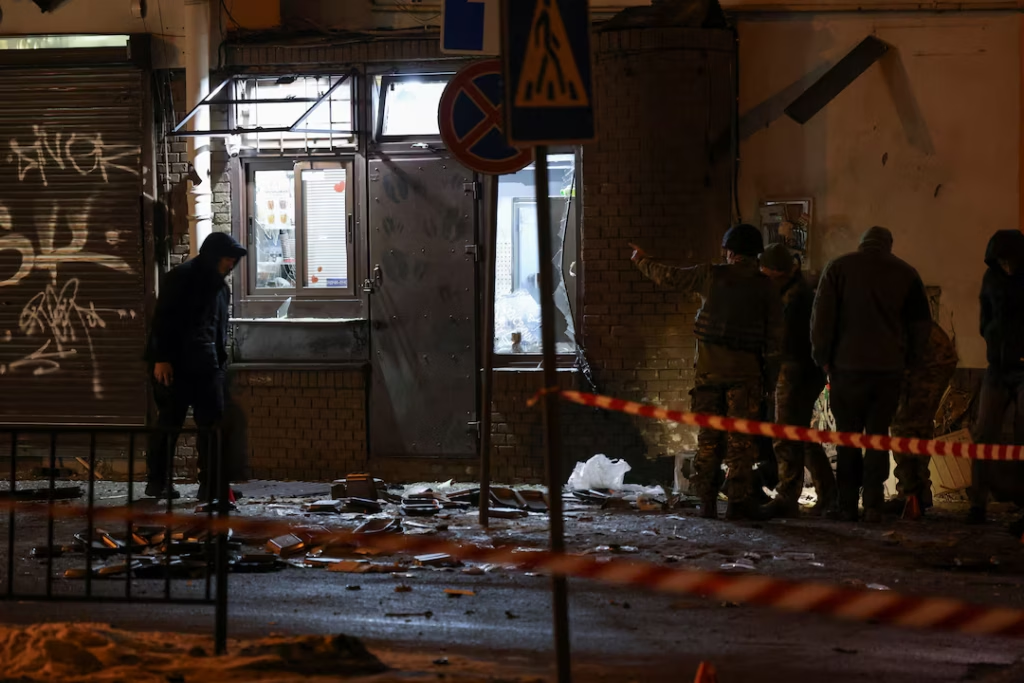
Ukraine’s National Police announced that several improvised explosive devices went off in Lviv shortly after midnight. Investigators have preliminarily determined that the blasts were caused by homemade explosives, police said in a statement posted on the Telegram messaging platform.
Lviv Mayor Andriy Sadovyi described the explosions as a terrorist act, signaling that authorities are treating the incident as deliberate sabotage rather than an accident.
President Volodymyr Zelenskiy said on X that a suspect had been detained in connection with the Lviv blasts. He did not disclose further details about the individual or possible motives.
The western city, located far from the front lines in eastern and southern Ukraine, has frequently served as a logistical hub and a refuge for civilians displaced by fighting. Though largely shielded from the most intense combat, Lviv has been targeted by missile and drone strikes throughout the war.
As authorities responded to the deadly explosions in Lviv, Russia launched dozens of ballistic and cruise missiles along with hundreds of drones in a coordinated overnight assault, Ukrainian officials said.
Ukraine’s military and regional authorities said the strikes focused heavily on energy facilities but also damaged residential buildings and railway infrastructure.
The attacks struck Kyiv and the surrounding region, as well as the Black Sea port city of Odesa and parts of central Ukraine. President Zelenskiy said on X that additional regions targeted included Dnipro, Kirovohrad, Mykolaiv, Poltava and Sumy.
“The main target was the energy sector,” Zelenskiy wrote, adding that homes and rail lines also sustained damage. He accused Moscow of prioritizing continued military pressure over diplomatic engagement.
“Moscow continues to invest in strikes more than in diplomacy,” Zelenskiy said, noting that in the past week alone Russia launched more than 1,300 drones, over 1,400 guided aerial bombs and 96 missiles against Ukraine.
There was no immediate response from Russian officials.
At least one person was killed and five others were injured in the Kyiv region, regional Gov. Mykola Kalashnyk said on Telegram. He said damage was recorded in five districts, with more than a dozen homes affected.
In Odesa, Gov. Oleh Kiper said a nighttime drone strike targeted regional energy infrastructure, sparking fires that were later extinguished.
Ukraine’s air force said Russia launched 50 missiles and 297 drones in the overnight assault. Air defense systems intercepted or otherwise neutralized 33 missiles and 274 drones, the air force said, indicating that some projectiles penetrated defenses.
Ukrainian Foreign Minister Andrii Sybiha called for intensified international sanctions against the Kremlin, writing on X that the continued bombardment amounted to terror.
“This terror cannot be normalized; it must be stopped,” Sybiha said. “Russia cannot wag the world, just as the tail cannot wag the dog.”
Strikes on Ukraine’s energy network have become a near-daily occurrence in recent months. Russia has repeatedly targeted thermal power plants, electrical substations and gas facilities in an effort to degrade Ukraine’s infrastructure.
Since launching its full-scale invasion in February 2022, Moscow has denied intentionally targeting civilians. Russian officials maintain that Ukraine’s civilian infrastructure constitutes a legitimate military objective because it supports the country’s war effort. Ukrainian authorities reject that characterization, arguing that the sustained attacks are intended to terrorize civilians and undermine morale.
The latest wave of bombardment unfolded as U.S.-brokered diplomatic efforts aimed at securing a ceasefire have struggled to gain traction. Talks held in Geneva on Feb. 17 and 18 failed to produce a breakthrough. Russia has demanded that Ukraine withdraw from areas of the eastern Donbas region that remain contested, a condition Kyiv has firmly rejected.
The twin developments — the deadly explosions in Lviv and the large-scale missile campaign — illustrate the multifaceted pressure facing Ukraine as the war grinds into another year.
The Lviv blasts, if confirmed as an act of sabotage, underscore the vulnerability of cities far from active battlefields. Western Ukraine has functioned as a key transit corridor for military supplies and humanitarian aid. Disruptions there could complicate logistics and strain already stretched security services.
Simultaneously, Russia’s continued targeting of the energy grid appears aimed at exhausting Ukraine’s resilience. Energy facilities are not only vital to civilian life but also to industrial production and military operations. Repeated strikes increase repair costs, complicate winter preparedness and amplify economic strain.
Despite high interception rates reported by Ukraine’s air force, even a small percentage of missiles and drones breaching defenses can inflict significant damage. The scale of the latest barrage — nearly 300 drones and 50 missiles in one night — signals Russia’s sustained capacity to mount complex, coordinated attacks.
Diplomatically, the lack of progress in Geneva suggests that both sides remain entrenched. Moscow’s insistence on territorial concessions remains unacceptable to Kyiv, while Ukraine’s leadership continues to seek broader international backing and stronger sanctions.
The simultaneous emergence of internal security threats, such as the Lviv bombings, and intensified external assaults may test Ukraine’s capacity to maintain stability across its territory. Yet officials have emphasized swift arrests, rapid repairs to infrastructure and continued air defense coordination as evidence of resilience.
As winter approaches and energy consumption rises, the durability of Ukraine’s power grid and the effectiveness of its air defenses will remain central to both the humanitarian situation and the broader military balance.
Reuters





