

Pakistan’s military carried out airstrikes along its border with Afghanistan early Sunday, killing at least 70 militants in what officials described as targeted operations against armed groups blamed for recent attacks inside Pakistan, the country’s deputy interior minister said. Afghan authorities rejected the claim, asserting that civilian areas were hit and that dozens of noncombatants were killed or wounded.
Talal Chaudhry, Pakistan’s deputy interior minister, said in an interview with Geo News that the strikes focused on hideouts of Pakistani militants operating from Afghan territory. He did not present evidence to substantiate the claim that at least 70 militants were killed. Pakistan’s state-run media later indicated that the number of militant fatalities had risen to 80.
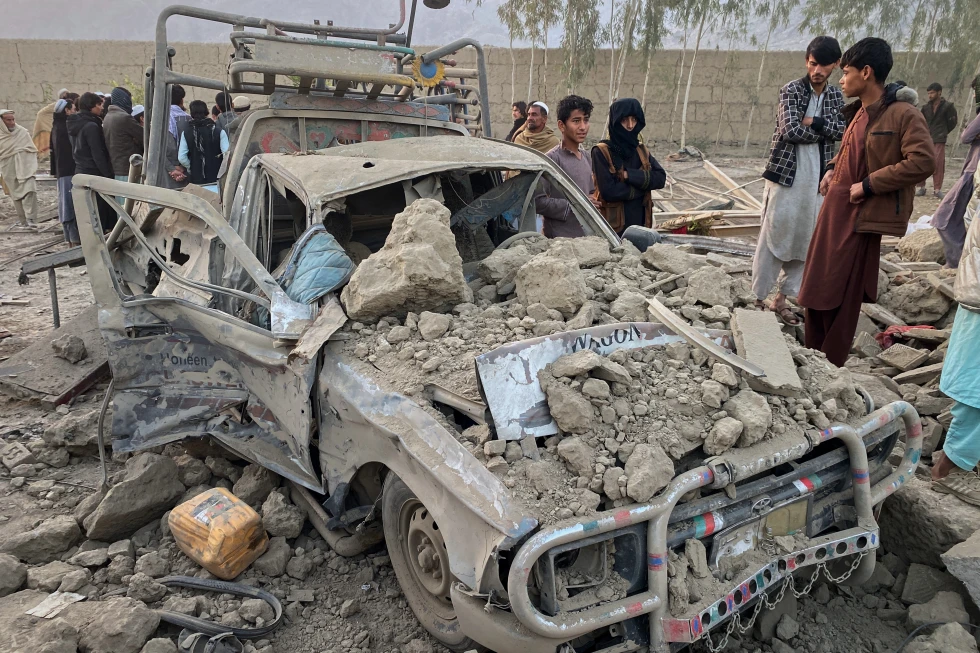
Across the border, Afghanistan’s Defense Ministry issued a statement saying “various civilian areas” in the eastern provinces of Nangarhar and Paktika were struck, including a religious madrassa and several residential homes. The ministry characterized the operation as a breach of Afghanistan’s sovereignty and airspace.
Zabihullah Mujahid, spokesperson for Afghanistan’s Taliban-led government, wrote on X that the attacks killed and injured “dozens, including women and children.” He dismissed Pakistan’s assertion that militants were the primary casualties as “inaccurate.”
Mawlawi Fazl Rahman Fayyaz, the provincial director of the Afghan Red Crescent Society in Nangarhar, said 18 people were confirmed dead and several others were wounded. Local residents in affected areas cleared debris Sunday and prepared funerals for those killed.
Habib Ullah, a tribal elder in Nangarhar, told The Associated Press that those killed were villagers with no ties to armed groups. “They lived simple lives,” he said, adding that the victims were not affiliated with the Taliban, security forces or the former Afghan government.
Pakistan’s President, Asif Ali Zardari, defended the military action late Sunday, describing it as grounded in Pakistan’s inherent right to defend its citizens from terrorism. In a statement, he said Islamabad had exercised restraint by targeting border hideouts and warned that those responsible for attacks inside Pakistan “will not remain beyond reach.”
Earlier this month, Zardari cautioned that Afghanistan’s current conditions resembled or exceeded the instability seen before the Sept. 11, 2001, attacks.
Afghanistan’s Ministry of Foreign Affairs summoned Pakistan’s ambassador to Kabul to protest the strikes. The ministry said safeguarding Afghan territory is the Islamic Emirate’s “Sharia responsibility” and warned that Islamabad would bear responsibility for the consequences of such operations.
Pakistan’s Information Minister Attaullah Tarar said on X that the military had conducted “intelligence-based, selective operations” against seven camps belonging to Tehrik-e-Taliban Pakistan, known as the TTP, and affiliated groups. He added that an affiliate of the Islamic State group was also targeted. Tarar said Pakistan remains committed to regional stability but stressed that protecting Pakistani citizens is a top priority.
Militant violence has escalated in Pakistan in recent years, with authorities attributing much of the surge to the TTP and banned Baloch separatist groups. The TTP, though distinct from Afghanistan’s Taliban, maintains ideological and operational ties. Islamabad accuses the group of using Afghan territory as a staging ground for attacks, an allegation both the TTP and Kabul deny.
Hours before Sunday’s cross-border operation, a suicide bomber struck a security convoy in the northwestern district of Bannu, killing two soldiers, including a lieutenant colonel. Pakistan’s military signaled afterward that it would intensify operations and would not exercise restraint against those responsible.
Last week, another suicide attack in Bajaur district in Khyber Pakhtunkhwa province killed 11 soldiers and a child when an explosives-laden vehicle rammed a security post. Pakistani officials later identified the attacker as an Afghan national.
Tarar said Pakistan possesses “conclusive evidence” linking recent attacks — including a suicide bombing at a Shiite mosque in Islamabad that killed 31 worshippers earlier this month — to militants acting under the direction of leadership based in Afghanistan. He said Islamabad has repeatedly urged Afghanistan’s Taliban authorities to take verifiable steps to prevent militant groups from launching cross-border assaults but alleged that those appeals have not yielded meaningful action.
He also called on the international community to press Afghanistan’s Taliban leadership to uphold commitments under the Doha agreement, which stipulates that Afghan territory should not be used to threaten other countries.
Security analyst Abdullah Khan, based in Islamabad, said the strikes reflect the breakdown of diplomatic efforts aimed at de-escalation. Mediation initiatives involving Qatar, Turkey and Saudi Arabia have not resolved tensions between Islamabad and Kabul, he said, adding that the latest military action risks further escalation.
A Qatari-mediated ceasefire followed deadly border clashes in October that killed dozens of soldiers, civilians and suspected militants. Those confrontations came after explosions in Kabul that Afghan officials attributed to Pakistan. Islamabad responded at the time with strikes deeper inside Afghan territory targeting militant positions.
While the truce has largely held, several rounds of talks in Istanbul in November did not produce a formal agreement, leaving relations strained and mistrust high.
The latest exchange underscores the fragile and volatile nature of Pakistan-Afghanistan relations, particularly as both governments grapple with domestic security pressures. For Islamabad, rising militant attacks — especially suicide bombings targeting military convoys and places of worship — have intensified public demand for decisive action. The military’s cross-border posture signals a willingness to expand operations beyond Pakistan’s immediate frontier.
For Kabul’s Taliban-led authorities, allegations of harboring militant groups threaten international legitimacy and complicate efforts to secure economic relief and diplomatic recognition. Publicly condemning the strikes as violations of sovereignty reinforces a narrative of defending national independence but may also deepen isolation.
Strategically, the persistence of the TTP insurgency presents a dilemma. If Pakistan escalates cross-border strikes, the risk of retaliatory violence or accidental clashes increases. Yet failure to act may embolden militant networks that exploit porous terrain and limited state control.
The collapse of mediation initiatives suggests diminishing space for quiet diplomacy. Absent a durable security framework or mutual verification mechanisms, each new attack risks triggering another round of recriminations and retaliation.
As funerals proceed in eastern Afghanistan and security alerts remain elevated in Pakistan’s northwest, the region faces renewed uncertainty. Whether backchannel diplomacy can prevent a broader confrontation remains an open question, but analysts warn that miscalculation could swiftly unravel the tenuous calm that has prevailed since last year’s clashes.
The Associated Press





