

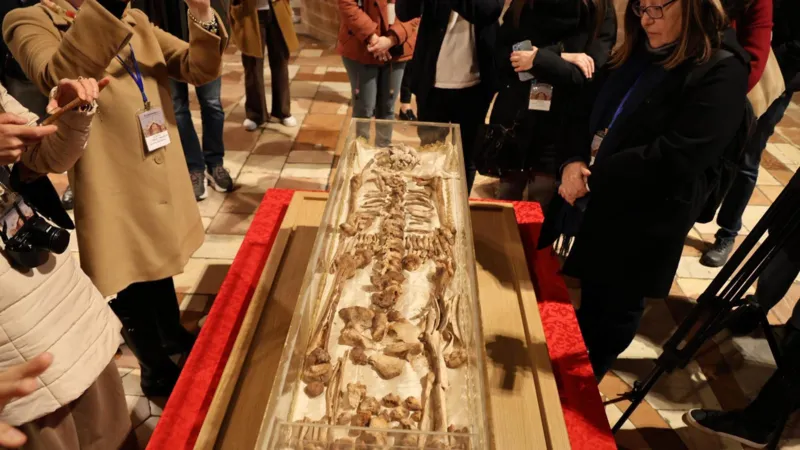
ASSISI, Italy (BN24) — The skeletal remains of St Francis of Assisi have been placed on public display in central Italy in a rare exhibition marking eight centuries since the death of one of Christianity’s most revered figures.
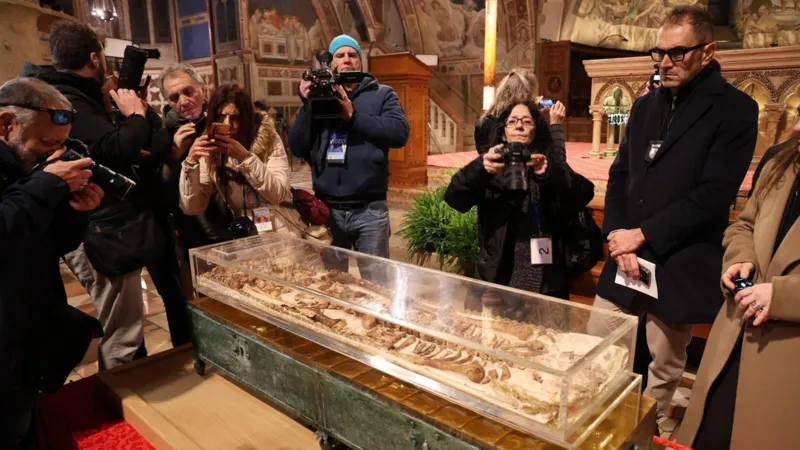
Church authorities in Italy indicated that roughly 400,000 pilgrims and visitors from across the globe have secured reservations to view the remains in Assisi, the saint’s birthplace. The display opened Sunday in the lower church of the Basilica of St Francis of Assisi and will continue through March 22.
The unveiling offers an extraordinary opportunity for the faithful. According to church officials, the remains have been publicly exhibited only once before for a single day in 1978, when access was restricted to a limited number of viewers.
Born in Assisi in either 1181 or 1182, Francis became known for abandoning his family’s wealth to embrace a life of poverty and service. He went on to establish the Franciscan religious order, emphasizing humility, compassion and devotion to the marginalized. Over the centuries, he has been recognized as the patron saint of animals and the environment, a reflection of his teachings about the interconnectedness of all creation.
The Catholic Church commemorates the Feast of St. Francis each year on Oct. 4, the anniversary of his death in 1226.
The display of his remains is unfolding at a moment of renewed interest in the saint’s legacy. The late Pope Francis, who led the Roman Catholic Church for more than a decade before his death last year, chose his papal name in tribute to the 13th-century saint. Vatican observers often noted that the pontiff sought to mirror Francis’ radical humility and concern for the poor.
Church representatives have framed the exhibition as both a spiritual milestone and a cultural event of global resonance. Pilgrims have traveled from Europe, Latin America, Asia and the United States, underscoring the enduring appeal of a figure whose message continues to shape Catholic identity.
Security and crowd-control measures have been heightened in Assisi to accommodate the anticipated influx of visitors. Local authorities are coordinating with church officials to manage reservations and ensure orderly access to the basilica’s lower church, where the remains are housed.
The basilica itself, a UNESCO World Heritage site, has long been a focal point of devotion. Constructed shortly after Francis’ canonization in 1228, it contains frescoes and artworks chronicling his life and spiritual journey. The current exhibition centers on the saint’s bones, presented in a manner intended to balance reverence with historical context.
For many of the faithful, the opportunity to witness the remains is viewed as a rare spiritual encounter. Pilgrims interviewed by Italian media described feelings of gratitude and solemn reflection as they prepared to enter the basilica.
Enduring Legacy in a Modern World
While the exhibition marks a historical anniversary, it also arrives at a time when Francis’ teachings appear particularly relevant. His embrace of poverty and his critique of material excess resonate in an era marked by economic inequality and environmental strain.
Francis’ writings and example have increasingly been invoked in discussions about climate change and ecological responsibility. His reverence for nature inspired the naming of Pope Francis’ 2015 encyclical on the environment, “Laudato Si’,” after the saint’s canticle praising creation. Though separated by centuries, the themes of humility and stewardship remain intertwined.
Scholars note that public displays of saints’ relics have historically served to reinforce communal identity within the Catholic tradition. Such events often draw believers seeking spiritual renewal, while also attracting historians and cultural tourists interested in medieval religious history.
The exhibition may also carry economic implications for Assisi and the surrounding Umbria region. With hundreds of thousands of visitors expected over the coming weeks, local businesses from hotels to restaurants stand to benefit from the influx of pilgrims. Religious tourism has long been a pillar of the town’s economy, and this milestone anniversary could provide a measurable boost.
At the same time, church leaders have emphasized that the commemoration is intended to foster reflection rather than spectacle. In homilies and public remarks, clergy have encouraged visitors to contemplate Francis’ message of peace and simplicity.
A Rare Glimpse into History
The limited prior public viewing in 1978 heightened anticipation for the current exhibition. That earlier display was brief and accessible to only a small audience, making this year’s extended viewing period highly unusual.
Historians observe that relic veneration dates back to early Christianity, when the physical remains of saints were believed to connect the faithful to sacred history. Over time, many relics were concealed or safeguarded to prevent damage or theft. The decision to unveil Francis’ remains reflects careful deliberation by church authorities, balancing preservation concerns with pastoral outreach.
As the exhibition continues, Assisi has once again become a focal point for global Catholicism. For some visitors, the journey is deeply personal a pilgrimage undertaken after years of devotion. For others, it is an opportunity to witness a piece of medieval history rarely accessible to the public.
Eight centuries after his death, Francis’ influence shows little sign of fading. His life story that of a merchant’s son who relinquished privilege to serve the destitute remains embedded in Christian teaching and cultural memory.
The public display of his bones, though temporary, underscores the enduring power of that narrative. As pilgrims file quietly through the basilica’s lower church, they participate in a tradition that links the present with the distant past a testament to the lasting imprint of a saint whose message continues to echo far beyond the stone walls of Assisi.





