

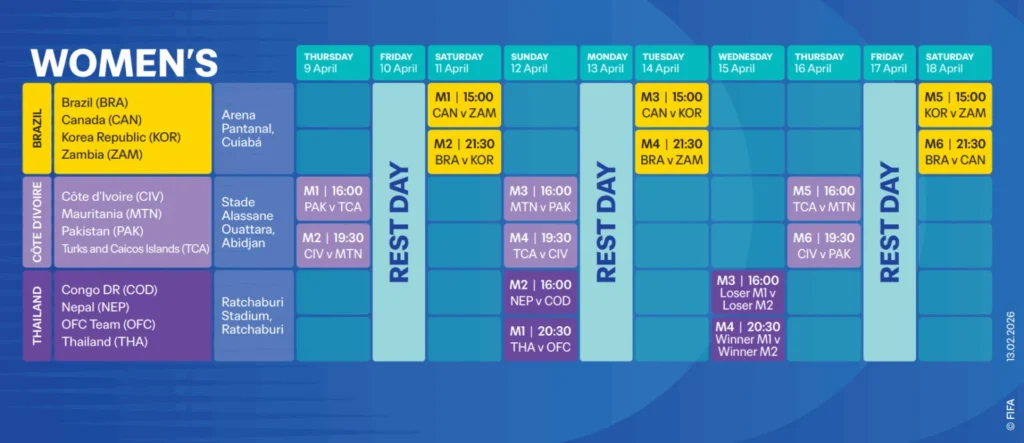
ZURICH, Switzerland (BN24) — World football’s governing body has made public the complete match schedule for the upcoming FIFA Series 2026, confirming that 48 national teams will compete in the expanded edition of the international friendly competition during the March and April 2026 window.
The timetable, made available Monday on FIFA’s official platform, outlines fixtures involving teams from all six continental confederations. The tournament format reflects a broader push to increase intercontinental matchups outside traditional championship settings.
The 2026 edition will feature 12 groups of four teams each nine in the men’s competition and three in the women’s division. Eleven FIFA Member Associations will serve as hosts, with Rwanda staging two separate groups. Additional host nations include Australia, Azerbaijan, Brazil, Côte d’Ivoire, Indonesia, Kazakhstan, New Zealand, Puerto Rico, Switzerland, Thailand and Uzbekistan.
All contests will be recognized as official international friendlies and carried by global broadcast partners, ensuring worldwide access for supporters and commercial stakeholders. The matches also present participating federations — particularly those with limited exposure to cross-confederation opponents — an opportunity to test themselves against unfamiliar styles of play.
Flexible Formats Within Groups
FIFA indicated that participating associations selected their preferred competitive structure within their respective groups. Some opted for a semifinal-and-final bracket arrangement, while others chose a round of predetermined fixtures. Regardless of format, each group will produce one winner.
To maintain competitive intensity, any match tied at the end of regulation will proceed directly to a penalty shootout. Extra time will not be played, a measure designed to limit player workload while ensuring decisive outcomes.
FIFA described the schedule as a continuation of the pilot edition staged in 2024. The governing body confirmed host nations and group compositions in January 2026, laying the foundation for the final match calendar released this week.
Part of Broader Development Strategy
In its announcement, FIFA framed the competition as part of a wider initiative to promote more balanced growth across global football. The governing body pointed to the value of meaningful fixtures outside marquee tournaments such as the upcoming FIFA World Cup 2026.
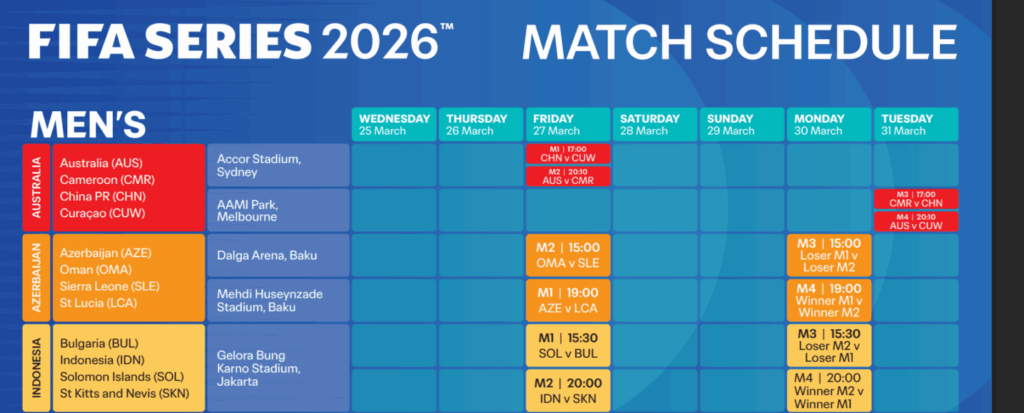
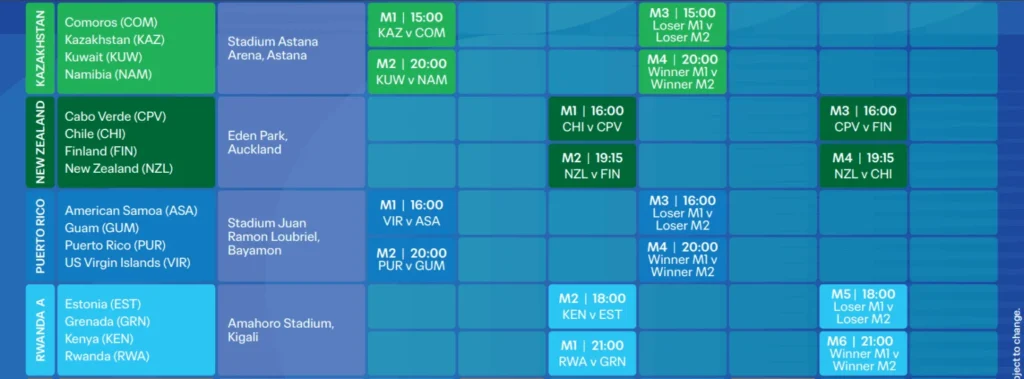
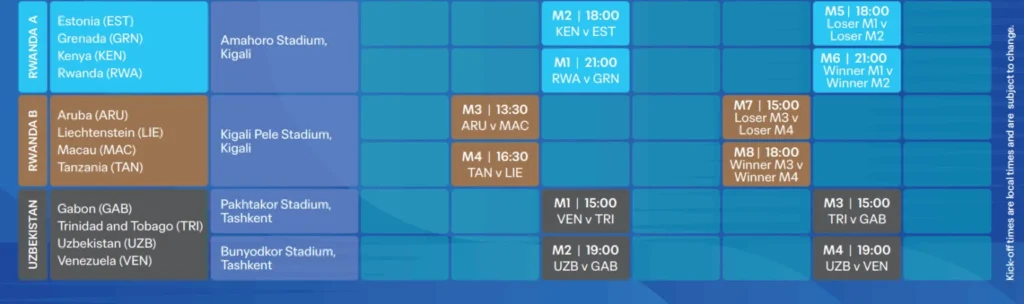
“The FIFA Series™ continues to deliver on our commitment to inclusive football development,” FIFA said in its statement. “By bringing teams from different confederations together in competitive settings, we are strengthening the sporting and cultural fabric of the game while giving emerging nations greater visibility on the international stage.”
The organization has increasingly emphasized competitive parity and broader access to high-level fixtures, particularly for smaller federations that rarely face opponents from outside their continental zones.
Strategic Timing Ahead of World Cup Expansion
While the FIFA Series is formally categorized as a friendly competition, its strategic timing carries broader implications.
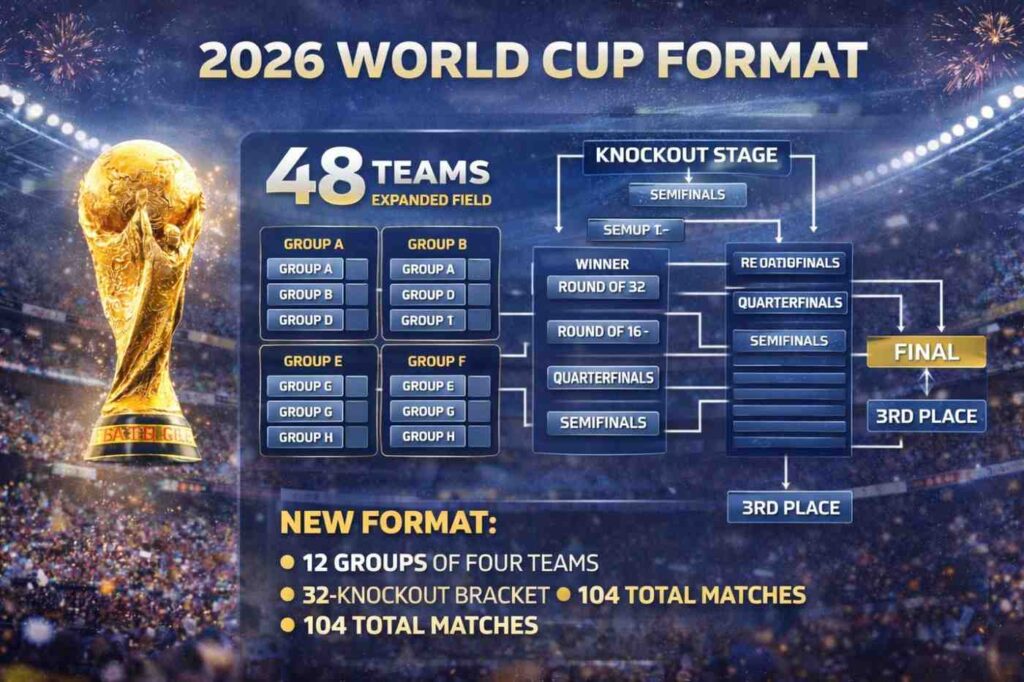
The 2026 calendar year will be dominated by preparations for the expanded 48-team World Cup, a format shift that mirrors the scale of the FIFA Series itself. By staging intercontinental friendlies months before the World Cup, FIFA appears to be creating rehearsal environments for federations adjusting to larger tournament structures and more diverse opposition pools.
For emerging football nations, the exposure may extend beyond technical development. Increased broadcast reach can enhance sponsorship prospects and strengthen diplomatic sports ties between federations. Hosting rights granted to countries such as Rwanda and Kazakhstan signal FIFA’s continued effort to decentralize elite football events away from traditional power centers in Europe and South America.
The absence of extra time is also notable. With domestic seasons and continental competitions crowding the football calendar, player welfare has become a recurring concern among clubs and national associations. Direct penalty shootouts after regulation offer a compromise: decisive outcomes without extended physical strain.
Commercial considerations are equally significant. Globally televised fixtures during a traditionally quieter international window provide inventory for sponsors and broadcasters, reinforcing FIFA’s year-round event strategy. The 2024 pilot reportedly demonstrated strong engagement in developing markets, a factor that likely influenced the expansion to 48 teams.
However, some analysts suggest that maintaining competitive credibility will depend on fixture quality and player availability. As friendlies, the matches may not always feature full-strength squads, particularly from top-ranked nations managing congested schedules. The tournament’s long-term relevance could hinge on whether it evolves into a more formalized competition structure.
Still, the breadth of confederation representation underscores FIFA’s central objective: widening access to meaningful international competition. In many cases, smaller associations face financial or logistical hurdles arranging intercontinental matches independently. Centralized coordination through the FIFA Series reduces those barriers.
The complete schedule including match dates, venues and kick-off times is now accessible through FIFA’s official channels. The March April 2026 window will mark the second staging of the initiative and the first at full scale.
As global football prepares for an expanded World Cup era, the FIFA Series may serve as both a developmental tool and a testing ground for new competitive models. Whether it becomes a permanent fixture in the international calendar will likely depend on competitive balance, commercial returns and feedback from participating federations. For now, FIFA’s latest move signals a clear direction: a more interconnected, globally distributed version of the international game, designed to ensure that exposure and opportunity extend well beyond football’s traditional strongholds





