

UVIRA, Democratic Republic of the Congo (BN24) Movement resumed Monday at the main crossing between the Democratic Republic of the Congo and Burundi, ending more than two months of closure that had cut off trade, separated families and strained the fragile economy of this lakeside city.
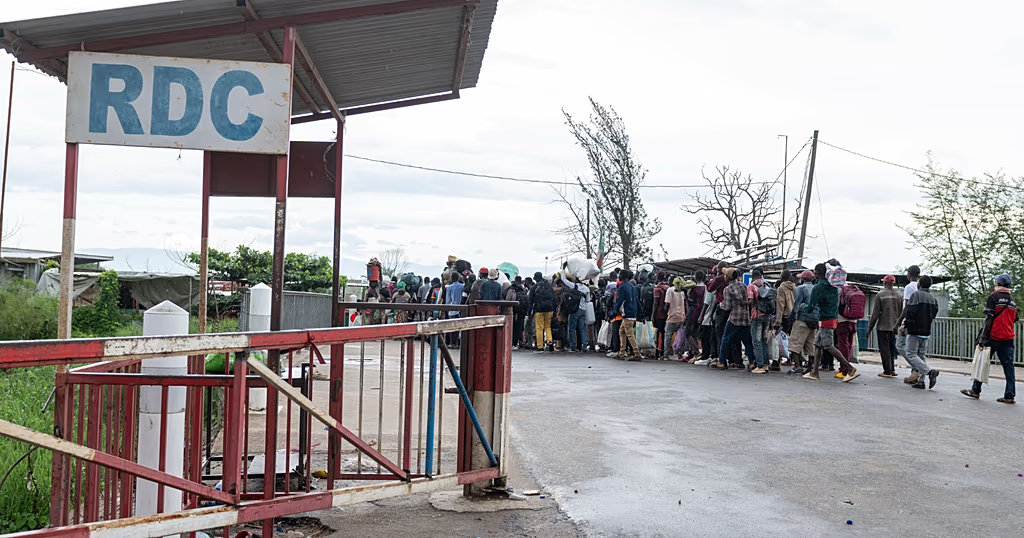
Crowds assembled at the Kavimvira border post on the Congolese side and at Gatumba in Burundi as authorities allowed pedestrians, traders and vehicles to pass through for the first time since late 2025. The reopening followed an announcement by the governor of South Kivu province a day earlier.
The frontier had been sealed after fighters linked to AFC/M23 seized control of Uvira amid escalating insecurity in eastern Congo. Burundi’s government shut its border post in response to the deteriorating security environment, leaving thousands stranded and halting the steady flow of goods that underpins daily life in this region along Lake Tanganyika.
By midmorning Monday, motorcycle taxis ferried passengers once more, bicycles stacked with sacks of produce rolled through the checkpoint and small-scale merchants carried goods across the boundary in scenes residents described as both emotional and long-awaited.
“I am very happy, because for a long time we were looking for a way to return home, but it was not possible,” said Dalili Mussa, a Congolese national who had remained in Burundi during the closure.
Many who crossed Monday had fled weeks earlier as gunfire echoed through neighborhoods. Aline Safi recounted the moment she decided to leave.
“We were in the house with the children when the crackling of bullets and bombs began,” she said. “That’s when we decided to flee to Burundi so as not to become victims.”
According to the United Nations High Commissioner for Refugees (UNHCR), advances by M23 rebels in South Kivu province triggered a notable influx of Congolese civilians into Burundi during the fighting. The agency indicated that the cross-border movement placed additional humanitarian pressure on host communities already grappling with limited resources.
With the crossing now accessible, some refugees have begun returning, though humanitarian organizations caution that conditions remain volatile.
Uvira’s economy, largely informal and heavily reliant on daily exchanges with Gatumba, was hit hard during the suspension. Traders reported shortages of essential goods, price spikes and declining household income as transport links were cut.
“The reopening of the border is a great joy for us and for all the residents of Uvira,” said Bosco Amani, a local trader. “Even in Gatumba, there is celebration. Motorcycles and bicycles are moving. I even saw students leaving their schools to come celebrate at the border.”
For residents, the reopening is both practical and symbolic. Kavimvira is more than a checkpoint; it is a lifeline connecting families, markets and services on both sides of the border. The resumption of traffic restores access to food supplies, medical care and education routes disrupted by the crisis.
Yet beneath the relief lies uncertainty.
The city still bears visible signs of recent clashes. Some buildings show damage, and the security presence remains noticeable. Local leaders have emphasized the need for sustained cooperation between Congolese and Burundian authorities to guarantee safe passage and prevent renewed instability.
The AFC/M23 group, which has been active in eastern Congo for years, has periodically seized territory, prompting displacement and international concern. The resurgence of the movement in South Kivu has once again drawn attention to unresolved grievances and the broader regional dynamics shaping conflict in eastern Congo.
The reopening of the Uvira-Gatumba crossing may signal more than a logistical adjustment; it reflects delicate regional calculations. Burundi’s decision to resume border operations suggests confidence however tentative that immediate threats near Uvira have diminished. At the same time, it underscores the economic interdependence binding border communities.
Cross-border trade in eastern Congo often operates outside formal customs systems, forming a backbone of subsistence for thousands. When the border closed, the impact rippled quickly: food scarcity intensified, informal credit systems stalled and transportation workers lost daily wages. In cities like Uvira, where formal employment opportunities are limited, such disruptions can accelerate poverty and fuel social tensions.
The return of commerce may help stabilize prices and restore income flows. However, economic revival alone cannot guarantee lasting calm. The underlying drivers of conflict in eastern Congo including competition over land, ethnic tensions and regional rivalries remain unresolved.
The involvement of neighboring states has historically complicated peace efforts. While the reopening represents coordination between Kinshasa and Bujumbura, sustained diplomatic engagement will be essential to prevent future closures that could once again isolate border populations.
For humanitarian agencies, the challenge now lies in managing returns while ensuring that displaced families have access to shelter, security and basic services. Premature returns to unstable areas risk exposing civilians to renewed violence.
Residents interviewed at the crossing expressed a shared hope that the border will remain open. For them, stability is measured less by political statements than by the ability to move freely, trade goods and send children to school without fear.
As foot traffic continued throughout the day, the sound of engines and conversation replaced the silence that had defined the crossing for weeks. In Uvira, the steady rhythm of people walking across Kavimvira offered a visible sign of resilience and a reminder that for border communities, peace is inseparable from mobility.
Whether this reopening marks a durable turning point or a temporary pause in a longer cycle of unrest remains uncertain. For now, however, the barrier is lifted, and with it, a measure of hope returns to the shores of Lake Tanganyika.





