

(NBC/Reuters) — Cuban authorities said Wednesday that border guard troops fatally shot four people and wounded six others aboard a Florida-registered speedboat after the vessel entered Cuban territorial waters and initiated gunfire near the island’s northern coast, an episode unfolding against a backdrop of strained relations between Havana and Washington.
Cuba’s Ministry of the Interior said the confrontation occurred about one nautical mile northeast of the El Pino channel near Falcones Cay, roughly 200 kilometers (120 miles) east of Havana. According to a ministry statement posted on Facebook and carried by multiple news outlets, five members of a Cuban border patrol unit approached the vessel to identify it when the crew of the speedboat opened fire.
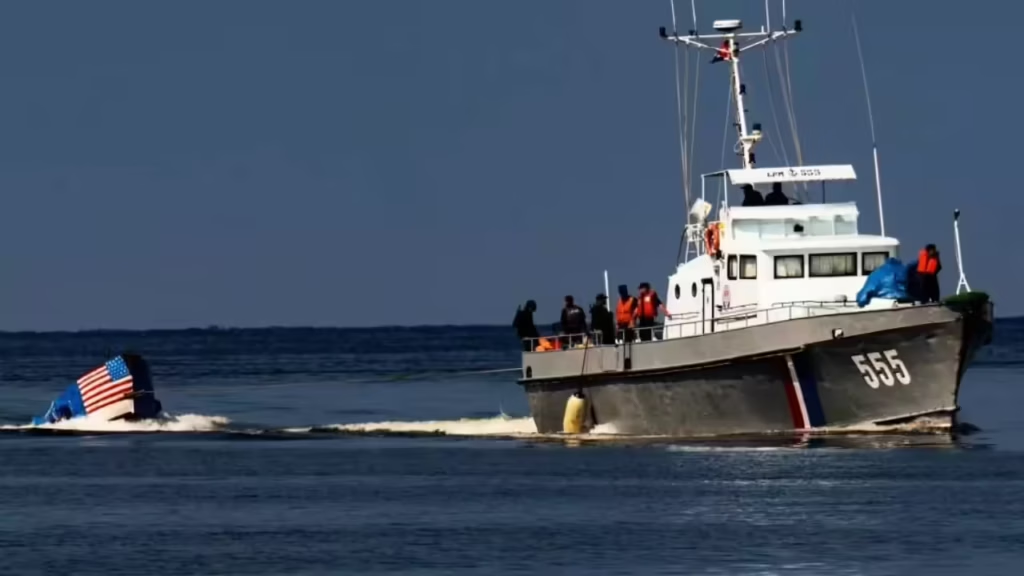
The exchange left the commander of the Cuban patrol boat wounded, the ministry said. Cuban forces returned fire, killing four people aboard the speedboat. Six others on the vessel were injured and evacuated for medical treatment, authorities said. The ministry added that the incident remains under investigation to determine the precise sequence of events.
Cuban officials identified the vessel as registered in Florida under number FL7726SH but did not release the names or nationalities of those killed or wounded.
NBC News cited Cuban officials as saying the Florida-registered boat violated territorial waters, triggering the armed confrontation with border guard troops. The ministry’s statement said the firefight erupted after Cuban personnel attempted to conduct an identification procedure.
“Faced with the current challenges, Cuba reaffirms its commitment to protecting its territorial waters,” the ministry said, describing national defense as a central pillar of sovereignty and regional stability.
The U.S. State Department did not immediately respond to requests for comment from Reuters and NBC News.
Florida Officials Demand Investigation
In Florida, Attorney General James Uthmeier announced that he had directed the Office of Statewide Prosecution to begin its own inquiry in coordination with federal, state and local partners.
“I’ve directed the Office of Statewide Prosecution to work with our federal, state, and law enforcement partners to begin an investigation,” Uthmeier wrote in a post on X. “The Cuban government cannot be trusted, and we will do everything in our power to hold these communists accountable.”
U.S. Rep. Carlos Gimenez, R-Fla., whose district includes the southern tip of Florida, also urged a federal review. In a statement, Gimenez called the episode a “massacre” and pressed U.S. authorities to determine whether any of the victims were American citizens or lawful permanent residents.
“United States authorities must determine whether any of the victims were U.S. citizens or legal residents and establish exactly what occurred,” Gimenez said, asserting that serious concerns had been raised about the use of lethal force against a U.S.-registered vessel. He did not provide evidence to support his characterization of the incident.
Secretary of State Marco Rubio was in St. Kitts and Nevis on Wednesday for meetings with Caribbean leaders. His office did not immediately issue a public statement addressing the confrontation.
Heightened Bilateral Tensions
The clash unfolded during a period of renewed friction between the United States and Cuba. The Trump administration has curtailed most oil shipments to the island, intensifying economic pressure on the Communist-led government. U.S. officials have also tightened restrictions on energy flows from Venezuela, a longtime ally of Havana.
At the same time, the United States announced Wednesday that it would permit limited sales to Cuba’s private sector, a move seen as a targeted adjustment within broader sanctions policy.
The broader geopolitical climate has grown more volatile following Washington’s capture of Venezuelan President Nicolas Maduro in Caracas on Jan. 3, an action that removed a key Cuban partner from power and further complicated regional dynamics.
Against that backdrop, even a single maritime confrontation carries outsized diplomatic implications.
Legal and Strategic Questions
Cuba maintains that the speedboat penetrated its territorial waters and initiated the exchange of gunfire. International maritime law generally recognizes a nation’s sovereignty within 12 nautical miles of its coastline. If Cuban forces acted within that zone and responded to gunfire, Havana could argue its actions were consistent with self-defense.
However, U.S. officials and Cuban-American lawmakers have cast doubt on Havana’s narrative, calling for independent verification of the facts. The absence of publicly released identities and the lack of immediate U.S. confirmation leave key details unresolved.
The incident also underscores the longstanding volatility of maritime crossings between Florida and Cuba. Over decades, speedboats have been used for migration, smuggling and political activism, often drawing swift response from Cuban authorities.
What distinguishes this episode is the reported exchange of gunfire and the fatal outcome, an escalation that risks inflaming an already fragile bilateral relationship.
While the facts remain under investigation, the confrontation highlights how quickly tensions between Havana and Washington can spill into open crisis. Maritime encounters are inherently sensitive, particularly when they involve U.S.-registered vessels and loss of life.
For Florida officials, the political stakes are high. Cuban-American communities wield significant influence in state and national elections, and allegations of excessive force by Cuban authorities resonate deeply among voters with personal ties to the island.
For Cuba, projecting control over its territorial waters serves both strategic and symbolic purposes. Amid economic strain and diplomatic isolation, Havana may view firm enforcement actions as demonstrations of sovereignty.
Yet such incidents also risk unintended escalation. If any of the deceased are confirmed to be U.S. citizens or residents, pressure could mount on Washington to respond more forcefully. Conversely, if evidence substantiates Cuba’s account of an armed provocation, U.S. authorities may face complex legal and diplomatic calculations.
With investigations now underway in both Havana and Florida, the coming days are likely to determine whether this episode remains an isolated maritime clash or becomes another flashpoint in a long history of mistrust between the two nations.





