

YAMBIO, South Sudan (BN24) — Ethiopian peacekeepers serving with the United Nations mission in South Sudan were awarded United Nations Medals during a ceremony in Yambio, recognizing their role in efforts to stabilize the conflict-affected nation.
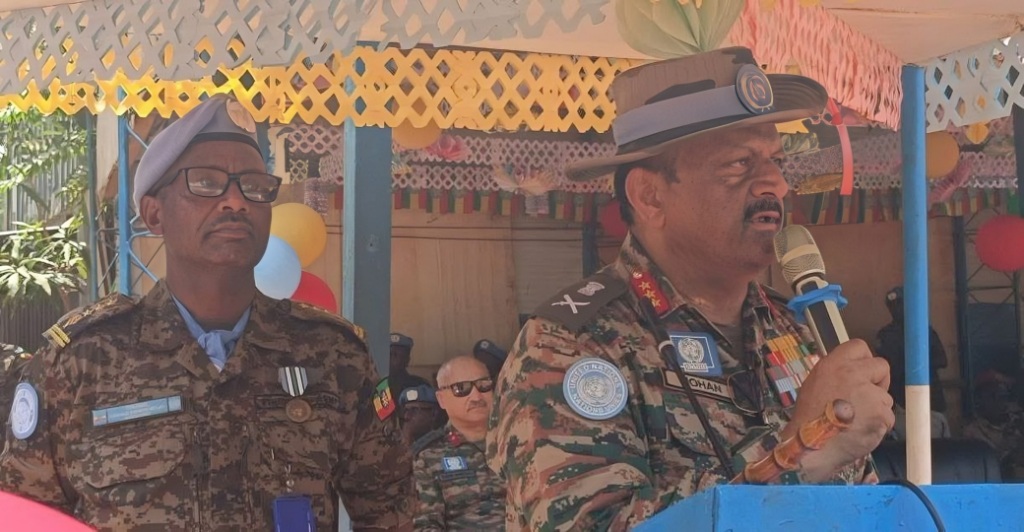
The event brought together U.N. officials and local authorities to honor members of the Ethiopian battalion deployed under the U.N. Mission in South Sudan, known as UNMISS. Troops across all ranks were recognized, including frontline personnel and support teams responsible for maintaining vehicles and equipment critical to field operations.
Among those honored was Major Tigist Ferede, a mechanic with more than two decades of service in Ethiopia’s armed forces. She described the significance of her work in maintaining mission vehicles in a region where mobility can mean the difference between safety and vulnerability.
“I served in the army for more than 20 years. This is my second UN mission. I was in the Sudan for my first mission,” Ferede said during the ceremony. She reflected on the challenges of her earlier deployment, noting that harsh weather conditions and limited interaction with local communities posed difficulties.
“It was challenging due to the harsh weather, and interaction with the local community was not easy, but when I came here for my second mission, it was much easier because the weather is conducive and the people are welcoming,” she said.
Ferede emphasized the broader meaning she attaches to her mechanical duties. “Every vehicle I repair carries hope. When they move safely, I know I’ve done my part for peace. I like the people here because we are all African, especially with South Sudan, we have a lot of similarities as they are our neighbours,” she added.
The United Nations Medal is awarded to peacekeepers who complete a designated period of service in a U.N. operation. In South Sudan, UNMISS has operated since 2011 with a mandate that includes protecting civilians, facilitating humanitarian assistance, and supporting implementation of peace agreements.
Lieutenant General Mohan Subramanian, Force Commander of UNMISS, used the occasion to pay tribute to Ethiopian personnel who have died while serving under the U.N. flag.
“Serving under the flag of the United Nations, 142 Ethiopian soldiers, men and women, have given up their lives and made a supreme sacrifice. As we stand here today in the parade receiving the coveted United Nations medal, let us all remember them and not forget their sacrifice,” Subramanian said. He broadened his remarks to include all peacekeepers who have lost their lives in missions around the world.
“Not only the Ethiopians, all of us in the United Nations, all Blue Helmets and everybody who wears a uniform and works for world peace or all civilians who work for world peace,” he said.
South Sudan, the world’s youngest nation, has experienced recurring violence since gaining independence in 2011. Although a 2018 peace agreement reduced large-scale clashes between rival factions, localized violence and intercommunal conflict continue to threaten stability in parts of the country.
Ethiopia has long been a significant contributor to U.N. peacekeeping operations, deploying troops and police units to missions across Africa and beyond. Its participation in South Sudan underscores regional efforts to prevent a relapse into widespread civil war.
For mechanics like Ferede, the mission’s goals are expressed in practical terms: ensuring armored personnel carriers, transport trucks, and other vehicles remain operational for patrols and rapid response. In remote areas with limited infrastructure, reliable transportation is central to protecting civilians and supporting humanitarian agencies.
UNMISS officials have frequently underscored that logistical readiness underpins the mission’s effectiveness. When vehicles break down or equipment fails, patrols can be delayed, and response times lengthened, potentially exposing vulnerable communities to harm.
The Yambio ceremony highlighted not only individual service but also the collective role of peacekeepers in a fragile security environment. Local officials attending the event voiced appreciation for the presence of international forces, which many residents view as a stabilizing influence amid periodic unrest.
The awarding of United Nations Medals to Ethiopian peacekeepers carries symbolic and operational significance. Symbolically, it reinforces Ethiopia’s standing as one of Africa’s leading contributors to multilateral peacekeeping. Operationally, it draws attention to the complex realities facing missions like UNMISS, where progress toward lasting peace remains uneven.
South Sudan’s peace process has advanced in stages, yet implementation gaps and sporadic violence persist. In this context, the role of foreign contingents such as the Ethiopian battalion is not merely ceremonial. Their presence can deter armed actors and reassure displaced populations considering returning home.
The remarks by Lt. Gen. Mohan Subramanian serve as a reminder of the costs associated with peacekeeping. The acknowledgment that 142 Ethiopian soldiers have died under U.N. command illustrates the risks involved, even in missions described as stabilization efforts rather than active warfighting operations.
Moreover, Major Ferede’s comments reflect an often-overlooked dimension of peacekeeping: the essential contributions of support personnel. While combat-ready troops patrol volatile areas, mechanics, medics, and logistics teams sustain the mission’s capacity to operate. Without them, mandates to protect civilians would be difficult to fulfill.
Regionally, Ethiopia’s engagement in South Sudan also aligns with broader African Union and Intergovernmental Authority on Development (IGAD) objectives to promote stability in the Horn of Africa. Given shared borders and intertwined economic interests, instability in South Sudan can have ripple effects across neighboring states.
As South Sudan continues to navigate its political transition, the visibility of disciplined, multinational forces wearing the blue helmet remains a tangible sign of international commitment. The medal ceremony in Yambio thus functioned both as recognition of past service and as a reaffirmation of the ongoing mission: safeguarding civilians and supporting a fragile peace.
For the Ethiopian peacekeepers who stood in formation to receive their medals, the honor marked the completion of a chapter of service. For the communities they serve, it represented continuity in the international effort to prevent renewed conflict in a country still striving to secure lasting stability.





