

ZHENGZHOU, China (BN24) —A Chinese industrial firm drew national attention after distributing the equivalent of $26 million in cash at its annual year-end celebration, inviting thousands of employees to take home as much money as they could physically carry.
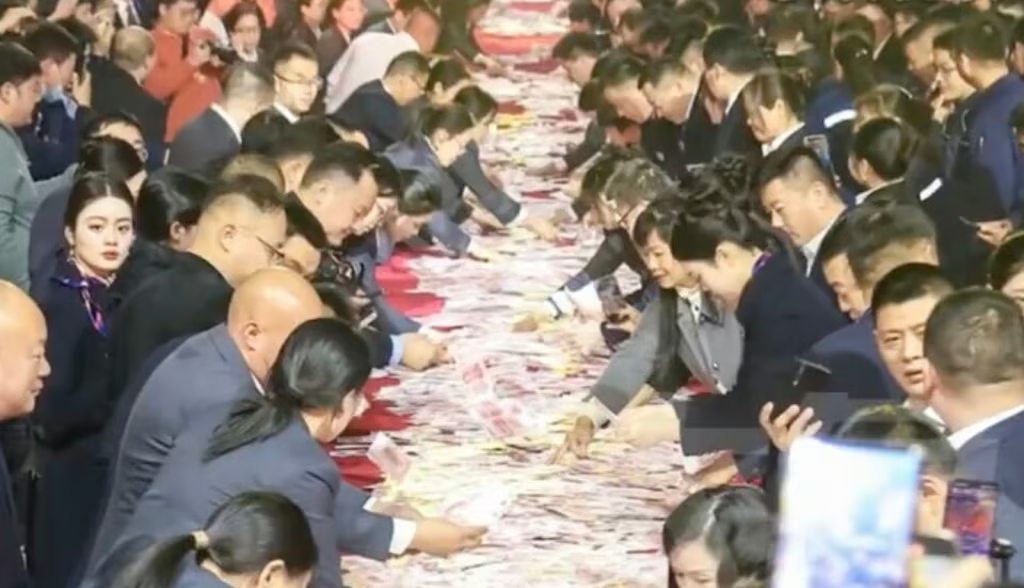
Henan Kuangshan Crane Co. Ltd. staged the event on Feb. 13, arranging stacks of banknotes across approximately 800 banquet tables at a large-scale company gathering attended by roughly 7,000 people.
Under bright stage lighting and decorative displays, employees in formal attire moved between the tables, some calculating how much they could gather in a single trip. Images circulating on Chinese social media showed towering piles of currency bundled and arranged in neat stacks.
The company’s chairman, Cui Peijun, addressed employees during the gala and defended the decision to hand out physical cash rather than transfer bonuses electronically.
“Some people ask why we don’t just transfer the money to their accounts, but that way, it’s just cold numbers,” Cui said during the celebration. He also dismissed suggestions of offering household goods or jewelry instead, adding, “Why are we giving out washing machines? Do you think gold prices have gone up? In previous years, we gave necklaces and rings bring up the cash and gave everyone another 20,000 yuan ($2,800).”
According to the South Korean newspaper Chosun Daily, at least one employee managed to carry away about $13,000 in cash during the event. The report highlighted the scale of the giveaway and the unusual method of distribution.
Cui, who controls approximately 98.88% of the company’s shares, effectively redirected a substantial portion of his dividend earnings back to staff through the mass payout.
Founded in 2002, Henan Kuangshan Crane manufactures and leases heavy industrial cranes and operates in more than 130 countries. The company has cultivated a reputation for generous employee incentives tied to profitability.
Financial disclosures cited by local media indicate the firm recorded net profits of about $38 million in 2024. Of that total, approximately $24 million was allocated to employee bonuses. The prior year, the company distributed $8.5 million among its 40 top-performing workers, with its three highest sales performers each earning roughly $730,000.
The firm also awarded nearly $230,000 in bonuses to almost 2,000 female employees to mark International Women’s Day in March of last year.
Cui has previously outlined his reasoning for the company’s expansive bonus policies. “It is not that I love giving out money,” he said in earlier remarks. “It is that young people are burdened with car loans and mortgages, and any relief we can offer helps.”
China’s private sector has faced mounting economic headwinds in recent years, including slower growth, real estate volatility, and rising youth unemployment. Against that backdrop, highly visible corporate bonus events can carry symbolic weight, signaling both financial resilience and internal solidarity.
While year-end bonuses are customary in China, particularly ahead of the Lunar New Year period,d payouts of this magnitude remain rare. Corporate profit-sharing arrangements are often distributed discreetly via bank transfer. Public cash disbursements on such a scale are uncommon and generate significant public attention.
Analysts say the spectacle may serve multiple purposes beyond employee reward. Public displays of largesse can reinforce corporate loyalty, boost morale, and enhance a company’s brand in a competitive labor market. In manufacturing sectors that rely on skilled technicians and sales teams, retention remains critical.
The optics of distributing physical currency also tap into cultural symbolism. In China, red envelopes containing cash are traditionally presented during holidays and celebrations as gestures of goodwill and prosperity. By amplifying that custom to an industrial scale, the company fused traditional gifting practices with corporate performance incentives.
However, some corporate governance observers note that concentration of ownership, such as Cui’s dominant 98.88% stak, allows unilateral decisions about dividend allocation. While employees benefit directly, such models depend heavily on the continued profitability and discretion of a single controlling shareholder.
Henan Kuangshan Crane’s global operations position it within a manufacturing sector that has experienced fluctuating demand tied to infrastructure spending worldwide. Continued international expansion into more than 130 countries suggests a diversified revenue base, which may underpin its ability to sustain large-scale bonuses.
The event also arrives at a time when policymakers in Beijing have emphasized boosting domestic consumption and stabilizing household finances. Substantial employee bonuses can contribute to short-term spending, particularly when distributed in cash ahead of major holiday periods.
The $26 million distribution illustrates how some privately held Chinese firms are using profit-sharing as both a motivational tool and a branding strategy. In a slower-growth economic environment, high-visibility reward programs can differentiate employers and mitigate workforce turnover.
Cui’s approach reflects a paternalistic leadership style historically present in parts of China’s manufacturing sector, where company founders often position themselves as stewards of employee welfare. By returning dividends directly to staff, he reinforces loyalty while consolidating his image as a benefactor.
From a labor economics perspective, lump-sum bonuses may have a stronger psychological impact than incremental salary adjustments. Behavioral research suggests tangible rewards, particularly those delivered publicly, can heighten perceptions of appreciation and collective achievement.
At the same time, sustainability remains a central question. Profit-linked bonuses are inherently cyclical. If global crane demand contracts or profit margins narrow, replicating such large-scale giveaways could become more difficult. Employees accustomed to exceptional distributions may recalibrate expectations.
Internationally, the story also underscores differences in corporate culture. In many Western firms, compensation transparency and regulatory frameworks limit theatrical distributions of cash. In China’s private sector, particularly among founder-controlled enterprises, flexibility allows for dramatic gestures that blend tradition, performance incentives, and public relations.
Ultimately, the spectacle at Henan Kuangshan Crane serves as botha elebration and a signal celebrating profitability while signaling confidence in future growth. Whether it becomes a model for other firms or remains a singular display of corporate generosity will likely depend on broader economic trends in China’s manufacturing landscape.





