

President Donald Trump announced early Saturday that the United States military has begun what he described as “major combat operations in Iran,” confirming American participation in a widening military campaign alongside Israel amid escalating tensions over Tehran’s nuclear program.
“A short time ago, the United States military began major combat operations in Iran,” Trump said in a video posted at 2:30 a.m. Eastern on Truth Social. He framed the action as defensive, declaring that the objective is to protect Americans by eliminating what he characterized as imminent threats posed by Iran’s government.
“It has always been the policy of the United States, in particular my administration, that this terrorist regime can never have a nuclear weapon,” Trump said. “They can never have a nuclear weapon.”
Two U.S. officials told NBC News that the operation is being carried out from both air and sea. One official indicated that a broad array of fighter aircraft are involved. Another said American forces are striking Iranian military and security installations. Three U.S. officials said Tomahawk cruise missiles were launched from Navy vessels toward targets inside Iran.
The Associated Press separately confirmed that the United States and Israel initiated coordinated strikes Saturday, with one apparent early target near offices associated with Supreme Leader Ayatollah Ali Khamenei in Tehran.
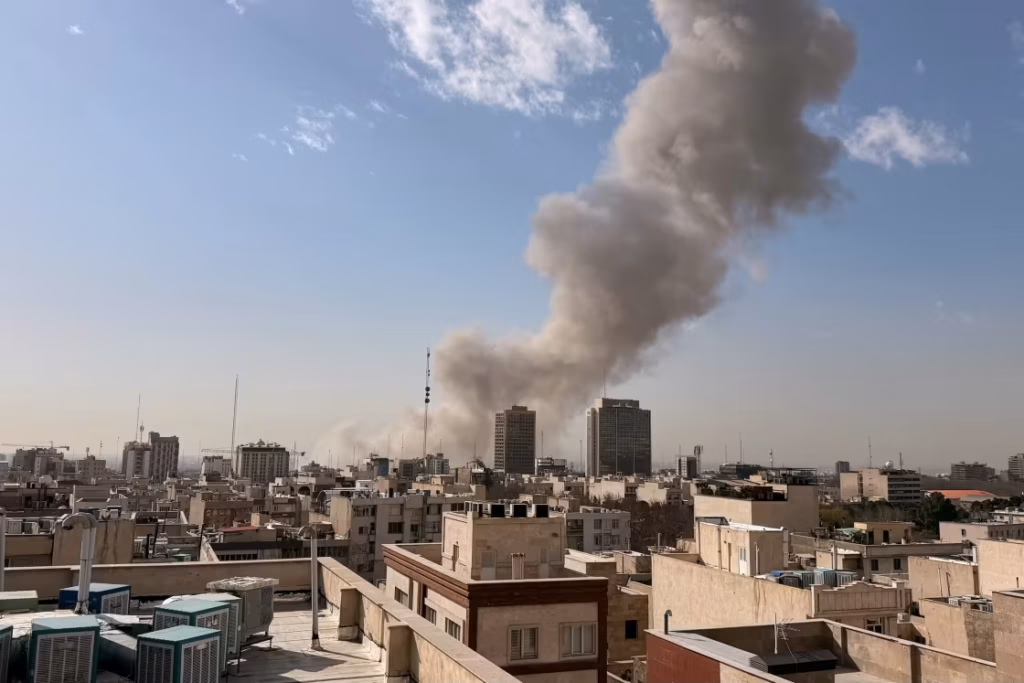
Iranian state media acknowledged multiple explosions across the country. Blasts were reported outside Tehran and in several cities, including Qom, Hamedan, Kermanshah, Karaj, Tabriz, Ilam and on Qeshm Island in the Persian Gulf. Iran’s semi-official FARS news agency said detonations were heard throughout the capital, while images broadcast on state television showed thick plumes of smoke rising over parts of Tehran.
Iran’s semi-official Tasnim news agency indicated that Iranian airspace had been closed.
An Israeli defense ministry spokesperson said Israel initiated what it called a preemptive strike aimed at removing threats to the country. “The State of Israel has launched a preemptive strike against Iran to remove threats against the State of Israel,” the spokesperson said, cautioning that retaliatory missile and drone attacks against Israeli territory could follow.
Sirens sounded across Israel as the strikes unfolded. The Israeli military said the alerts were intended to prepare civilians for the possibility of incoming projectiles. Israeli television networks shifted coverage to bomb shelters as much of the country’s streets appeared largely empty.
Israeli Defense Minister Israel Katz publicly acknowledged the offensive as smoke billowed over Tehran.
A U.S. official, speaking on condition of anonymity because of the sensitivity of ongoing operations, told NBC News that American forces are actively participating in the strikes with Israel and that the campaign remains underway.
In his address, Trump cautioned that conflict could bring American casualties, particularly if Iran retaliates.
“My administration is taking every possible step to minimize the risk to U.S. personnel in the region,” Trump said. “Even so, the Iranian regime seeks to kill. The lives of courageous American heroes may be lost, and we may have casualties. That often happens in war.”
There have been no immediate indications of American deaths or injuries linked to the initial wave of strikes.
Trump’s announcement follows months of mounting tension tied to Iran’s nuclear ambitions. During his recent State of the Union address, the president accused Tehran of pursuing “sinister nuclear ambitions.” The United States had been engaged in nuclear discussions with Iran, but the diplomatic track appeared increasingly strained in recent weeks.
The administration has significantly bolstered U.S. military assets in the Middle East. A second carrier strike group, the USS Gerald R. Ford Carrier Strike Group, was ordered to the region earlier this month. The USS Abraham Lincoln carrier group was already operating nearby following a deployment decision announced Feb. 13.
NBC News reported that the U.S. ambassador to Israel circulated guidance urging Americans who wished to depart to do so “TODAY,” an email that NBC said it reviewed and that was first disclosed by The New York Times.
Iranian lawmaker Ebrahim Azizi issued a defiant message on social media after the strikes. “We warned you!” he wrote. “Now you’ve started down a path whose end is no longer in your hands.”
Iranian media outlets confirmed at least two strike sites in central Tehran. Additional blasts were reported near maritime facilities, including Asaluyeh and the port of Chabahar, suggesting attention to naval capabilities.
Eric Schouten, chief executive of the Netherlands-based Dyami security intelligence firm, told The Associated Press that the strikes appear to be “preparatory shaping actions.” He said disabling radar systems, surface-to-air missile batteries and command nodes would typically precede a broader air campaign intended to secure air superiority.
“The broader pattern suggests preparatory shaping actions,” Schouten said. He described the operation as consistent with the opening phase of a coordinated military campaign rather than a symbolic show of force.
The launch of major combat operations marks one of the most significant escalations between Washington and Tehran in decades. While U.S. administrations have previously conducted targeted strikes — including the 2020 killing of Iranian Gen. Qassem Soleimani — a sustained joint campaign with Israel aimed at degrading Iranian military infrastructure carries far-reaching implications.
If the operation extends over several days, as two U.S. officials suggested to NBC News, it could test Iran’s capacity for asymmetric retaliation. Tehran has historically relied on proxy forces across the region, including groups in Lebanon, Syria and Iraq, to respond indirectly to Israeli and American actions.
The mobilization of two carrier strike groups signals both deterrence and preparation for escalation. Such a force posture not only enables extended air operations but also communicates readiness to defend U.S. assets and allies against counterstrikes.
The strikes also arrive at a delicate geopolitical moment. Energy markets could react sharply if maritime routes in the Persian Gulf are disrupted. Qeshm Island’s proximity to the Strait of Hormuz — through which a significant share of global oil flows — heightens concerns over potential shipping interference.
Domestically, Trump’s decision underscores a hard-line approach that prioritizes coercive leverage over diplomatic compromise in confronting Iran’s nuclear trajectory. Whether the campaign succeeds in constraining Tehran’s capabilities without triggering broader regional war remains uncertain.
For now, U.S. and Israeli officials have signaled determination to continue operations as events rapidly unfold across the Middle East.
NBC/AP





