

(AP) — Iranian state media reported Sunday that members of Supreme Leader Ayatollah Ali Khamenei’s immediate family, including a daughter and grandchild, were killed in coordinated U.S.-Israeli airstrikes that also claimed the life of the country’s longtime leader, marking a dramatic escalation in a conflict already reshaping the Middle East.
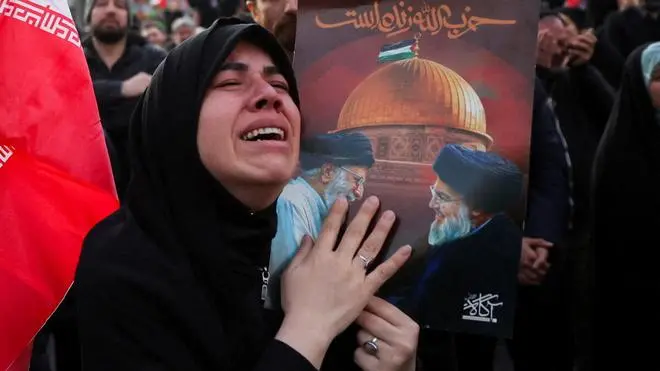
The semiofficial Fars News Agency said Khamenei’s daughter, son-in-law, grandchild and a daughter-in-law died during strikes that hit the supreme leader’s compound in central Tehran early Saturday. The confirmation followed earlier announcements that the 86-year-old cleric had been killed in the bombardment. Iranian state television delivered the news in a tearful broadcast and declared a 40-day national mourning period.
Iranian outlets, including Fars and other state-affiliated agencies, stated that the family members were inside the compound when it was struck and that their deaths were verified after communication with sources at the residence. The reports did not detail the precise circumstances of each death or clarify whether additional relatives were present.
The United States and Israel have not publicly addressed the reported deaths of Khamenei’s relatives. President Donald Trump announced Saturday on Truth Social that Khamenei had been killed in what he described as a sweeping military operation conducted jointly with Israel. Trump wrote that the Iranian leader had been unable to evade “Highly Sophisticated Tracking Systems” and characterized the moment as an opportunity for the Iranian public to reclaim political control.
Iranian authorities confirmed Khamenei’s death hours after Trump’s statement. State television described the supreme leader as having been at his office “performing his assigned duties” when the strike occurred. Satellite imagery published by international outlets showed significant structural damage within the Tehran compound.
The reported deaths of Khamenei’s daughter and grandchild add a deeply personal dimension to an operation that Iranian officials have portrayed as a broad assault on the country’s leadership. Iranian government statements have framed the strike as an act of aggression aimed not only at military infrastructure but at the political core of the Islamic Republic.
The strikes unfolded amid escalating hostilities between Tehran, Washington and Jerusalem following stalled negotiations over Iran’s nuclear program. Iranian officials had previously warned that any direct military action against the country’s leadership would trigger retaliation. In the hours after the attack, Iran launched missiles and drones toward Israeli territory and U.S. installations in the Gulf, according to statements from regional governments and military officials.
The violence has coincided with reports of heavy civilian casualties elsewhere in Iran. A separate airstrike on a girls’ school in Minab during the opening day of operations reportedly killed more than 100 people, most of them students, according to Iranian accounts. U.S. Central Command said it was reviewing allegations of civilian harm but did not confirm responsibility.
The killing of Khamenei’s immediate relatives intensifies uncertainty over Iran’s political succession. The supreme leader held ultimate authority over Iran’s armed forces, judiciary and key state institutions. While Iran’s constitution outlines procedures for selecting a successor, no publicly designated heir had been confirmed before his death. Iranian officials have indicated that interim authority will rest with senior state figures pending deliberations by the Assembly of Experts.
Beyond succession questions, the reported deaths within Khamenei’s family may deepen public emotion and nationalist sentiment inside Iran. Historically, external attacks that result in civilian casualties — particularly those involving children — have rallied segments of Iranian society around the state, even among citizens critical of its policies. Analysts note that such events can complicate any expectation that leadership losses alone will weaken regime cohesion.
At the same time, internal pressures remain. Iran has endured years of economic strain under international sanctions and widespread protests. Human rights monitors have documented thousands of deaths during security crackdowns in recent years. The removal of the country’s most powerful figure, combined with the loss of close relatives in a high-profile strike, introduces both instability and the possibility of intensified internal power struggles.
International reaction has been swift but measured. Several Gulf states have urged restraint, warning that continued escalation could endanger maritime traffic through the Strait of Hormuz, a corridor that carries a significant share of global oil exports. Markets in Asia and Europe showed volatility Sunday amid fears that further strikes or retaliatory attacks could disrupt energy supplies.
From Washington’s perspective, the administration has characterized the operation as a targeted effort to dismantle Iran’s military and nuclear command structure. U.S. officials have emphasized that the objective was to neutralize perceived threats, not to target civilians. Yet the confirmed deaths of Khamenei’s family members are likely to prompt scrutiny from international bodies and human rights organizations.
For Israel, the operation reflects a long-standing strategy of preemptive action against what it views as existential threats. Israeli leaders have argued for years that Iran’s nuclear ambitions and regional proxy network pose direct risks to Israeli security. The reported elimination of senior Iranian figures — now including family members of the supreme leader — signals a willingness to escalate beyond conventional military targets.
The broader implications remain uncertain. Leadership decapitation can sometimes fragment centralized authority, but it can also consolidate power among hardline factions. Iran’s Revolutionary Guard, a powerful military and economic force, may assert a more dominant role during the transition. Such a shift could harden Tehran’s posture in ongoing regional confrontations.
Meanwhile, the symbolism of a 40-day mourning period underscores the weight of the moment within Iran’s political culture. In Shiite tradition, the 40th day after death carries religious significance, often serving as a focal point for public gatherings and expressions of collective grief. Observers say these commemorations could become flashpoints for either unity or dissent, depending on how events unfold.
As of Sunday, no independent international investigation had verified the precise circumstances surrounding the deaths of Khamenei’s daughter, grandchild and other relatives. Iranian state media accounts remain the primary source of information . The coming days are expected to bring additional disclosures as foreign governments and international agencies assess the scale of the strikes and their consequences.
What is clear is that the loss of Khamenei and members of his family marks one of the most consequential episodes in Iran’s post-revolutionary history. The event intertwines military escalation, political transition and deeply personal tragedy — elements that together could reshape the trajectory of the Islamic Republic and the balance of power across the Middle East.





