

TEHRAN, Iran (BN24) — Iran’s national football team could withdraw from this summer’s World Cup following U.S. and Israeli airstrikes that killed Supreme Leader Ayatollah Ali Khamenei, the head of the country’s football federation indicated Sunday, casting uncertainty over one of the tournament’s most politically sensitive participants.
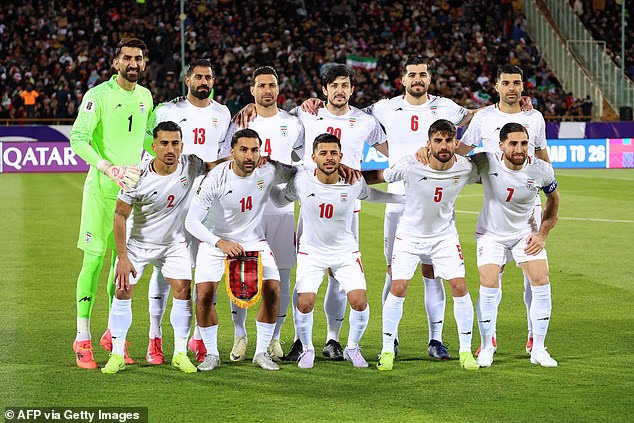
The comments came a day after a coordinated military operation struck several major Iranian cities, including Tehran, amid escalating tensions between Iran and Western allies. Iranian state television broadcast remarks from Mehdi Taj, president of the Iranian Football Federation, suggesting that participation in the global tournament may no longer be assured.
“With what happened today and with that attack by the United States, it is unlikely that we can look forward to the cup,” Taj said on the Iranian TV network “Tehran,” as cited by Marca. He added that a final determination would rest with the country’s sports authorities.
“But the sports chiefs are the ones who must decide on that,” Taj said.
The World Cup, scheduled to take place across the United States, Canada and Mexico, is set to begin in just over three months. Iran is slated to open its campaign against New Zealand at SoFi Stadium in Los Angeles. The team is also scheduled to face Belgium and Egypt during the group stage, with matches in Los Angeles and Seattle.
If Iran advances beyond the group stage and both it and the United States finish second in their respective groups, the two nations could meet in Dallas on July 3 a matchup that would carry heightened political significance given the latest developments.
FIFA officials addressed the unfolding situation cautiously. Speaking Saturday at an International Football Association Board (IFAB) meeting in Wales, FIFA General Secretary Mattias Grafstrom acknowledged awareness of the breaking news but refrained from detailed comment.
“I read the news the same way you did this morning,” Grafstrom said. “We had a meeting today, and it would be premature to comment on that in detail.”
He added that FIFA’s priority remains the safe organization of the tournament.
“Of course we will monitor the developments around all issues around the world,” Grafstrom said. “We had a final draw in Washington where all teams participated, and our focus is to have a safe World Cup with everybody participating.”
Iran earned qualification for its fourth consecutive World Cup by finishing first in Group A of Asian qualifying, reinforcing its status as one of the strongest sides in the Asian Football Confederation. The team has increasingly established itself as a consistent presence on the global stage, advancing through a competitive regional field to secure its place in the expanded tournament.
The sudden geopolitical upheaval, however, introduces uncertainty that extends beyond sport.
The possibility of Iran’s withdrawal presents complex logistical and diplomatic challenges for FIFA and tournament organizers. Replacing a qualified team at this late stage could require emergency procedures under FIFA regulations, potentially involving the next-best finisher in Asian qualifying or a special playoff arrangement.
Beyond scheduling considerations, security planning could face intensified scrutiny. The World Cup is expected to draw millions of spectators across North America, and any escalation of hostilities or retaliatory actions could heighten security concerns in host cities, particularly if politically sensitive matchups materialize.
The prospect of a U.S.–Iran match on American soil already carried symbolic weight even before the airstrikes. Past encounters between the two nations in international competitions have drawn global attention, blending sport with diplomatic undertones. A renewed confrontation under current circumstances would likely amplify those dynamics.
Political analysts note that national teams often become symbols of unity during times of domestic crisis. Iran’s leadership may face competing pressures balancing public sentiment, security concerns and international optics when determining whether to proceed with participation.
A withdrawal could also have economic consequences. The World Cup represents significant commercial opportunity through sponsorships, broadcasting revenue and global exposure. For Iranian players, many of whom compete internationally, missing the tournament would represent both a professional setback and a loss of global visibility.
While the immediate focus centers on whether Iran will compete, the broader significance lies in how geopolitical conflict increasingly intersects with global sporting events. International tournaments such as the World Cup are designed to transcend politics, yet history shows they often reflect the prevailing international climate.
FIFA’s cautious language underscores the delicate balance it must strike. The organization seeks to avoid political entanglement while ensuring safety and competitive integrity. However, in situations involving state-level conflict, neutrality becomes more complicated.
Should Iran withdraw voluntarily, FIFA may avoid imposing sanctions. But if security concerns or political pressure compel external intervention, the governing body could face criticism from multiple sides. Additionally, the potential absence of a major Asian team would alter competitive dynamics in Group G and beyond.
The coming weeks will likely determine whether diplomacy, de-escalation or further conflict shapes the trajectory of Iran’s participation. For now, uncertainty clouds preparations just 107 days before kickoff.
As global attention turns toward North America for the expanded 2026 tournament, organizers confront a stark reminder: even the world’s most celebrated sporting spectacle is not insulated from geopolitical shockwaves.
FIFA officials have indicated they will continue monitoring developments as they assess the path forward.





