

American and Israeli forces pounded targets across Iran on Sunday, unleashing massive bombs on ballistic missile facilities and obliterating naval vessels as part of an intensifying military campaign following the assassination of Supreme Leader Ayatollah Ali Khamenei, while President Donald Trump signaled unexpected willingness to engage diplomatically with Tehran’s emerging leadership despite vowing vengeance for the first American casualties in the expanding conflict.
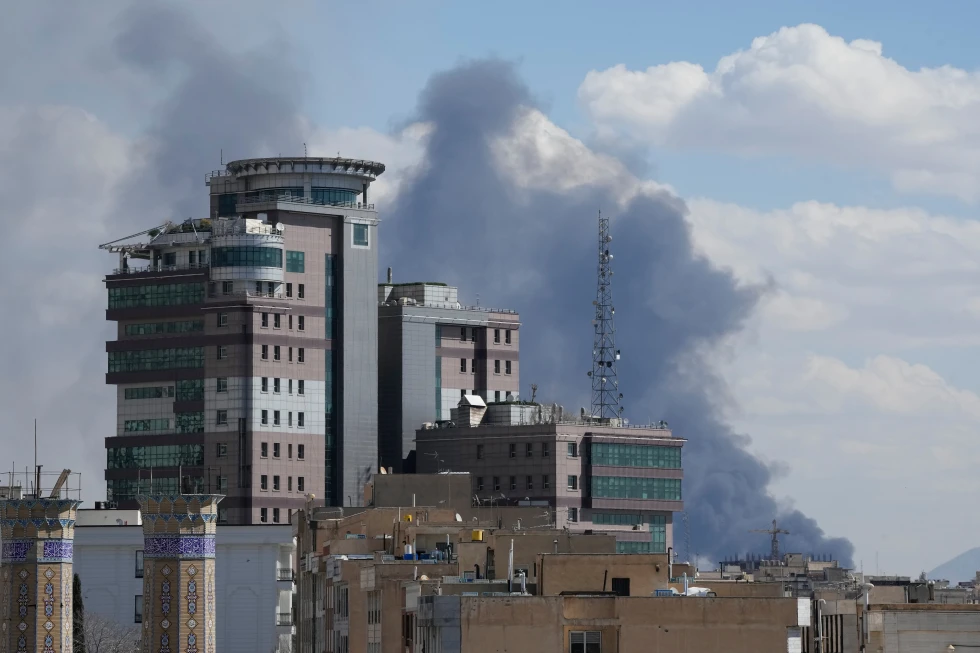
Blasts rattled windows throughout Iran and sent towering smoke plumes above Tehran as the relentless bombardment entered its second full day. Iranian authorities confirmed more than 200 people have perished since strikes commenced Saturday, killing Khamenei and numerous senior leaders in coordinated attacks that eliminated the theocratic regime’s top echelon in what Israeli military officials characterized as a meticulously planned operation exploiting a “golden opportunity” when key figures gathered simultaneously.
Iran vowed devastating retaliation, launching missiles at Israel and Gulf Arab states in counteroffensives that the U.S. military acknowledged resulted in three American service members’ deaths—the first known U.S. combat casualties from the conflict. Israeli emergency services confirmed strikes hit multiple locations including Jerusalem and a synagogue in the central town of Beit Shemesh, where nine people died and 28 sustained injuries, elevating Israel’s overall death toll to eleven. Eleven individuals remained missing following the Beit Shemesh attack, police disclosed.
However, the assaults on Iran demonstrated no indications of diminishing as American and Israeli forces targeted critical military, political, and intelligence installations in what appeared to constitute an expanding war carrying potential for prolonged conflict that could engulf the Middle East and destabilize it catastrophically. The strikes represented a startling display of military might for an American president who ascended to office championing an “America First” platform and pledging to avoid “forever wars.”
Trump issued a video statement posted to social media declaring the United States would “avenge” the fallen service members’ deaths and warning that “there will likely be more” killed before hostilities conclude. His acknowledgment of probable additional American casualties marked a sobering recognition that the military operation he authorized carried genuine risks extending beyond surgical precision strikes initially suggested.
Israel, which had committed to “nonstop” bombardment, announced it was escalating attacks, with 100 fighter jets simultaneously striking Tehran targets, Brigadier General Effie Defrin told journalists at a briefing. The targets encompassed buildings belonging to Iran’s air force, its missile command apparatus, and its internal security forces that violently suppressed anti-government demonstrations in January that left thousands dead.
The U.S. military confirmed that B-2 stealth bombers struck Iran’s ballistic missile installations with 2,000-pound munitions—among America’s most powerful conventional weapons designed to penetrate hardened underground facilities. Trump declared via social media that nine Iranian warships had been sunk and that the Iranian navy’s headquarters had been “largely destroyed,” conveying the comprehensive nature of military operations aimed at dismantling Iran’s conventional warfare capabilities.
Europe has predominantly remained distant from direct military involvement while pressing for diplomatic resolution, but in an indication that conflict could draw additional nations into combat, Britain, France, and Germany announced Sunday their readiness to cooperate with the United States to help neutralize Iran’s retaliatory strikes.
British Prime Minister Keir Starmer confirmed Britain would permit the United States to utilize its military bases for strikes against Iranian missile sites. The United Kingdom maintains strategically positioned bases on Cyprus and the Chagos Islands—a British archipelago in the Indian Ocean providing proximity to Middle Eastern theaters.
The weekend attacks constituted the second occasion in eight months that American and Israeli forces had combined against Iran. During the 12-day war last June, Israeli and American strikes substantially degraded Iran’s air defenses, military leadership, and nuclear program infrastructure. However, Khamenei’s assassination—ending his more than three-decade rule over Iran—creates a leadership vacuum dramatically increasing risks of regional instability whose consequences remain impossible to predict.
Trump, who one day earlier had encouraged Iranians to “take over” their government through popular uprising, signaled Sunday his openness to dialogue with Iran’s nascent leadership despite the ongoing bombardment.
“They want to talk, and I have agreed to talk, so I will be talking to them,” Trump told The Atlantic magazine, revealing that communication channels existed even as American warplanes continued dropping bombs on Iranian territory. The president’s simultaneous prosecution of military operations while entertaining diplomatic engagement illustrated the contradictory impulses characterizing his Iran strategy.
In a separate interview with the Daily Mail, Trump indicated the military campaign against Iran could persist for approximately four weeks, providing the first timeline for operations whose objectives and endpoints remained vaguely defined despite their catastrophic humanitarian and geopolitical consequences.
Iranian strikes reached far beyond American and Israeli targets, dragging Gulf cities that have long promoted themselves as regional safe havens into direct combat. The foreign ministers of Qatar, Saudi Arabia, the United Arab Emirates, Kuwait, Oman, and Bahrain declared Sunday that their nations retain “the legal right to respond and the right to self-defense” following Iranian strikes that hit hotels, airports, and additional sites throughout multiple Gulf capitals.
In the United Arab Emirates, authorities confirmed that most Iranian missiles and drones were intercepted by sophisticated air defense systems. However, some projectiles penetrated defenses or fell as debris, killing three people, injuring others, and causing substantial damage to civilian infrastructure in cities marketed globally as secure environments for business and tourism.
Bahrain and Kuwait reported that Iranian strikes within both countries hit civilian targets rather than exclusively military installations, contradicting Tehran’s claims of limiting retaliation to American bases and exposing Gulf populations to combat effects their governments had desperately sought to avoid.
Israel launched a barrage of strikes against Lebanon’s capital Beirut early Monday after the Lebanese militant organization Hezbollah fired missiles across the border—the first time in more than one year that Hezbollah has claimed strikes against Israel. The Israeli military confirmed intercepting a projectile that crossed the border while several others fell in unpopulated areas without causing injuries or damage.
Hezbollah declared in a statement that the strikes constituted retaliation for Khamenei’s assassination and for “repeated Israeli aggressions,” signaling that Iran’s principal Lebanese proxy was entering the conflict despite warnings from Western diplomats that Hezbollah involvement could trigger devastating Israeli retaliation against Lebanon.
In Tehran, little evidence emerged suggesting Iranians had heeded Trump’s exhortations for popular uprising against the government. Streets remained largely deserted as residents sheltered during airstrikes, witnesses told The Associated Press while speaking anonymously for fear of retribution. The paramilitary Basij forces—which played central roles crushing protests—established checkpoints throughout the city, they confirmed.
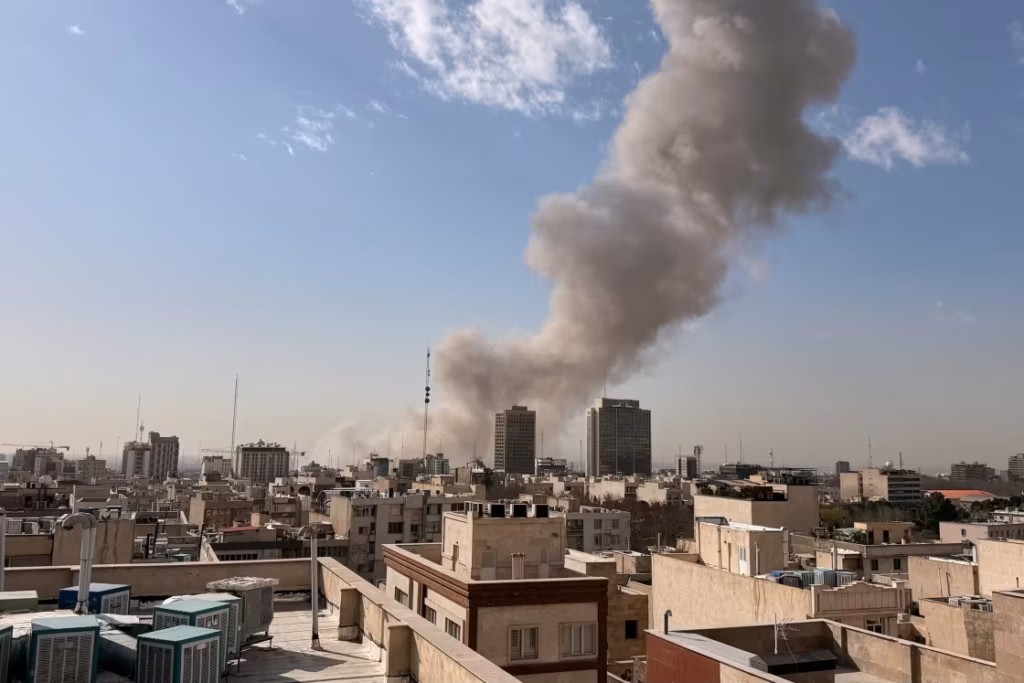
Two powerful explosions echoed through Tehran’s affluent Niavaran neighborhood late Sunday. An eyewitness in the city told AP that their apartment windows shook violently, and residents evacuated onto streets fearing remaining indoors posed greater danger. Video footage from Tehran showed smoke plumes filling the skyline, and the official IRNA news agency confirmed that portions of the Islamic Republic of Iran Broadcasting building were struck Sunday.
In southern Iran, at least 165 people perished Saturday when a girls’ school was struck, with dozens more wounded, IRNA conveyed. The Israeli military stated it lacked awareness of strikes in that area, while the U.S. military indicated it was investigating the reports—suggesting possible targeting errors or intelligence failures that produced mass civilian casualties at an educational facility.
As supreme leader since 1989, Khamenei maintained final authority over all major policies, leading Iran’s clerical establishment and the Revolutionary Guard—the two primary power centers within the governing theocracy. His elimination creates unprecedented uncertainty about succession processes and whether Iran’s complex political system can maintain cohesion amid external military assault.
The CIA had been tracking movements of senior Iranian leaders including Khamenei for months, according to a person familiar with operations who was not authorized to comment publicly and spoke on condition of anonymity. Intelligence was shared with Israeli officials, and strike timing was adjusted partially based on that information, the source revealed.
Iranian President Masoud Pezeshkian announced in a prerecorded message that a new leadership council had commenced work. The country’s foreign minister, Abbas Araghchi, indicated a new supreme leader would be selected within “one or two days,” though the process for choosing Khamenei’s successor amid ongoing bombardment remained unclear.
Araghchi wrote Sunday in correspondence to the United Nations that attacks on Iran by the United States and Israel—including the strike assassinating Khamenei—”recklessly open a dangerous Pandora’s box, eroding the bedrock of sovereign equality and the stability of the international system.” His letter argued that targeting heads of state violated fundamental international law principles and established precedents that could return to haunt Western powers.
As word circulated regarding Khamenei’s death, some Tehran residents could be observed cheering from rooftops, witnesses confirmed. Others mourned as a black flag was raised over the Imam Reza shrine in Mashhad—Iran’s holiest site—symbolizing grief in Shia tradition.
An Iranian medical professional in northern Iran conveyed that he and colleagues spent early Sunday hours celebrating Khamenei’s death indoors because armed security forces remained heavily deployed throughout his city. Forces were stopping and interrogating people celebrating in vehicles, though no gunfire had erupted, said the doctor who spoke anonymously fearing reprisal.
“It was one of the best nights, if not the best night of our lives,” the physician said in a voice message from the city of Rasht. “It was actually my first time ever smoking a cigarette. It was a very, very nice time. We didn’t sleep at all. And we don’t even feel tired.”
The sharply divided reactions within Iran exposed profound fault lines in a nation traumatized by thousands killed during the January crackdown that Khamenei authorized against anti-government protests—the deadliest unrest wave since the 1979 Islamic Revolution. For many Iranians who experienced decades of repression under his rule, Khamenei’s death represented liberation regardless of the chaotic circumstances surrounding it.
Araghchi blamed the United States and Israel for initiating warfare. He indicated he had spoken with counterparts in Gulf countries and urged them to pressure Washington and Jerusalem to terminate military operations before additional casualties accumulated and regional stability deteriorated beyond recovery.
“You have crossed our red line and must pay the price,” Iran’s parliamentary speaker Mohammad Bagher Qalibaf declared in a televised address. “We will deliver such devastating blows that you yourselves will be driven to beg.” The inflammatory rhetoric reflected Iranian leadership’s determination to project strength despite catastrophic losses and vulnerability exposed by successful enemy strikes against the most protected targets.
Trump warned via social media against additional Iranian retaliation, writing “IF THEY DO, WE WILL HIT THEM WITH A FORCE THAT HAS NEVER BEEN SEEN BEFORE!”—his characteristic bombastic threat style amplified by capital letters suggesting both genuine anger and calculated intimidation.
An Israeli military official described Saturday’s mission against Iranian leadership as the result of months of “extremely high coordination” with the United States. The official, speaking anonymously to discuss covert operations, explained that various factors created a “golden opportunity” including weeks of training and monitoring senior figures’ movements combined with “real time intelligence” that targets had gathered together.
The results, the official revealed, were near-simultaneous strikes within 60 seconds of one another at three locations 1,000 miles from Israel that killed Khamenei and approximately 40 senior figures including the Revolutionary Guard commander and Iran’s defense minister—a decapitation strike virtually eliminating the theocratic regime’s top leadership tier in minutes.
According to Reuters, Israel launched renewed waves of strikes on Tehran on Sunday while Iran responded with additional missile barrages, plunging the Middle East and global economy into deepening uncertainty. U.S. and Israeli strikes—combined with Iranian retaliation—sent shockwaves worldwide through sectors from shipping to air travel to petroleum markets, amid warnings of escalating energy costs and business disruption throughout the Gulf region.
U.S. Central Command confirmed hitting more than 1,000 Iranian targets since the campaign’s commencement. Trump declared via video statement posted to Truth Social that military strikes would continue until “all our objectives are achieved,” though he never precisely defined those objectives beyond vague references to preventing nuclear weapons development and eliminating threats.
Trump instructed Iranian military and police to lay down arms, promising immunity for those surrendering while threatening “certain death” for those resisting. He reiterated calls for Iranian populations to revolt against the government. “I call upon all Iranian patriots who yearn for freedom to seize this moment, to be brave, be bold, be heroic and take back your country,” Trump declared in the prerecorded video. “America is with you.”
With the vital Strait of Hormuz closed and Gulf cities of Dubai, Abu Dhabi, and Doha under bombardment, the scale of risk Trump accepted by attacking Iran months before U.S. midterm elections determining congressional control was becoming unmistakable. Only approximately one-quarter of Americans approved of the operation according to a Reuters/Ipsos poll conducted Sunday, suggesting significant domestic political vulnerability.
If Hormuz—the passage for roughly 20 percent of global oil supplies—remains closed beyond several days, American consumers will experience pressure on gasoline prices, creating political liabilities for Republicans defending congressional seats in November elections.
The Israeli military announced late Sunday that its air force had established aerial superiority over Tehran, and that strike waves across the capital had targeted intelligence, security, and military command centers. An Israeli official confirmed that Israel’s present focus involves undermining the Iranian government so thoroughly that it collapses, adding that Israel “is acting in its own ways” to encourage Iranians taking to the streets.
Iran’s Revolutionary Guards claimed Sunday they had hit three U.S. and UK oil tankers in the Gulf and Strait of Hormuz, and attacked military bases in Kuwait and Bahrain with drones and missiles. Shipping data showed hundreds of vessels including oil and gas tankers dropping anchor in nearby waters as traders anticipated sharp crude oil price jumps Monday morning when markets opened.
Global air travel sustained heavy disruption as continued airstrikes kept closed major Middle Eastern airports including Dubai—the world’s busiest international hub—in one of the most significant aviation interruptions in recent years. Airlines canceled thousands of flights, stranding passengers and severing commercial connections that sustain the region’s service-based economies.
Russian President Vladimir Putin denounced Khamenei’s death as cynical murder while Chinese Foreign Minister Wang Yi characterized it as “blatant killing,” signaling that major powers viewed the assassination as dangerous precedent that could legitimize targeting their own leaders in future conflicts.
Inside Iran, facing its gravest existential challenge since the 1980-88 war with Iraq, the hastily assembled leadership council struggled to project authority while managing military operations, succession politics, and popular unrest simultaneously—a nearly impossible combination that raised prospects of state collapse whose regional consequences remained terrifyingly unpredictable.
AP/Reuters





