

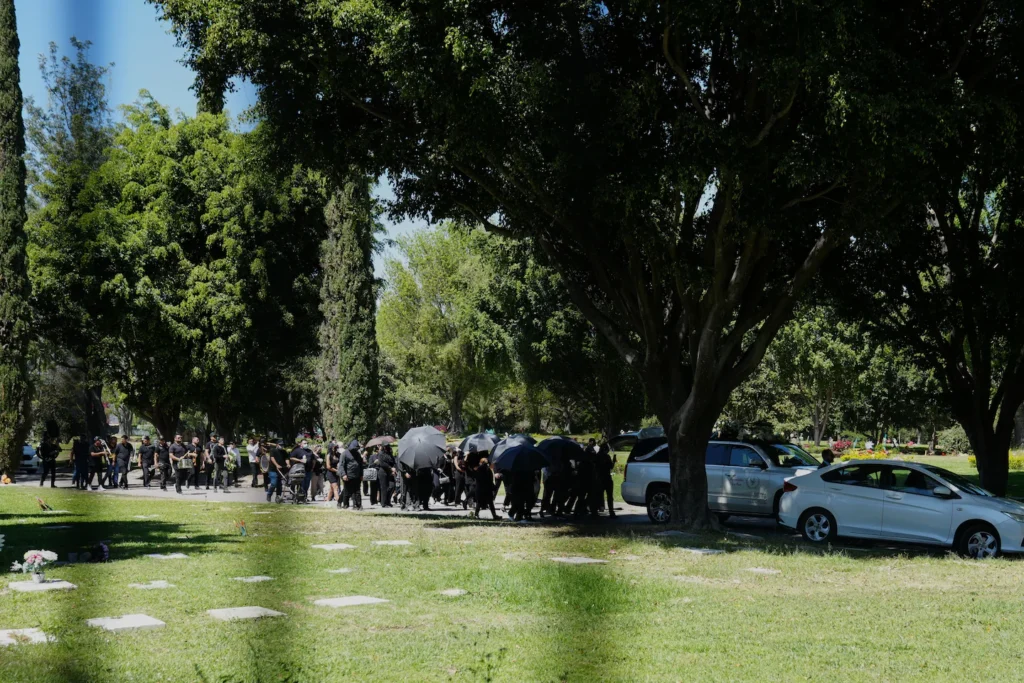
The slain leader of the Jalisco New Generation Cartel was buried Monday in a gleaming golden casket in a Zapopan cemetery, drawing dozens of mourners and a heightened military presence in the cartel’s home state of Jalisco.
Nemesio Oseguera Cervantes — widely known as “El Mencho” — was laid to rest in the Guadalajara metropolitan area after being killed by Mexican army forces during an operation to capture him last week, a federal official confirmed on condition of anonymity due to security concerns.
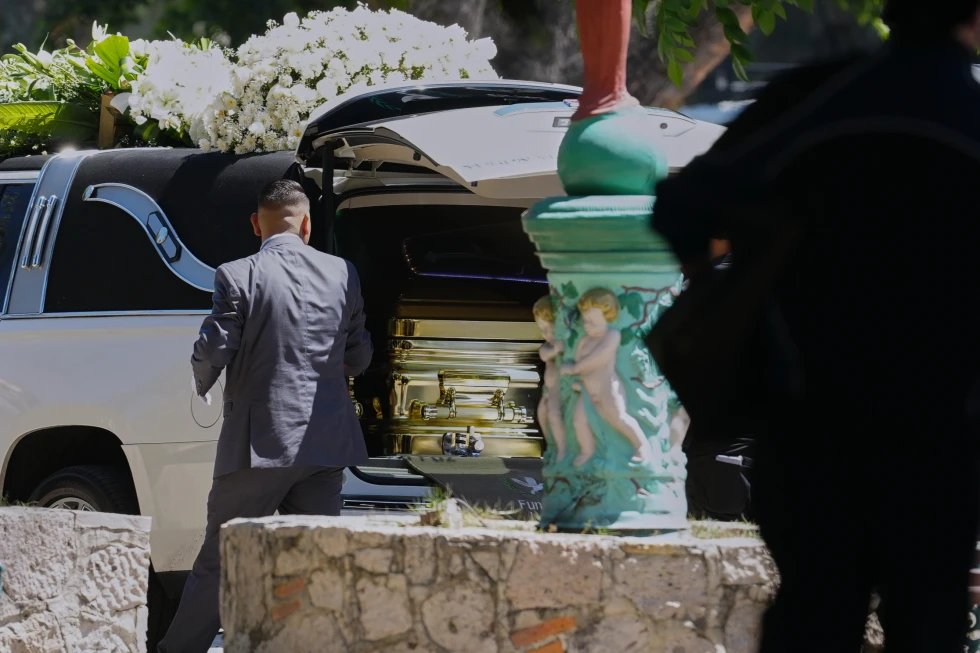
The funeral procession moved through Zapopan, a suburb of Guadalajara, accompanied by a band playing regional Mexican banda music. Many attendees carried black umbrellas despite sunny skies, as enormous floral wreaths — some featuring a rooster motif referencing his nickname “Lord of the Roosters” — surrounded the polished gold-colored coffin.
The Attorney General’s Office declined to officially confirm the burial site, citing security reasons. Authorities had increased patrols around a local funeral home since Sunday as wreaths began arriving without names attached.
According to officials, Oseguera Cervantes died from multiple gunshot wounds sustained during a confrontation with soldiers outside a home in Tapalpa, Jalisco. Defense Secretary Ricardo Trevilla had previously said the cartel leader and two bodyguards were gravely wounded during the exchange and died while being transported to a hospital.
A death certificate obtained by The Associated Press cited bullet wounds to his chest, abdomen and legs.
His body was transferred to Mexico City for an autopsy before being returned to his family over the weekend. The certificate noted that burial was to take place — a standard legal procedure in violent death cases to preserve the possibility of future forensic review.
Oseguera Cervantes’ killing triggered waves of violence across roughly 20 Mexican states. More than 70 people died in clashes and reprisals in the days surrounding the military operation, according to government figures. Security operations targeting other high-ranking cartel members remain ongoing.
Though one of Mexico’s most feared figures, Oseguera Cervantes maintained an unusually low public profile. The only widely known photographs of him stem from arrests in California in the 1980s and early 1990s on robbery and drug-related charges.
Born Rubén Oseguera Cervantes in Michoacán, he later adopted the name Nemesio — the origin of his nickname “El Mencho.” After migrating to the United States and serving time for heroin trafficking, he was deported to Mexico, where he began rising through the ranks of organized crime.
Following the arrest and deaths of senior figures within the Milenio and Sinaloa cartels, Oseguera Cervantes co-founded the Jalisco New Generation Cartel around 2009. Within two decades, it grew into one of the most powerful criminal organizations in Mexico, with operations spanning most Mexican states and dozens of countries abroad.
U.S. authorities had offered up to $15 million for information leading to his capture. In 2024, the United States formally designated the group as a foreign terrorist organization.
Security analysts attribute the cartel’s rapid expansion to strategic alliances, aggressive territorial control and diversification into extortion, fuel theft and real estate, in addition to drug trafficking.
The secrecy surrounding Oseguera Cervantes’ burial reflects a long-standing pattern in Mexico, where funerals of major traffickers are often shrouded in mystery and spectacle.
In Culiacán, Sinaloa, elaborate mausoleums commemorate former kingpins such as Ignacio Coronel and Arturo Beltrán Leyva. Other cases have taken more unusual turns — including the 2012 theft of the body of Heriberto Lazcano and the bizarre 1997 death of Amado Carrillo Fuentes during plastic surgery.
Ballads known as narcocorridos celebrating or mythologizing traffickers often emerge within hours of a cartel leader’s death. Songs about “El Mencho” circulated rapidly following confirmation of his killing.
Experts caution that the death of a cartel leader does not necessarily weaken an organization. Past crackdowns have frequently led to fragmentation, splinter groups and intensified violence as factions compete for control.
The Mexican government has pledged continued operations against the cartel’s upper ranks. However, analysts note that Oseguera Cervantes built a decentralized structure capable of sustaining operations even in his absence.
His burial in a golden casket — under tight security in the state that gave the cartel its name — closes one chapter in Mexico’s decades-long struggle with organized crime. Whether it marks a turning point or the start of renewed conflict remains uncertain.
For now, authorities remain on high alert as the power vacuum left by one of Mexico’s most powerful cartel leaders begins to unfold.





