

(AP/Reuters) — President Donald Trump threatened Tuesday to sever trade ties with Spain after the European ally declined to allow U.S. forces to use jointly operated bases for missions tied to strikes on Iran, intensifying a diplomatic rift that now spans military policy, trade authority and NATO defense spending.
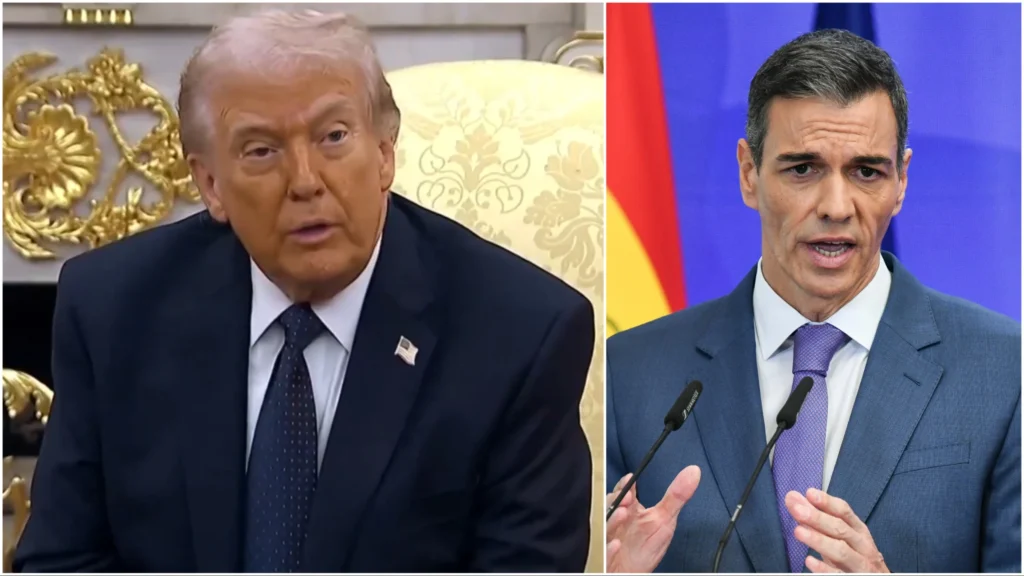
Speaking during an Oval Office meeting with German Chancellor Friedrich Merz, Trump declared that he had directed Treasury Secretary Scott Bessent to explore cutting off commercial dealings with Spain.
“We’re going to cut off all trade with Spain,” Trump said. “We don’t want anything to do with Spain.”
The remarks followed comments a day earlier by Spanish Foreign Minister José Manuel Albares, who said Madrid would not authorize U.S. use of joint military installations in southern Spain for operations not covered by the United Nations charter. Albares emphasized that the bases were not involved in weekend strikes targeting Iran.
Spain hosts U.S. forces at Naval Station Rota and Morón Air Base under long-standing bilateral defense agreements. While Trump insisted that U.S. forces could access the facilities if necessary, he added that “we don’t have to,” signaling frustration with Spain’s refusal.
Reuters separately detailed that the United States had repositioned 15 aircraft, including refueling tankers, from Rota and Morón after Spain’s Socialist-led government indicated they could not be used in operations against Iran.
It remains uncertain how the president could unilaterally suspend trade with Spain, which is part of the European Union. The EU negotiates trade agreements collectively on behalf of its 27 member states.
A spokesperson for Spanish Prime Minister Pedro Sánchez said any U.S. review of trade arrangements must respect private enterprise autonomy, international law and existing agreements between Washington and Brussels.
European Commission spokesperson Olof Gill said the bloc expects the Trump administration to honor a trade framework negotiated in Scotland last year after months of economic turbulence linked to Trump’s earlier tariff actions.
Trump’s warning comes shortly after the U.S. Supreme Court invalidated sweeping tariffs he had imposed under the International Emergency Economic Powers Act (IEEPA). While the court concluded that IEEPA does not grant authority for broad tariff programs, Trump has argued that the ruling leaves intact his power to implement embargoes.
During the Oval Office session, Trump publicly asked Bessent and U.S. Trade Representative Jamieson Greer for their views. Bessent said the court had reaffirmed the president’s embargo authority, adding that the Treasury, Commerce Department and USTR would initiate reviews into potential actions under other trade statutes.
Trade law specialists noted that invoking IEEPA for an embargo would require a declaration that Spain poses an “unusual and extraordinary threat” to U.S. national security or foreign policy. Peter Shane, a professor at New York University, told Reuters that it was difficult to see how Spain’s refusal to allow use of air bases for strikes on Iran would meet that threshold.
A spokesperson for the Treasury Department did not provide additional comment to The Associated Press.
Trump also renewed criticism of Spain’s defense expenditures. He asserted that Spain was the only NATO member unwilling to commit to a 5% of GDP defense spending benchmark, a level the United States has advocated.
Last year, Spain indicated it could meet capability targets by allocating 2.1% of GDP to defense. Germany’s Merz acknowledged that Spain had resisted higher commitments and said European leaders were urging Madrid to raise spending closer to 3% or 3.5%.
Spain’s government maintained Tuesday that it remains a “key member of NATO,” contributing significantly to European security.
The defense spending debate has been a recurring flashpoint. Trump previously threatened tariff measures when Spain declined to endorse the 5% benchmark, tying military commitments to economic leverage.
Sánchez has openly criticized U.S. and Israeli strikes on Iran, describing them as “unjustifiable” and “dangerous,” while also condemning Iranian attacks in the region. His administration has called for immediate de-escalation and diplomatic engagement.
Spain’s stance marks another chapter in strained relations between the Trump administration and Madrid. Under Sánchez, Spain has also criticized Israel’s campaign in Gaza and denied port access to vessels carrying weapons bound for Israel.
Despite Trump’s threat, Spain’s economic exposure to U.S. retaliation may be limited relative to other European states. Spain is the world’s largest exporter of olive oil and ships auto parts, steel and chemicals to the United States. However, U.S. Census Bureau figures show Washington recorded a $4.8 billion trade surplus with Spain in 2025, marking the fourth consecutive year of surplus. U.S. exports totaled $26.1 billion, including growing shipments of crude oil and liquefied natural gas, while imports from Spain reached $21.3 billion.
Trump’s warning reflects a broader strategy of linking economic pressure to geopolitical objectives. By pairing NATO spending demands with trade threats, the administration appears intent on compelling allies to align more closely with U.S. security priorities, particularly amid escalating tensions with Iran.
Yet the approach carries risks. Any attempt to impose a full embargo on an EU member could trigger coordinated retaliation from Brussels, potentially escalating into a transatlantic trade confrontation at a time of fragile global growth.
The legal pathway is also uncertain. While embargo authority exists under IEEPA, applying it to a NATO ally over basing access could face judicial scrutiny and political pushback from Congress. Moreover, framing Spain’s decision as a national security threat may prove legally tenuous.
Diplomatically, the dispute exposes fissures within NATO. As European governments debate appropriate defense spending levels and engagement in Middle Eastern conflicts, Washington’s assertive posture may deepen divisions rather than consolidate unity.
Energy markets and defense planners are closely watching whether the confrontation remains rhetorical or evolves into formal trade action. If implemented, punitive measures could disrupt supply chains involving energy exports, agricultural goods and industrial components on both sides of the Atlantic.
For now, Spain has signaled it intends to defend its economic interests while maintaining cooperation within NATO and the EU framework. Whether the dispute becomes a symbolic warning shot or the opening salvo in a broader trade battle may depend on how aggressively the administration moves from rhetoric to execution.
The episode underscores how rapidly military conflicts abroad can spill into economic and diplomatic arenas, reshaping alliances long considered stable.





