

COLOMBO, Sri Lanka (BN24) —An Iranian navy vessel sank off the coast of Sri Lanka early Tuesday, leaving about 140 people unaccounted for after search teams pulled 32 survivors from the water, Sri Lankan naval authorities said.
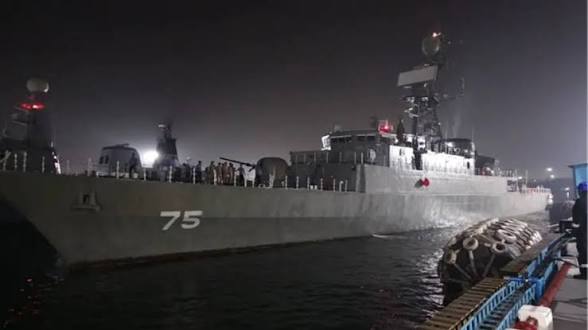
The ship, identified as the Iranian navy vessel IRIS Dena, issued a distress signal before disappearing beneath the surface in waters that fall within Sri Lanka’s designated search-and-rescue zone, naval officials in Colombo said.
Sri Lanka’s navy indicated that approximately 180 people had been aboard the vessel, citing documentation linked to the ship. While 32 individuals were rescued, the fate of the remaining passengers and crew remained uncertain as of Tuesday evening.
Budhika Sampath, a spokesman for the Sri Lanka Navy, said the alert was received during the early hours of March 4. Although the vessel went down outside Sri Lanka’s territorial waters, it was still within the country’s internationally recognized maritime rescue region.
“Even though the location was beyond our territorial sea, it lies within our search and rescue area of responsibility,” Sampath told the BBC. “Under international maritime obligations, we were required to respond.”
Rescue crews arriving at the coordinates reported spotting oil slicks and floating life rafts, but did not immediately locate the vessel itself. Survivors were found adrift in the water and were brought aboard Sri Lankan naval ships for medical attention and questioning.
“When our teams reached the scene, the ship was not visible,” Sampath said in remarks carried by the BBC. “We observed patches of oil and lifeboats. We then located individuals in the water and brought them to safety. Subsequent checks confirmed they were from an Iranian naval vessel.”
Sri Lankan authorities said they were working to determine the exact number of those missing. Although ship records indicated 180 people were on board, officials cautioned that final figures could shift as verification continues.
The cause of the sinking has not been established. Sampath dismissed speculation that a submarine strike may have brought down the vessel, describing such claims as unsubstantiated.
“There is no evidence at this stage to support assertions of a submarine attack,” he told the BBC. “The circumstances leading to the sinking remain under investigation.”
Sri Lanka’s military has not offered further details on possible mechanical failure, collision, weather conditions, or other contributing factors. Maritime tracking data and communication logs are expected to form part of the inquiry.
The incident unfolded against a backdrop of escalating tensions in the Middle East. Israel has launched a new wave of strikes across parts of the region. In Lebanon, several fatalities were recorded in attacks that the Israel Defense Forces said were aimed at Hezbollah operatives and infrastructure.
While no immediate connection between the naval sinking and regional hostilities has been established, the broader security climate has drawn attention to naval movements and military deployments in international waters.
Iran has not publicly disclosed additional information about the mission or purpose of the IRIS Dena at the time of the incident. Tehran’s naval operations frequently include patrols, training exercises, and long-distance deployments intended to project maritime presence beyond the Persian Gulf.
International maritime law obligates coastal states to respond to distress calls within designated search-and-rescue zones, regardless of a vessel’s nationality. Sri Lanka’s swift mobilization reflects those conventions, maritime analysts say.
Search operations were ongoing Tuesday, with Sri Lankan naval units combing the area for additional survivors. Weather and sea conditions were not immediately detailed by authorities, though oil sheens and scattered debris complicated visibility at the scene.
The sinking of a foreign naval vessel in the Indian Ocean carries geopolitical as well as humanitarian implications. Iran has,s in recent years, rs expanded its naval reach, deploying ships to distant waters in a demonstration of strategic capability. The IRIS Dena’s presence near Sri Lanka underscores Tehran’s broader maritime ambitions.
If mechanical failure or navigational error is ultimately determined to be the cause, the incident could prompt scrutiny of maintenance standards and operational readiness within Iran’s navy. A catastrophic systems breakdown at sea would likely intensify domestic and international questions about fleet sustainability.
Should evidence suggest external involvement, though none has been presented, the ramifications could extend far beyond maritime safety. The Middle East is already experiencing heightened volatility, with Israel conducting strikes in Lebanon targeting Hezbollah positions, as acknowledged by the Israel Defense Forces. Any perception of interconnected military events would amplify regional tensions.
At present, however, there is no official indication linking the naval loss to hostilities elsewhere.
For Sri Lanka, the episode highlights the strategic importance of its maritime zone. Positioned along major shipping routes in the Indian Ocean, the country plays a critical role in global trade corridors. Its response also reflects adherence to international maritime conventions, reinforcing its standing within global shipping networks.
Humanitarian concerns remain paramount. The survival window for individuals lost at sea narrows rapidly, depending on water temperature, weather patterns, and available flotation devices. The discovery of life rafts suggests that at least some evacuation procedures were initiated before the vessel sank, raising cautious hope that additional survivors could be located.
As search efforts continue, families in Iran and elsewhere await confirmation of the missing. Naval disasters are comparatively rare but often devastating, given the concentration of personnel on board and the inherent dangers of open-water operations.
Further updates are expected as Sri Lankan authorities complete survivor interviews and coordinate with Iranian officials. Until then, questions surrounding the sinking of the IRIS Dena from technical failure to operational context, remain unresolved.
The humanitarian toll, meanwhile, is already significant, with roughly 140 people feared missing in one of the most serious naval incidents in the region in recent years.





