

JERUSALEM (BN24) — Israel’s defense minister declared Wednesday that any successor to Iran’s Supreme Leader who pursues policies hostile to Israel would be considered a target, escalating rhetoric following reports that Ayatollah Ali Khamenei was killed in joint U.S.-Israeli strikes on Tehran.
Defense Minister Israel Katz issued the warning in a statement posted on the social media platform X, saying that no potential leader would be immune if they continued what he described as efforts to threaten Israel and its allies.
“Any leader selected by the Iranian terror regime to continue leading the plan for Israel’s destruction, threatening the United States, the free world, and countries in the region, and suppressing the Iranian people, will be a certain target for assassination, no matter his name or where he hides,” Katz wrote.
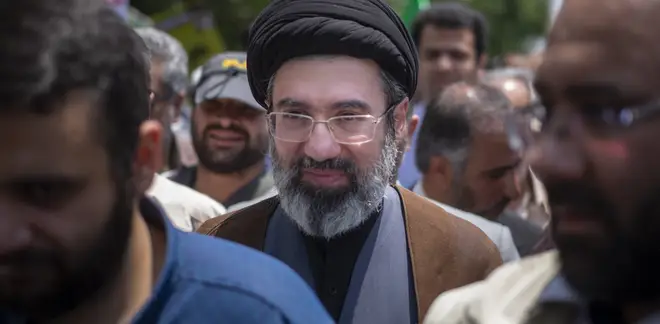
The statement came amid mounting speculation over who will succeed Khamenei, Iran’s most powerful political and religious authority. Iranian opposition outlet Iran International has indicated that Mojtaba Khamenei, the late leader’s 56-year-old son, is viewed as a leading contender.
According to Iran International, Mojtaba Khamenei was favored by Iran’s Assembly of Experts, the clerical body constitutionally tasked with appointing and overseeing the Supreme Leader, under pressure from elements within the Islamic Revolutionary Guard Corps, or IRGC. The claims could not be independently verified.
Mojtaba Khamenei, the second-oldest son of the late supreme leader, is not a senior-ranking cleric and has never held elected office or an official government post. However, he maintains longstanding ties to the IRGC and is widely believed by analysts to exert significant influence behind the scenes. He served in Iran’s armed forces during the 1980-1988 Iran-Iraq war.
For years, Mojtaba Khamenei has been mentioned in political circles as a possible successor to his father, though his potential candidacy has been controversial. Critics inside and outside Iran have argued that his elevation would resemble dynastic succession, drawing comparisons to the hereditary rule of the U.S.-backed Shah, who was toppled during the 1979 Iranian Revolution.
Reports have previously suggested that Ali Khamenei had identified three senior clerics as possible successors in the event of his death. Mojtaba’s name was not publicly associated with the reported shortlist. Some accounts indicated that the elder Khamenei had reservations about promoting his son, concerned it could undermine the Islamic Republic’s foundational rejection of monarchy.
Iranian authorities have not publicly confirmed details surrounding the reported strikes on Tehran or the status of succession deliberations. The absence of official statements has fueled uncertainty within Iran and across the region.
Israel has long viewed Iran as its primary regional adversary, citing Tehran’s support for armed groups hostile to Israel and its rhetoric regarding the Jewish state. Iranian leaders, in turn, have accused Israel of aggression and covert operations inside Iranian territory. Tensions have frequently manifested in proxy conflicts across Lebanon, Syria, and Gaza.
Katz’s remarks signal a potential hardening of Israel’s posture during a moment of leadership transition in Tehran. Public threats directed at a future Iranian leader represent an escalation in tone, even within the context of longstanding hostilities.
Security analysts say that leadership uncertainty in Iran could have far-reaching consequences for regional stability. A succession process perceived as opaque or influenced heavily by the IRGC may deepen internal divisions, particularly at a time when Iran faces economic strain and domestic discontent.
At the same time, overt Israeli threats may bolster hardline factions within Iran who argue that confrontation with Israel and the United States is inevitable. Historically, external pressure has sometimes strengthened the position of security institutions such as the IRGC, which portray themselves as guardians of national sovereignty.
The Assembly of Experts, composed of senior clerics elected by popular vote but vetted by state bodies, is responsible for appointing the Supreme Leader. While its deliberations are typically conducted behind closed doors, the selection carries immense weight. The Supreme Leader controls the armed forces, appoints key judicial and media officials, and has the final say on major state policies.
Any move to elevate Mojtaba Khamenei could test the legitimacy of the Islamic Republic’s political framework. The 1979 revolution was rooted in opposition to hereditary monarchy, and critics argue that transferring power within the same family risks eroding ideological credibility.
International observers are closely watching developments, particularly given Iran’s role in regional security dynamics and its nuclear program. A new leader’s stance on negotiations, military posture, and relations with neighboring countries could reshape diplomatic calculations.
For now, Israel’s warning underscores the fragility of an already volatile situation. Whether Katz’s statement is intended as deterrence or as a signal of future operational intent remains unclear. What is evident is that the leadership transition in Tehran — combined with direct rhetoric from Jerusalem — has introduced a new layer of unpredictability into Middle Eastern geopolitics.
As regional actors await confirmation from Iranian authorities, the prospect of further escalation looms, with succession politics in Tehran intersecting sharply with Israel’s security doctrine.





