

WASHINGTON — The Justice Department disclosed FBI records Thursday summarizing interviews with an unidentified woman who made sexual assault allegations against President Donald Trump connected to an alleged encounter when she was a minor, releasing documents that had been improperly withheld during the department’s court-mandated disclosure of materials from the Jeffrey Epstein investigation.
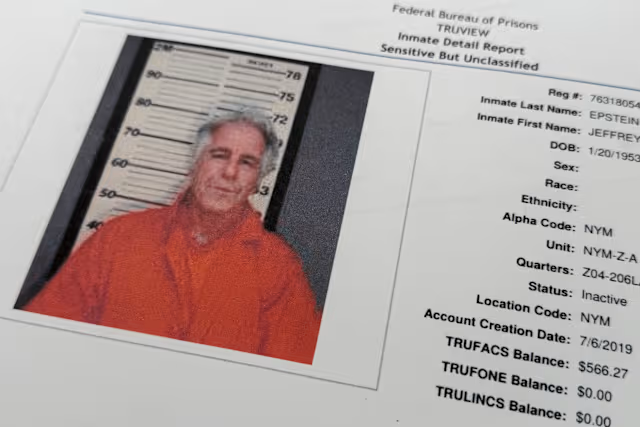
FBI agents interviewed the woman four times during 2019 as part of their investigation into accused sex trafficker Jeffrey Epstein. The Justice Department had previously released a log confirming those interviews occurred but provided a summary of only one meeting—in which she accused Epstein of molesting her when she was a teenager—while failing to disclose the three additional interview summaries that included allegations against Trump.
The newly disclosed records, posted on the department’s website Thursday, reveal that the woman also claimed Trump attempted to force her to perform oral sex after Epstein introduced her to the future president in New York or New Jersey during the 1980s when she was between 13 and 15 years old. The allegations describe conduct that, if accurate, would constitute serious criminal offenses under federal and state laws prohibiting sexual assault of minors.
The White House did not immediately respond to requests for comment regarding the disclosures. Politico, which first broke the story about the released documents, conveyed that White House press secretary Karoline Leavitt characterized the woman’s claims as “completely baseless accusations, backed by zero credible evidence.”
The Justice Department has cautioned that some documents within the massive Epstein file release include “untrue and sensationalist claims made against President Trump,” suggesting that not all allegations should be accepted as verified facts. Reuters could not independently confirm the accuracy of the woman’s allegations, and FBI records indicate agents ceased communicating with her in 2019 without clear explanation for why the investigative relationship ended.
The Justice Department acknowledged in a post on social media platform X that the records released Thursday were among 15 documents that officials had “incorrectly coded as duplicative” and consequently failed to publish during earlier disclosure rounds. The admission raised questions about whether the misclassification represented innocent bureaucratic error or deliberate concealment of politically sensitive material involving the sitting president.
The disclosure arrives as the Justice Department confronts intensifying congressional scrutiny over its management of documents from the Epstein investigation, which federal law requires the department to make public following passage of the Epstein Files Transparency Act. Democrats have accused the Trump administration of deliberately concealing records related to the president, and a House of Representatives committee voted to subpoena Attorney General Pam Bondi so lawmakers can question her directly about how the government is handling these legally mandated disclosures.
Trump has consistently maintained that his association with Epstein terminated in the mid-2000s and that he remained unaware of the financier’s sexual abuse of minors. However, records previously released by the department demonstrate Trump flew on Epstein’s private aircraft multiple times during the 1990s—a fact Trump has denied despite documentary evidence including flight manifests and pilot testimony.
After the financier first faced accusations of sexual misconduct in the mid-2000s, Trump contacted the police chief in Palm Beach to convey that “everyone has known he’s been doing this,” according to an FBI interview record documenting the conversation. The phone call suggests Trump possessed knowledge of Epstein’s predatory behavior yet failed to report it to authorities or publicly distance himself until media attention made the relationship politically toxic.
In the report documenting the woman’s final interview, conducted in October 2019 during Trump’s first presidency, agents asked whether she would be willing to provide additional information about Trump. In response, the agent wrote, she “asked what the point would be of providing the information at this point in her life when there was a strong possibility nothing could be done about it.”
Her expressed skepticism about whether powerful figures face accountability for sexual misconduct reflects broader patterns in cases involving wealthy, politically connected individuals accused of crimes. The woman’s reluctance to continue cooperating with FBI investigators—particularly during a period when Trump occupied the White House and theoretically could influence Justice Department priorities—illustrates the intimidation and futility victims often experience when accusing powerful men of sexual violence.
The timing of the final interview in October 2019 proved significant. Trump was president, possessing substantial influence over executive branch agencies including the FBI and Justice Department. Whether the woman’s concerns about “nothing could be done about it” reflected general cynicism about justice for sexual assault victims or specific fears about investigating a sitting president remains ambiguous from the FBI summary.
FBI records suggest agents stopped speaking with the woman in 2019 without pursuing the allegations against Trump further. The investigative file provides no clear explanation for why agents discontinued contact, whether prosecutors declined to pursue charges, or whether the woman withdrew cooperation. The opacity surrounding investigative decisions creates space for speculation about whether political considerations influenced how seriously authorities treated her allegations.
The broader context of the Epstein investigation reveals systematic failures by law enforcement and prosecutors to aggressively pursue individuals in the financier’s orbit despite substantial evidence of widespread sexual abuse. Epstein’s 2008 non-prosecution agreement with federal prosecutors—negotiated when Alexander Acosta served as U.S. Attorney for the Southern District of Florida—allowed him to plead guilty to state solicitation charges while avoiding federal sex trafficking charges that could have resulted in life imprisonment.
That controversial deal, which was concealed from victims in potential violation of the Crime Victims’ Rights Act, exemplifies the preferential treatment wealthy, connected defendants sometimes receive within the criminal justice system. The agreement’s extraordinarily lenient terms sparked outrage when details became public, ultimately forcing Acosta’s resignation as Trump’s Labor Secretary in 2019.
Epstein faced new federal sex trafficking charges in New York in July 2019 following investigative journalism that exposed the extent of his abuse and the protection he received from law enforcement. However, he died by apparent suicide in his Manhattan jail cell in August 2019 while awaiting trial, eliminating the possibility of courtroom testimony that might have implicated other individuals in his trafficking network.
The suspicious circumstances surrounding Epstein’s death in a federal detention facility—including apparent failures in suicide prevention protocols—fueled conspiracy theories and intensified demands for investigating others who may have participated in or enabled his crimes. The subsequent prosecution and conviction of Ghislaine Maxwell provided some accountability but left unresolved questions about other potential conspirators.
The Justice Department’s document release, mandated by congressional legislation, was intended to provide transparency around federal investigative efforts and potentially expose individuals who escaped accountability. However, the acknowledgment that 15 documents were “incorrectly coded as duplicative”—including FBI interview summaries detailing allegations against the current president—raises serious questions about the reliability of the entire disclosure process.
Congressional Democrats have characterized the withholding of documents related to Trump as evidence of corrupt intent to protect the president from damaging revelations. Republicans have defended the Justice Department’s handling of the disclosure while questioning the credibility of allegations against Trump contained in investigative files.
The committee vote to subpoena Attorney General Bondi reflects Democratic determination to investigate whether political considerations influenced which documents were released, how they were redacted, and whether the “incorrect coding” explanation for missing Trump-related materials represents plausible error or deliberate concealment. Bondi’s testimony before Congress will likely prove contentious as lawmakers from both parties question her about internal Justice Department processes and decision-making regarding the Epstein files.
For victims’ advocates who have consistently demanded comprehensive disclosure of investigative materials, Thursday’s release represents both vindication and frustration. The fact that documents detailing serious allegations against a sitting president were withheld due to purported coding errors undermines confidence that the Justice Department has fully complied with transparency legislation or that all relevant materials have now been disclosed.
The woman whose allegations were finally made public through Thursday’s release joins numerous Epstein victims whose accounts of abuse have been documented in FBI files, court proceedings, and media investigations. Whether her specific allegations against Trump will receive further investigation or simply become part of a historical record of claims that were never criminally prosecuted remains uncertain.
The broader implications of the disclosure extend beyond this individual case to questions about how democratic societies handle allegations against powerful political figures. The apparent cessation of FBI interest in the woman’s allegations during Trump’s first presidency—combined with the subsequent failure to release interview summaries during court-mandated disclosures—creates patterns suggesting that political power provides insulation from accountability for sexual misconduct.
As the controversy over Epstein files continues, the fundamental question persists: whether the Justice Department prioritizes transparency and accountability or protecting politically connected individuals from embarrassing or incriminating revelations. Thursday’s belated disclosure, arriving only after sustained congressional pressure and media scrutiny, suggests that without external oversight, significant materials related to Trump might never have been made public at all.





