

TEL AVIV, Israel (AP-style) — Israel’s military indicated Saturday that its forces have launched roughly 3,400 airstrikes inside Iran since the beginning of the ongoing conflict involving Israel, the United States, and Tehran about a week ago, signaling a rapid escalation in hostilities between the longtime regional adversaries.
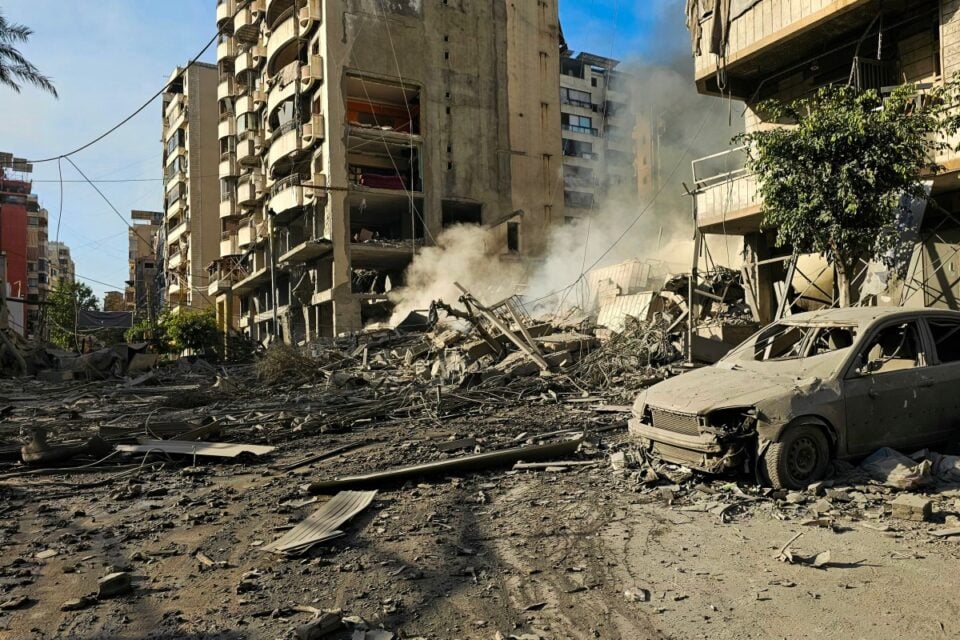
Military spokesperson Brig. Gen. Effie Defrin explained during a briefing that Israeli forces have released approximately 7,500 munitions against targets located across Iranian territory during the campaign. The operations are part of a broad military effort that Israeli authorities say is aimed at weakening Iran’s strategic capabilities and military infrastructure.
Defrin described the operations as continuing and expansive, noting that Israeli forces remain engaged in sustained aerial campaigns against various installations across Iran.
Later Saturday evening, the Israeli military announced the start of what it described as a new “wave of strikes” in the Iranian capital, Tehran. The statement suggested that additional targets were being engaged as the operation entered another phase, though specific locations or damage assessments were not immediately disclosed.
The intensifying attacks reflect the growing scale of the confrontation, which has evolved into one of the most direct military clashes between Israel and Iran in modern times.
In a separate development Saturday, Iran’s Islamic Revolutionary Guard Corps asserted that it had carried out a missile strike against the United States’ Juffair base in Bahrain.
The Guards indicated the strike came as retaliation for what they described as an earlier attack involving American forces operating from the base.
“In response to the aggression of American terrorists from the Juffair base against the Qeshm desalination plant, this American base was immediately struck by precision-guided solid-fuel and liquid-fuel missiles of the IRGC,” the Guards announced through a statement posted on their official website.
Iranian authorities maintained that the U.S. facility had been used to launch an attack targeting a desalination plant located on Qeshm Island earlier the same day.
Independent verification of the Iranian claim was not immediately available, and U.S. officials had not issued an immediate response to the assertion at the time of publication.
The Juffair naval installation hosts a major U.S. military presence in the Gulf region and serves as a central hub for American naval operations, including activities connected to the U.S. Fifth Fleet.
The intensifying exchange underscores the widening geographic scope of the conflict, which has expanded beyond Iran and Israel to include military sites and strategic infrastructure across the broader Middle East.
Israel’s operations deep inside Iranian territory mark a significant shift from previous confrontations, which largely involved covert operations, proxy conflicts, and limited targeted strikes.
The scale of the reported strikes, 3,400 operations involving thousands of munitions, suggests a sustained aerial campaign designed to systematically degrade Iranian military capabilities.
Military analysts note that the use of thousands of precision munitions within such a short timeframe indicates extensive logistical coordination and intelligence-driven targeting.
Meanwhile, Iran’s claim of retaliatory missile strikes against a U.S. military facility suggests Tehran may be attempting to broaden the confrontation by directly targeting American interests in the region.
Such developments raise concerns among international observers that the conflict could spiral into a wider regional war involving multiple state actors and strategic chokepoints such as the Persian Gulf.
The targeting of desalination infrastructure referenced in the Iranian statement highlights the increasing vulnerability of civilian-support systems during the conflict.
Desalination facilities play a crucial role in water supply across the Gulf region, where freshwater resources are scarce. Any disruption to such infrastructure could create humanitarian concerns alongside military consequences.
Additionally, the mention of the Juffair base reflects the strategic importance of Bahrain as a central location for U.S. naval power in the Middle East.
If confirmed, a direct Iranian missile strike on the installation would mark one of the most overt attacks on U.S. military infrastructure linked to the current conflict.
The rapid pace and scale of Israel’s strikes indicate that the operation is not merely symbolic retaliation but part of a broader strategic effort aimed at reshaping Iran’s military posture.
By striking thousands of targets in a relatively short timeframe, Israeli forces appear to be focusing on degrading command-and-control systems, missile infrastructure, and logistical networks that could threaten Israeli territory.
At the same time, Iran’s messaging surrounding the alleged attack on the U.S. base suggests a calculated attempt to signal deterrence while demonstrating that Tehran retains the capacity to retaliate beyond its own borders.
However, escalating the conflict to include American military assets could significantly raise the stakes. The United States maintains multiple bases and naval installations throughout the Gulf, meaning further retaliation could draw additional countries into the confrontation.
Security experts also emphasize that such exchanges create risks for commercial shipping lanes and energy infrastructure in the region. The Persian Gulf remains one of the world’s most critical oil transit corridors, and heightened military activity could disrupt global energy markets.
Diplomatic channels in Europe and Asia are already expressing concern about the potential economic consequences should the conflict expand further.
For now, the trajectory of the conflict remains uncertain. Both sides appear committed to demonstrating military strength, while international actors urge restraint to prevent the crisis from evolving into a broader war.
Israel’s ongoing operations and Iran’s claims of retaliation indicate that the confrontation is entering a more volatile phase with potentially far-reaching implications for regional security.





