

(AP) — A massive fire erupted at a fuel storage facility in Tehran late Saturday after Israeli forces carried out airstrikes on the site, marking a dramatic escalation in the week-old war between Iran, Israel and the United States as leaders on all sides signaled the conflict could intensify further.
Columns of flames and smoke rose into the night sky above the Iranian capital following the strike. Video captured by The Associated Press showed the horizon glowing red as emergency crews struggled to contain the blaze.
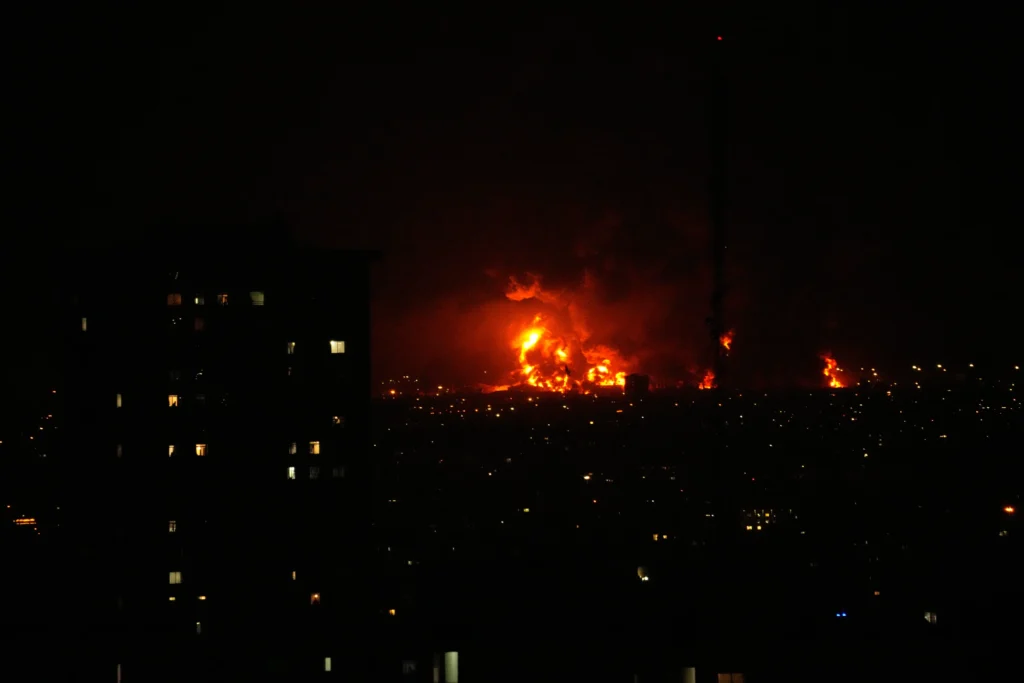
Israel’s military acknowledged that it had struck fuel storage facilities in Tehran, describing the targets as part of the country’s broader energy infrastructure.
The attack appeared to be the first time since the war began that a civilian industrial site inside the capital had been hit.
Iranian state media attributed the strike to “an attack from the U.S. and the Zionist regime,” referring to Israel. The facility reportedly supplies fuel to Tehran and several neighboring provinces in northern Iran.
The strike came as Israeli Prime Minister Benjamin Netanyahu warned that the next phase of the conflict could bring unexpected developments.
Netanyahu said Israel had “many surprises” prepared for the coming days of the war, which has rapidly expanded beyond its initial military targets.
The conflict began with a series of coordinated airstrikes by the United States and Israel that killed key members of Iran’s leadership, including Supreme Leader Ayatollah Ali Khamenei, according to Iranian officials.
Since then, Iran has responded with waves of ballistic missiles and drone attacks targeting Israel, U.S. military assets and several countries in the Persian Gulf.
The growing confrontation has exposed tensions within Iran’s political leadership over how to proceed with the conflict.
Iranian President Masoud Pezeshkian publicly apologized Saturday for missile and drone attacks that struck “neighboring countries,” signaling a possible willingness among some leaders to reduce regional escalation.
In a brief message that appeared to have been recorded hastily, Pezeshkian said Iran should avoid further strikes on nearby states unless they directly participate in attacks against Iran.
“Our armed forces should not target neighboring countries or launch missiles toward them unless those nations attack us,” Pezeshkian said.
He added that diplomatic efforts could still provide a path toward resolving the crisis.
Pezeshkian also rejected a demand by U.S. President Donald Trump that Iran surrender unconditionally.
“That’s a dream that they should take to their grave,” he said.
Other members of Iran’s leadership council struck a far more confrontational tone.
Judiciary chief Gholam Hossein Mohseni-Ejei, one of the three officials overseeing the country’s leadership after Khamenei’s death, said Iran would continue attacking sites used by its adversaries.
“The geography of some countries in the region — both overtly and covertly — is in the hands of the enemy,” Mohseni-Ejei wrote on X. “Intense attacks on these targets will continue.”
Iran’s parliament speaker, Mohammad Bagher Ghalibaf, a former commander in the Revolutionary Guard, echoed that message, saying countries hosting U.S. bases would remain at risk while American forces operate in the region.
“As long as the presence of U.S. bases continues, those countries will not enjoy peace,” Ghalibaf wrote on X.
Iran’s mission to the United Nations later suggested that some strikes on civilian areas in neighboring states may have occurred when U.S. air-defense systems intercepted Iranian weapons, though it provided no evidence.
Late Saturday, Iranian security official Ali Larijani sought to project unity, telling state media that Iran’s leaders were aligned on how to respond to the conflict.
“Our leaders are united on this issue and have no disagreements,” Larijani said.
He also revealed that Iran’s leadership council had asked for preparations to convene the Assembly of Experts, the body responsible for selecting the country’s next supreme leader.
President Donald Trump indicated that the United States does not intend to scale back its military campaign against Iran in the near term.
Speaking to reporters aboard Air Force One on Saturday, Trump said the United States was not interested in negotiations at this stage.
“We’re not looking to settle,” Trump said. “They’d like to settle. We’re not looking to settle.”
He warned that Iran could face additional strikes targeting new areas and groups of individuals, though he did not specify potential targets.
Trump described the ongoing U.S. operations as an “excursion,” adding that economic disruptions such as rising energy prices would stabilize once the conflict concludes.
The conflict continued to ripple across the Middle East Saturday.
In Baghdad, three Iraqi security officials told The Associated Press that a missile struck the helicopter landing pad inside the U.S. Embassy complex.
The officials spoke on condition of anonymity because they were not authorized to speak publicly.
The embassy declined to comment, and there were no immediate reports of casualties.
It was the first known strike to land inside Baghdad’s heavily fortified Green Zone since the war began.
Iraq’s caretaker prime minister, Mohammed Shia al-Sudani, condemned the attack as a “terrorist act” carried out by what he described as “rogue groups.”
Several U.S. allies in the Gulf also reported incoming attacks.
Authorities in Bahrain activated warning sirens as Iranian missiles targeted the island kingdom.
Saudi Arabia said it intercepted drones heading toward the massive Shaybah oil field and shot down a ballistic missile aimed at Prince Sultan Air Base, which hosts American troops.
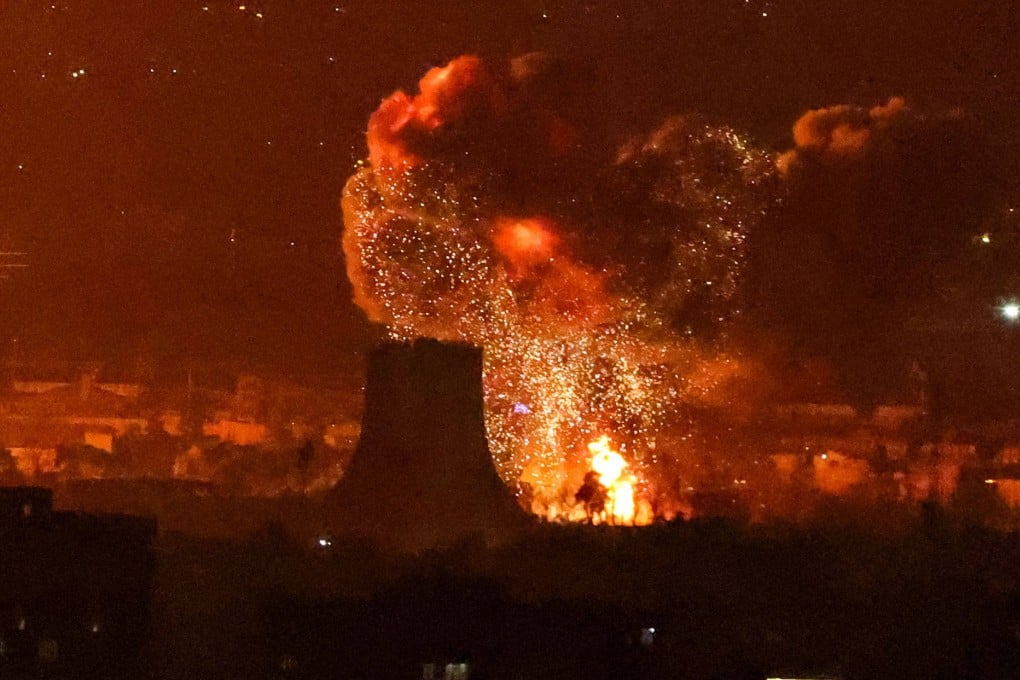
In the United Arab Emirates, officials said debris from intercepted aerial weapons fell onto a vehicle and killed an Asian driver. The UAE has now recorded four deaths since the conflict began, all foreign nationals.
Residents in Dubai reported hearing explosions early Saturday morning as air-defense systems engaged incoming threats.
Passengers at Dubai International Airport were directed into underground train tunnels while authorities assessed the situation.
The escalating attacks have left civilians throughout the region on edge.
A university student in western Tehran told The Associated Press that even neighborhoods far from government and military installations were living in fear amid the ongoing bombardment.
“Tehran is under severe bombardment,” the student said, speaking anonymously due to security concerns.
Israel earlier Saturday said it struck an airport in Tehran that it believes has been used to transfer weapons and funding to regional militant groups allied with Iran.
The conflict has already caused significant casualties across the region.
Officials in Iran say at least 1,230 people have been killed there since the war began. Authorities in Lebanon report more than 290 deaths, while Israel has confirmed 11 fatalities.
Six U.S. service members have also been killed during the fighting.
Despite repeated missile alerts across Israel Saturday, authorities reported no additional casualties from the latest wave of Iranian attacks.
The strike on Tehran’s fuel storage facility signals a potentially important shift in the war’s trajectory. By targeting energy infrastructure within the Iranian capital, Israel appears to be expanding its strategy beyond military sites toward assets that could weaken Iran’s economic and logistical capacity.
Such attacks carry major risks. Energy infrastructure is closely tied to global oil markets, and damage to facilities in Iran — one of the world’s major energy producers — could trigger wider economic disruptions.
At the same time, Iran’s divided political response highlights uncertainty within its leadership following the death of Supreme Leader Khamenei. The contrasting statements from President Pezeshkian and hard-line figures such as Mohseni-Ejei suggest a struggle between factions advocating restraint and those pushing for continued escalation.
Another significant factor is the growing involvement of regional states. Missile interceptions over Bahrain, Saudi Arabia and the United Arab Emirates illustrate how quickly the conflict has spread beyond its initial participants.
If attacks on Gulf energy infrastructure intensify, the war could evolve into a broader regional confrontation involving multiple governments, global oil markets and major international powers.
For now, both sides appear to be preparing for a prolonged and unpredictable conflict — one that could reshape the security landscape of the Middle East for years to come.





