

GOLD COAST, Australia (BN24)— March 9, 2026. Concerns are mounting over the safety of members of Iran’s women’s national soccer team after their elimination from an international tournament in Australia, with activists and officials warning that some players could face punishment when they return home.
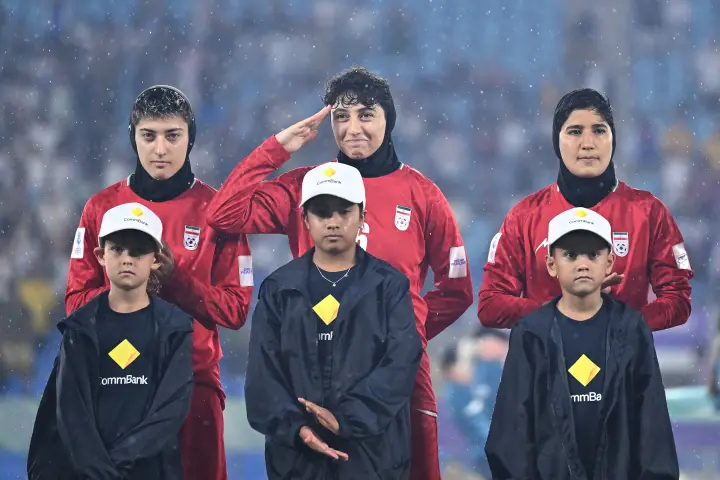
Iran’s squad was defeated 2–0 by the Philippines on Sunday night at a stadium on the Gold Coast, ending its campaign in the Women’s Asian Cup. Yet the match itself was overshadowed by wider political concerns surrounding the team’s conduct during the tournament and the possible consequences awaiting them in Iran.
The controversy intensified earlier in the week when players stood silently during the Iranian national anthem before a match, a gesture that observers interpreted as a possible act of protest against the country’s leadership. The moment quickly drew international attention and raised questions about whether the athletes could face reprisals under Iran’s restrictive political system.
Australian Foreign Minister Penny Wong said the government and many Australians were watching the situation closely.
Speaking on the Australian Broadcasting Corporation’s program Insiders, Wong said Australia stood “in solidarity” with the Iranian people, particularly women.
“It has been really moving for Australians to see them in Australia,” Wong said, referring to the visiting team. “And the Matildas swapping jerseys with them was, I think, a very evocative moment. It spoke to solidarity and the way in which sport can bring us together.”
She added that Australia remains aware of the broader human rights context inside Iran.
“We know this regime has brutally murdered many of its own people. We know this regime has brutally oppressed many Iranian women, and we stand in solidarity with the men and women of Iran, particularly Iranian women and girls,” Wong said. She declined to comment directly on the players’ personal circumstances.
Advocates and members of the public have urged the Australian government to take steps to ensure the athletes’ safety. A petition circulating on Change.org has drawn thousands of signatures, calling for authorities to offer protection to any player who might wish to remain in Australia.
The petition describes the players as facing an “impossible situation,” saying they may risk punishment if they return to Iran but also face potential retaliation against their families if they attempt to remain abroad.
“These concerns are immediate and serious,” the petition reads. It highlights reports that members of the team did not sing the national anthem before a match earlier in the tournament.
Organizers of the petition also point to claims that individuals linked to Iran’s government are accompanying the team and monitoring the athletes closely. According to the petition, players’ movements and communications may be restricted during their time abroad.
“Credible reporting has also raised concerns that regime-connected personnel are embedded with the delegation, that players are not allowed to move freely, and that their communications are restricted,” the petition states.
Supporters argue that Australia, as host of the tournament, has both logistical and ethical responsibilities to ensure the athletes can seek help if needed.
“Australia is hosting this tournament. That carries not only logistical responsibilities, but moral ones,” the petition says.
“This is a moment for principled leadership. These players should not be forced back into danger because they displayed conscience, dignity, or fear in public view.”
Iranian journalists and analysts have echoed similar concerns. Raha Pourbakhsh, a sports reporter with Iran International TV, said members of the team have faced pressure from authorities even while traveling abroad.
Speaking on The Sports Ambassador podcast, Pourbakhsh said players had allegedly been warned that their professional careers could be ended and that they could face imprisonment if they engaged in political acts during the tournament.
“They have threatened them with their careers being ended and also jail time,” Pourbakhsh said during the interview.
According to her account, the athletes were required to sign agreements before leaving Iran pledging they would not seek asylum in Australia.
“They forced the players into signing hefty bail agreements assuring the authorities they would not become refugees in Australia,” she said.
Pourbakhsh also alleged that officials instructed players to sing the national anthem and display enthusiasm during matches to project an image of normalcy.
“They have also been told that they must sing along to the national anthem and also to show joy and happiness if they score a goal to show that everything is normal,” she said.
Sources familiar with the team’s situation have also told international media that seeking asylum in Australia may not be feasible for most players because of potential risks to relatives who remain in Iran.
The issue has drawn renewed attention to the dangers athletes and public figures can face when international sports intersect with political dissent.
Iran’s sporting community has been deeply affected by the country’s recent wave of protests and government crackdowns. Demonstrations erupted after the death of Mahsa Amini in 2022 and have since evolved into a broader movement calling for greater rights for women and political reform.
Athletes in particular have occasionally used international competitions to express solidarity with protesters. Such gestures have sometimes been met with severe consequences once participants return home.
The risks are not merely theoretical. Iranian footballer Zahra Azadpour, 27, was killed in January during protests in Karaj, north of Tehran, according to reports cited by activists and international media. Another figure connected to Iranian soccer, 23-year-old referee Sabha Rashtian, was also fatally shot while participating in demonstrations in Isfahan.
Those incidents have deepened fears among supporters of the women’s team that athletes could become targets of political retaliation.
While the Iranian women’s national team traveled to Australia primarily for competition, the tournament has evolved into a flashpoint in the global conversation about sports, politics, and human rights. International sporting events increasingly serve as stages where athletes can express solidarity with political movements or challenge authorities at home.
The situation also places host nations in a delicate diplomatic position. Australia must balance its role as tournament organizer with its foreign policy relationships and obligations under international asylum law. Providing protection to athletes who request it could provoke tensions with Tehran, yet failing to respond could trigger criticism from human rights groups and the public.
Another layer of complexity involves the families of athletes still inside Iran. Even if individual players wanted to remain abroad, the possibility of retaliation against relatives often discourages such decisions. That dynamic has been documented in several past cases involving athletes and journalists who defected from authoritarian states.
The global visibility of women’s soccer has also amplified the significance of the Iranian team’s silent anthem moment. In recent years, women’s football has emerged as one of the fastest-growing sports worldwide, bringing greater scrutiny to gender equality issues within participating nations.
For many observers, the episode underscores how international sport can become intertwined with broader struggles for civil liberties. Whether the Iranian players return home without repercussions may depend not only on internal politics in Tehran but also on the level of international attention that remains focused on their situation.





