

(AP/BBC/Reuters) — A U.S. military refueling aircraft crashed in western Iraq during operations connected to the war with Iran, triggering an emergency rescue mission, United States Central Command announced Thursday.
The aircraft, a Boeing KC‑135 Stratotanker, went down after what military officials described as an “incident” involving two aircraft flying in the same area.
Central Command said one aircraft landed safely while the other crashed in what it described as “friendly airspace” in western Iraq.
Rescue teams were immediately dispatched to the crash site.
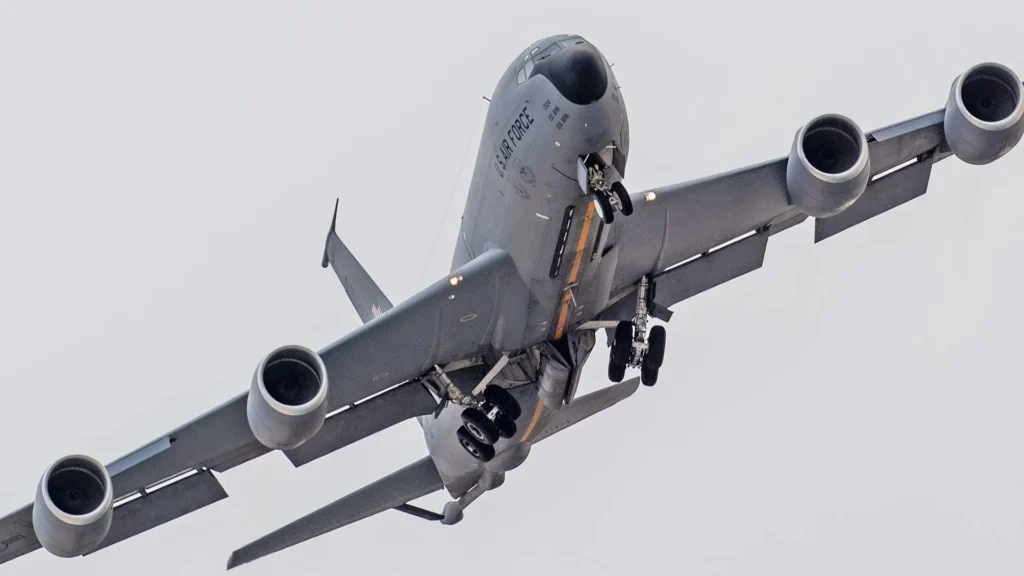
“The incident occurred in friendly airspace during Operation Epic Fury, and rescue efforts are ongoing,” the command said in a statement, referring to the U.S. military campaign targeting Iranian military infrastructure.
Officials emphasized that the crash was not caused by hostile fire or friendly fire, suggesting that enemy action did not bring down the aircraft.
A U.S. official familiar with the developing situation, speaking on condition of anonymity, told The Associated Press that the second aircraft involved in the incident was also a KC-135 refueling tanker.
Authorities have not yet confirmed whether there were casualties.
The tanker aircraft was part of the extensive aerial network supporting Operation Epic Fury, the U.S. military campaign launched after the United States and Israel began coordinated strikes against Iranian targets on Feb. 28.
In recent weeks, the Pentagon has moved a significant number of aircraft into the Middle East as part of the operation.
Refueling aircraft such as the KC-135 play a critical role in sustaining long-range combat missions.
They allow fighter jets, bombers and surveillance aircraft to remain airborne for extended periods by transferring fuel mid-flight.
Military analysts note that these aircraft are often positioned in carefully coordinated aerial formations involving multiple combat jets and support planes operating simultaneously.
Although the cause of the crash remains under investigation, aviation experts say one possible explanation could involve a mid-air collision or mishap during aerial refueling operations.
The BBC noted that refueling missions require aircraft to fly extremely close together — sometimes only a few feet apart — while a fuel boom extends from the tanker to connect with another aircraft.
During these operations, pilots rely on precision maneuvering and visual cues to align their aircraft with the tanker.
Once contact is established, fuel flows through the boom for several minutes while the aircraft maintain tight formation.
The process becomes even more complex when conducted at night or under combat conditions.
In some cases, aircraft lights are turned off to reduce the risk of detection by enemy radar or missile systems.
In such environments, multiple aircraft may be operating simultaneously in confined airspace.
Maintaining formation under those circumstances requires exceptional skill from pilots and boom operators.
A typical KC-135 carries a crew of three: a pilot, a co-pilot and a boom operator responsible for controlling the refueling apparatus.
The crash represents the latest aviation incident since the United States and Israel began military operations against Iran.
According to reporting cited by The Guardian, it marks the fourth U.S. aircraft lost since the start of the conflict on Feb. 28.
Earlier this month, three U.S. fighter jets were accidentally shot down by Kuwait Air Defense Forces in what officials described as a “friendly fire” incident.
All pilots in those aircraft successfully ejected and survived.
The broader conflict has already resulted in significant casualties.
Seven U.S. service members have been killed in attacks linked to the war, while Reuters indicated earlier this week that as many as 150 American troops have been wounded during retaliatory strikes by Iran.
Iranian officials say more than 1,300 people have died inside the country since the fighting began, according to the nation’s ambassador to the United Nations.
Aerial refueling aircraft like the KC-135 are often described by military planners as the “lifeline” of long-range air operations.
Without them, combat aircraft would be limited by their onboard fuel capacity, significantly reducing mission range and operational endurance.
In modern conflicts — particularly those involving strikes across vast geographic distances — refueling tankers enable bombers and fighter jets to travel thousands of miles to reach their targets and return safely.
The United States Air Force maintains one of the largest aerial refueling fleets in the world.
According to the service’s Air Mobility Command, nearly 400 tanker aircraft operate across the U.S. military’s global logistics network.
These aircraft often fly continuous missions during major conflicts, remaining airborne for hours while servicing multiple fighter jets.
Rescue operations in western Iraq may prove complex depending on the location of the crash site.
Although the region is described by the military as “friendly airspace,” large portions of western Iraq consist of remote desert terrain with limited infrastructure.
Search and rescue teams typically rely on helicopters, drones and ground forces to reach downed aircraft crews quickly.
Military doctrine places a high priority on recovering pilots and aircrew, both for humanitarian reasons and to prevent sensitive equipment or information from falling into hostile hands.
Officials have not yet disclosed the number of crew members aboard the aircraft at the time of the crash.
The crash illustrates the enormous operational pressure placed on military aviation during large-scale conflicts.
Since the start of the war with Iran, the United States has significantly increased its air presence across the Middle East.
That expansion has created an environment where dozens of aircraft may operate simultaneously across relatively tight air corridors.
Such conditions increase the risk of accidents even when enemy forces are not directly involved.
Military analysts note that logistical aircraft — particularly refueling tankers — often fly continuous missions that stretch crews and equipment.
While combat losses typically draw more public attention, aviation accidents have historically accounted for a substantial share of aircraft losses during prolonged military operations.
The incident also underscores how aerial refueling missions, though routine, remain among the most technically demanding tasks in military aviation.
As investigators work to determine the precise cause of the crash, the outcome of the rescue mission will likely be the Pentagon’s immediate focus.
Further details about the aircraft, its crew and the circumstances of the crash are expected as the investigation continues.





