

(AP) — The United States has ordered approximately 2,500 Marines and an amphibious assault ship to the Middle East, significantly reinforcing American forces in the region as the war involving Iran intensifies and begins to reshape global energy markets.
A U.S. official familiar with the deployment confirmed the move Friday while speaking to The Associated Press on condition of anonymity because the military planning had not yet been publicly detailed.
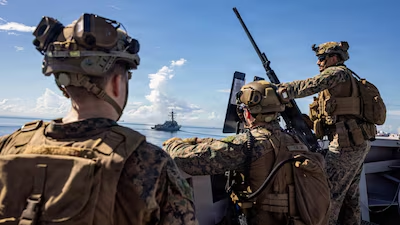
The reinforcements include elements of the 31st Marine Expeditionary Unit and the amphibious assault ship USS Tripoli, which have been directed toward the Middle East amid the deepening conflict involving Iran, Israel, and several regional actors.
The order represents one of the largest single reinforcements of U.S. military personnel to the region since the outbreak of the current hostilities nearly two weeks ago.
The latest deployment comes as Iranian missile and drone attacks continue to strike Israeli territory and energy infrastructure across the Gulf region. At the same time, Israeli aircraft have launched waves of strikes against Iranian military facilities and related targets.
The conflict has also disrupted one of the world’s most critical shipping corridors — the Strait of Hormuz — through which roughly one-fifth of globally traded oil typically passes.
Iran’s actions to effectively shut the strait have amplified concerns across global energy markets, pushing oil prices higher and raising fears of wider economic repercussions.
Meanwhile, violence has spilled beyond Iran and Israel into neighboring countries.
In Lebanon, Israel has intensified airstrikes against the Iran-backed militant group Hezbollah, contributing to a worsening humanitarian crisis.
Lebanon’s Health Ministry indicated that nearly 800 people have been killed and more than 850,000 displaced since the latest round of fighting began.
In an interview with Fox News, President Donald Trump suggested that the duration of the conflict remains uncertain.
“The war will end when I feel it in my bones,” Trump said during the interview.
He also cautioned that overthrowing Iran’s ruling system would be difficult, pointing to the country’s internal security apparatus.
Trump specifically cited the Basij, a force aligned with Iran’s leadership that has historically suppressed domestic protests.
“That’s a big hurdle for people who don’t have weapons,” Trump said.
Military officials said the Marine deployment does not necessarily signal that American ground combat operations are imminent.
Units such as the 31st Marine Expeditionary Unit are trained for a broad range of missions that include evacuating civilians, securing embassies, conducting amphibious operations and responding to humanitarian disasters.
The Marine unit and its supporting ships are based in Okinawa and have spent recent days moving across the Pacific.
Satellite imagery recently captured the USS Tripoli sailing near Taiwan, suggesting it could take more than a week to reach waters near Iran.
Once there, the vessel would likely join a growing American naval presence that already includes the aircraft carrier USS Abraham Lincoln and multiple guided-missile destroyers operating in the Arabian Sea.
At the start of the week, the U.S. Navy had at least 12 ships in the area.
As the military buildup continued, a powerful blast struck a central district of Tehran during a large state-organized rally.
The explosion occurred in Ferdowsi Square, where thousands had gathered for the annual Quds Day.
Participants at the rally were chanting anti-Israel and anti-U.S. slogans when the blast erupted.
Israel had issued a warning in Persian on social media urging civilians to leave the area shortly beforehand.
However, many residents may not have seen the message because Iranian authorities have imposed sweeping internet restrictions across the country.
Footage circulating online showed crowds continuing to chant religious slogans as smoke rose in the distance.
Among those present was Gholamhossein Mohseni Ejei, who was conducting a televised interview when the explosion occurred.
Security guards quickly surrounded him as the broadcast continued.
Iranian officials did not immediately confirm casualties.
In Washington, Defense Secretary Pete Hegseth described the scale of ongoing military operations against Iranian targets.
Hegseth said more than 15,000 enemy targets have been struck since the start of the war.
That average — roughly 1,000 targets per day — highlights the intensity of the air campaign underway.
He also sought to reassure markets concerned about disruptions to oil shipments through the Strait of Hormuz.
“We have been dealing with it and don’t need to worry about it,” Hegseth said during a briefing.
Amid the expanding operations, the U.S. military confirmed that all six crew members aboard a KC‑135 Stratotanker died after the aircraft crashed in Iraq.
Officials with U.S. Central Command said the crash did not involve hostile fire.
Another aircraft involved in the mission landed safely.
The incident pushed the confirmed U.S. death toll in the conflict to at least 13 service members.
Earlier in the war, three American fighter jets were mistakenly shot down by friendly fire from Kuwait, military officials said.
Iran continued launching attacks across the broader Gulf region.
Authorities in Oman said two people were killed when drones crashed in the Sohar area, the Oman News Agency said.
Elsewhere, a U.S. official indicated that the Navy destroyer USS Oscar Austin intercepted an Iranian ballistic missile over Turkey.
Residents in Adana said they heard a loud blast followed by sirens at Incirlik Air Base, which hosts American forces.
In Lebanon, Israeli strikes continued to batter areas believed to host Hezbollah infrastructure.
An attack on the southern coastal city of Sidon killed at least eight people, the country’s Health Ministry said.
The death toll could rise as rescue workers search collapsed buildings.
The United Nations estimates that hundreds of thousands have fled their homes since the latest escalation began.
During a visit to Lebanon, Secretary-General António Guterres launched a $325 million humanitarian appeal.
Lebanese Prime Minister Nawaf Salam urged Israel to halt its strikes while also criticizing Hezbollah’s attacks on Israeli targets.
“There is no justification in holding an entire nation hostage,” Salam said.
Israel’s defense minister, Israel Katz, signaled that the military campaign could expand.
The strikes so far, Katz said earlier, are “just the beginning.”
The dispatch of 2,500 Marines to the Middle East reflects Washington’s effort to maintain strategic flexibility in a rapidly expanding conflict.
Marine Expeditionary Units function as crisis-response forces capable of evacuating civilians, reinforcing embassies or launching amphibious operations if conditions deteriorate.
Their deployment suggests the Pentagon is preparing for scenarios ranging from humanitarian evacuations to possible escalation involving American personnel.
Equally significant is the economic dimension of the war.
Iran’s disruption of the Strait of Hormuz threatens global oil supply chains at a moment when energy markets remain fragile. Even temporary restrictions in the narrow waterway can trigger sharp price increases worldwide.
Another concern involves regional spillover.
The conflict already spans multiple fronts — Iran, Israel, Lebanon, Turkey and the Gulf states — increasing the risk that a localized war could evolve into a broader regional confrontation.
The arrival of additional U.S. forces may help deter further escalation, but it also underscores how quickly the crisis has drawn in global powers.
If the fighting continues to widen, analysts warn the Middle East could face one of its most volatile geopolitical periods in decades, with significant consequences for global security and the world economy.





