

All six crew members aboard a U.S. military refueling aircraft died after their KC‑135 Stratotanker crashed during a combat support mission connected to the war against Iran, American military authorities confirmed Friday.
Officials from U.S. Central Command disclosed that the tanker went down Thursday in western Iraq following an incident involving two aircraft operating in what the military described as “friendly airspace.”
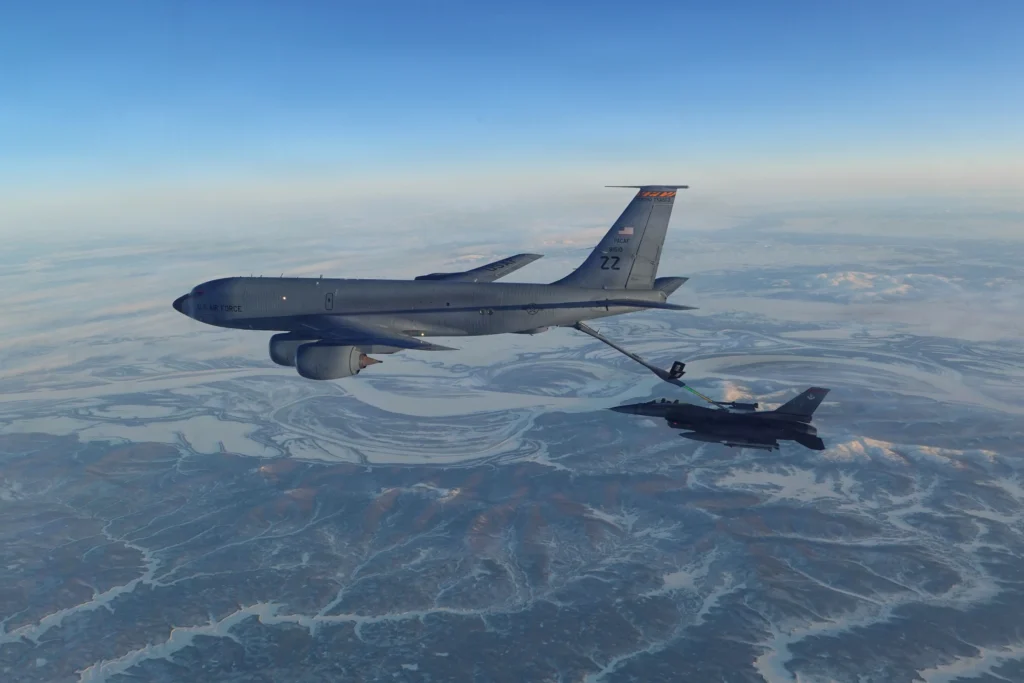
A second aircraft involved in the episode completed the mission safely and landed without damage, military officials said, while the circumstances that led to the crash remain under investigation.
The loss of the tanker marks another deadly episode in the expanding U.S. military campaign known as Operation Epic Fury, pushing the confirmed American death toll in the conflict to at least 13 service members.
Seven other U.S. troops were previously killed in combat operations tied to the war, while roughly 140 American service members have sustained injuries, including several severe cases, according to figures the Pentagon shared earlier in the week.
Three of the six airmen killed in the crash were assigned to the Ohio Air National Guard 121st Air Refueling Wing, Mike DeWine revealed in a message posted to social media.
DeWine did not release the names of the airmen but extended condolences to their families and colleagues.
“Our hearts are with the families and fellow airmen grieving this tragic loss,” the governor wrote.
Military officials indicated that the crew was conducting an operational mission supporting combat aircraft when the incident occurred.
Senior defense leaders acknowledged the crash during a briefing at the Pentagon, though confirmation of the deaths came afterward.
Pete Hegseth described the crew as American heroes while addressing reporters.
“War is hell. War is chaos,” Hegseth said. “As we saw yesterday with the tragic crash of our KC-135 tanker, bad things can happen. American heroes, all of them.”
At the same briefing, Dan Caine told journalists that the crash unfolded over friendly territory in western Iraq while the crew was engaged in a combat support mission.
Both officials emphasized that preliminary information shows the aircraft was not brought down by hostile fire or friendly fire.
Military authorities have not yet identified the specific chain of events that caused the aircraft to crash.
A U.S. official familiar with the incident, speaking anonymously due to the ongoing investigation, indicated that the second aircraft involved in the encounter was also a KC-135 tanker.
Meanwhile, Yechiel Leiter wrote on the social platform X that the other aircraft safely reached Israel following the incident.
Aviation specialists note that refueling missions require aircraft to fly extremely close together, sometimes only a few feet apart, which creates a narrow margin for error.
Yang Uk said it would be unusual for a tanker aircraft to be shot down by enemy forces because refueling operations typically occur far from the front lines of combat.
The KC-135 Stratotanker is among the most important support aircraft in the U.S. military arsenal.
Its primary mission is to refuel fighter jets, bombers and surveillance aircraft while they are in flight, dramatically extending their range and allowing them to remain in combat zones for longer periods.
The aircraft can also transport cargo and personnel and is sometimes used in aeromedical evacuation missions to move wounded troops from the battlefield.
The tanker is based on the same airframe design as the Boeing 707, one of the most widely used passenger aircraft of the mid-20th century.
Although the KC-135 has undergone numerous upgrades over the decades, the final examples were produced in the 1960s.
According to the Congressional Research Service, the U.S. Air Force maintained 376 KC-135 tankers as of last year, including aircraft assigned to active duty units, the Air National Guard and the Air Force Reserve.
The tanker fleet is gradually being replaced by the next-generation KC‑46A Pegasus, though hundreds of Stratotankers remain in service.
A typical KC-135 crew includes three airmen: a pilot, a co-pilot and a boom operator.
The boom operator controls a telescoping refueling arm that extends from the rear of the aircraft to deliver fuel to another plane.
During the operation, the receiving aircraft carefully approaches the tanker and aligns with the boom, often guided by a series of lights beneath the aircraft.
The boom operator typically performs the task while lying face-down and looking through a viewing window at the underside of the tanker.
Some variants of the aircraft also use wing-mounted pods that allow them to refuel multiple aircraft at once.
Military experts note that such missions frequently occur at night and sometimes without external lighting to avoid detection by enemy radar or missiles.
Despite its long service history, the KC-135 has been involved in several fatal accidents.
One of the most recent occurred in May 2013 when a tanker supporting operations in Afghanistan crashed shortly after takeoff near Chaldovar.
An investigation by the U.S. Air Force determined that problems with the aircraft’s rudder contributed to the accident.
As the crew struggled to maintain control, the tail section separated and the aircraft broke apart in midair, killing all three people aboard.
Another historic accident occurred in 1966 when a tanker collided with a B‑52 Stratofortress carrying nuclear weapons near Palomares.
The crash caused nuclear material to scatter across the area, triggering a major international cleanup operation.
The latest crash has revived questions about safety procedures aboard KC-135 aircraft, including the use of parachutes.
Alan Diehl said not all KC-135 crews historically carried parachutes.
Maintenance costs and training requirements were among the reasons the equipment was sometimes removed from the aircraft in earlier decades.
In some cases, military guidance suggested it was statistically safer for crews to remain inside the aircraft rather than attempt a midair escape.
“Removing parachutes from military aircraft may sound peculiar, but KC-135s are not like other aircraft,” an Air Force news release in 2008 explained while discussing the policy.
Diehl cautioned that it remains unclear whether parachutes were present on the aircraft that crashed in Iraq or whether they would have altered the outcome.
Refueling tankers are expected to become even more essential if the conflict with Iran continues to expand.
Long-distance missions may require American aircraft to operate far from regional bases as Iranian forces reposition deeper inside the country.
Air-to-air refueling enables fighters and bombers to stay airborne for extended periods, making it a crucial element of sustained air campaigns.
Although fighter jets and missile strikes dominate headlines during wartime, the crash underscores the often-overlooked dangers faced by support crews operating behind the front lines.
Aerial refueling missions involve complex choreography between multiple aircraft traveling at high speed while maintaining extremely close formation.
Even a minor error in positioning or turbulence can trigger a catastrophic chain reaction.
The loss of a tanker also carries strategic implications.
Each KC-135 acts as a force multiplier, allowing dozens of combat aircraft to extend their missions without landing. Losing one reduces operational flexibility, particularly during a sustained campaign such as the current war involving Iran.
At the same time, the accident highlights the aging nature of parts of the U.S. tanker fleet. Although heavily upgraded, many KC-135 aircraft remain more than half a century old.
The Pentagon has accelerated efforts to introduce the KC-46A Pegasus as a replacement, but the transition will take years to complete.
For now, the Stratotanker remains a backbone of American air operations — and the crash in Iraq serves as a reminder that even the most routine support missions carry serious risks in wartime.
AP





