

(AP) — Israel said Tuesday it killed two senior Iranian security figures in overnight airstrikes, a move Israeli officials described as a significant blow to Iran’s leadership as the conflict between the longtime adversaries intensified across the Middle East.
Iran did not immediately acknowledge the deaths, but responded with fresh waves of missile and drone attacks targeting Israel and several Gulf Arab nations, underscoring a rapidly widening war with no immediate path to de-escalation.
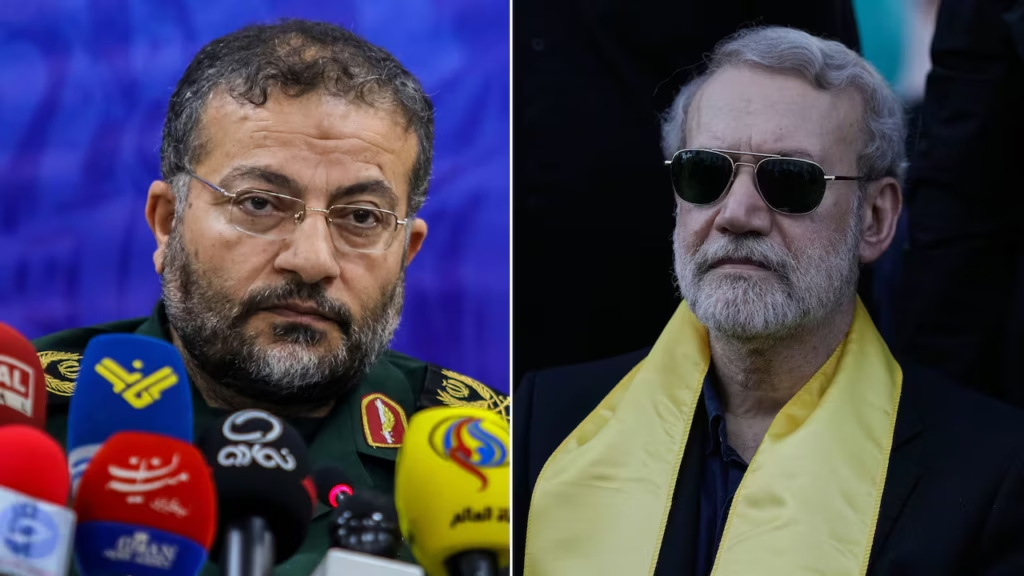
Israeli Defense Minister Israel Katz said the strikes killed Ali Larijani, secretary of Iran’s Supreme National Security Council, and Gholam Reza Soleimani, the head of the paramilitary Basij force under the Islamic Revolutionary Guard Corps.
“They were eliminated last night,” Katz said, describing the operation as part of Israel’s broader effort to weaken Iran’s command structure during wartime.
Larijani had been one of Iran’s most influential political figures, particularly after the death of Supreme Leader Ali Khamenei, who was killed in an airstrike during the opening phase of the war. Larijani previously served as parliament speaker and was closely involved in strategic decision-making, including nuclear negotiations with the administration of President Donald Trump.
Soleimani, meanwhile, commanded the Basij, a volunteer force that has played a central role in enforcing domestic security and suppressing dissent across Iran.
Both figures had been sanctioned by Western governments over their involvement in Iran’s crackdown on protests earlier this year.
Israeli Prime Minister Benjamin Netanyahu said the killings were intended to erode Iran’s governing system.
“We are undermining this regime to give the Iranian people the opportunity to remove it,” Netanyahu said, signaling Israel’s broader strategic objective.
The deaths of Larijani and Soleimani, if confirmed, would represent one of the most significant losses for Iran’s leadership structure since the conflict began, stripping the government of key figures involved in both security operations and political coordination.
Iran’s current Supreme Leader, Mojtaba Khamenei, has not appeared publicly in recent days. Israeli officials have suggested he may have been wounded, though no independent confirmation has emerged.
In response, Iran fired additional missiles and drones toward Israeli territory and Gulf nations, expanding the geographic scope of the conflict.
Air defenses were activated across multiple countries as projectiles targeted energy infrastructure and urban centers.
In the United Arab Emirates, authorities temporarily closed airspace over Dubai as the military intercepted incoming threats. The shutdown marked the second such disruption in as many days.
Explosions were also reported over Abu Dhabi, where officials said a man was killed by debris from an intercepted missile, bringing the death toll in the country to eight since the war began.
In the emirate of Fujairah, an oil facility was struck in a drone attack, though authorities said no injuries were reported. A tanker anchored nearby sustained minor damage after being hit by debris, according to the United Kingdom Maritime Trade Operations.
Elsewhere in the region, Saudi Arabia said it intercepted drones, while air defense systems were heard engaging targets over Doha.
In Iraq, the U.S. Embassy in Baghdad was struck by shrapnel from intercepted drones, highlighting the risk to American personnel in the region.
The escalating attacks have intensified fears of a global energy crisis, particularly as Iran signaled it would maintain tight control over the Strait of Hormuz, through which roughly one-fifth of the world’s oil supply passes.
Iranian officials indicated that while the waterway technically remains open, access could be restricted for the United States and its allies.
Shipping traffic has already been disrupted, with about 20 vessels reportedly struck since the conflict began.
Rising oil prices and concerns over supply disruptions have begun to ripple through global markets.
President Donald Trump said he had urged several countries to deploy naval forces to safeguard shipping routes, though no immediate commitments were announced.
The Israeli military said it had launched a “wide-scale wave of strikes” targeting Tehran, focusing on command centers, missile launch sites and air defense systems.
Israel also intensified operations against Hezbollah positions in Lebanon, where the group has been firing rockets into northern Israel since the conflict escalated.
The Lebanese Armed Forces said one soldier was killed and four others wounded in an Israeli strike on the village of Kfar Sir.
Lebanese authorities say more than 1 million people have been displaced by the fighting, with hundreds killed since hostilities intensified.
According to the Iranian Red Crescent, more than 1,300 people have been killed in Iran since the conflict began.
In Israel, officials say at least 12 people have died from Iranian missile strikes, while the United States has reported 13 military personnel killed in the broader conflict.
The reported killing of two high-ranking Iranian officials marks a critical escalation point in the war, suggesting Israel is now targeting not only military infrastructure but also the leadership core of the Iranian state.
Such strikes carry both tactical and symbolic weight. Removing figures like Larijani and Soleimani could disrupt coordination within Iran’s security apparatus, but it also risks provoking a more aggressive response from Tehran.
Iran’s decision to expand attacks beyond Israel to include Gulf states signals a shift toward a regionalized conflict, drawing in countries that had previously tried to remain on the sidelines.
The involvement of strategic النفط infrastructure and the Strait of Hormuz raises the stakes far beyond the Middle East. Even limited disruptions in this corridor can have immediate global consequences, driving up energy prices and increasing economic uncertainty worldwide.
At the same time, the reluctance of other nations to commit military support despite U.S. appeals reflects broader concerns about being pulled into a prolonged and unpredictable war.
With both Israel and Iran showing little willingness to back down, analysts warn the conflict may enter a more dangerous phase marked by sustained regional attacks, economic disruption and the potential for wider international involvement.
As the situation continues to evolve, the coming days may prove pivotal in determining whether the conflict remains contained or spirals into a broader regional war with global repercussions.





