

Russian forces killed at least 22 people across Ukraine on Tuesday in a sustained wave of missile, drone, and aerial bomb attacks that struck a residential neighborhood, a gas production facility, and a frontline city — all while both sides announced competing ceasefires neither appeared ready to honor.
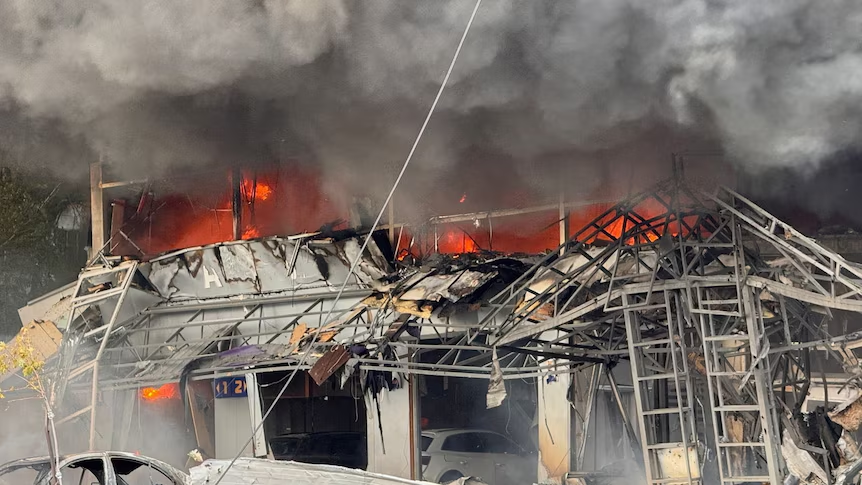
The deadliest single strike hit Zaporizhzhia, where at least 12 people were killed and 16 wounded when Russian munitions tore into residential buildings, a car repair shop, and a car wash. Regional governor Ivan Fedorov shared images from the scene showing a heavily damaged structure engulfed in fire and smoke, burning cars, and bloodied survivors being helped away from the wreckage by first responders.
Five people died when Russian forces dropped three aerial bombs on Kramatorsk, a city on the eastern front line. Ukrainian President Volodymyr Zelensky confirmed the strike on Telegram and warned the death toll could climb. Five others were wounded.
A Russian overnight strike on gas production facilities in the Poltava region killed five more. In that same region, governor Vitaliy Dyakivnych confirmed four people died and 37 were injured in missile and drone strikes at two separate locations, with an industrial plant and railway infrastructure damaged. Two emergency responders were among the dead — killed in a deliberate double-tap strike, a tactic where Russian forces hit a target a second time specifically to kill the rescue workers who respond to the first explosion. Another 23 rescue workers were among the injured.
In Russia, a Ukrainian drone strike on the Chuvashia region killed two people, Russian state media confirmed.
Rival Ceasefires, Continued Killing
The bloodshed unfolded against a backdrop of dueling ceasefire announcements that underlined the gulf between the two sides’ visions of how this war might pause — or end.
Moscow declared a ceasefire for May 8 and 9, the dates Russia commemorates the Soviet Union’s victory over Nazi Germany in World War II with its annual Victory Day military parade. This year’s celebrations are to be scaled back, Russian authorities said, because of the threat posed by Ukrainian drone attacks on Moscow.
Kyiv responded with a counter-proposal: an open-ended ceasefire beginning at midnight Wednesday, with a direct challenge to Moscow to match it. Zelensky made his position plain. It was not acceptable, he said, for Russia to halt strikes for one day to stage a military parade while having spent the preceding days pounding Ukrainian cities.
“Utter cynicism,” Zelensky called it — pushing for a ceasefire to hold “propaganda celebrations” while the attacks continued.
Russia’s Defense Ministry delivered its own message in parallel, warning that any Ukrainian attempt to disrupt Victory Day commemorations would be met with missile strikes on Kyiv.
Russia said its air defenses intercepted 289 Ukrainian drones overnight, with air raid alerts issued across 18 regions.
Ukraine Strikes Deep Into Russia
Ukrainian forces did not limit themselves to defense. Long-range strikes penetrated deep into Russian territory on Tuesday, targeting military-industrial infrastructure hundreds of miles from the front line.
Zelensky confirmed Ukrainian forces deployed long-range “Flamingo” cruise missiles that traveled more than 1,500 kilometers to strike military-industrial targets inside Russia. Regional authorities said three people were wounded in drone attacks on Cheboksary, a city on the Volga River, with one hospitalized.
A cruise missile struck a defense plant in the area producing navigation modules used in Russian drones and missiles — a direct hit on the supply chain feeding the weapons killing Ukrainians on the other end.
Ukrainian forces also targeted Russian energy infrastructure. A fire broke out at an industrial site in Kirishi in the Leningrad region after a strike on a major refinery. Authorities said the blaze was brought under control and no casualties were reported.
The dueling ceasefire announcements from Moscow and Kyiv are less a sign of peace seeking than a competition for the moral high ground — and a window into how each side is managing the narrative around a war now grinding through its fifth year.
Russia’s offer is narrow and self-serving by design. A 48-hour pause timed to Victory Day protects the optics of a parade celebrating a historical triumph while imposing no real constraint on the military campaign. It asks Ukraine to stop fighting while Russia’s army remains positioned across Ukrainian territory. It offers nothing about the occupation, nothing about prisoners, nothing about the thousands of Ukrainian civilians displaced or killed since February 2022.
Zelensky’s counter-offer — an open-ended ceasefire starting midnight Wednesday — is shrewder politically. It calls Russia’s bluff. If Moscow genuinely wants peace, it can match the offer. If it refuses, the refusal speaks louder than any parade. The problem is that an open-ended ceasefire without defined terms, verified withdrawal, and enforceable guarantees is not a peace agreement. It is a pause that one side can end at the moment of its choosing.
Both proposals arrive in the context of a broader diplomatic stalemate. The United States under Trump has pushed for negotiations while maintaining pressure on both sides. European governments have backed Ukraine’s right to determine its own ceasefire terms. None of the external pressure has produced a framework both Kyiv and Moscow will accept.
What Tuesday demonstrated, as it has on so many Tuesdays before it, is that the killing continues regardless of what is announced in press releases. Twelve people died in Zaporizhzhia while ceasefire proposals were being drafted. First responders were deliberately targeted in Poltava while diplomats discussed pauses. A gas facility burned while both governments competed to appear more committed to peace than the other.
The people of Ukraine are not waiting for the narrative to resolve. They are living inside it.
Alarabiya





