

(AP/PakistanToday) — A bomb concealed in a rickshaw tore through a crowded marketplace in northwest Pakistan on Tuesday, killing at least nine people and injuring more than two dozen others, officials said, in the latest surge of violence in a region near the Afghan border.
The explosion struck a busy bazaar in Lakki Marwat, located in Khyber Pakhtunkhwa province, where civilians, vendors and commuters were moving through the area when the device detonated. Police chief Azmat Ullah confirmed that two traffic officers and a woman were among those killed.
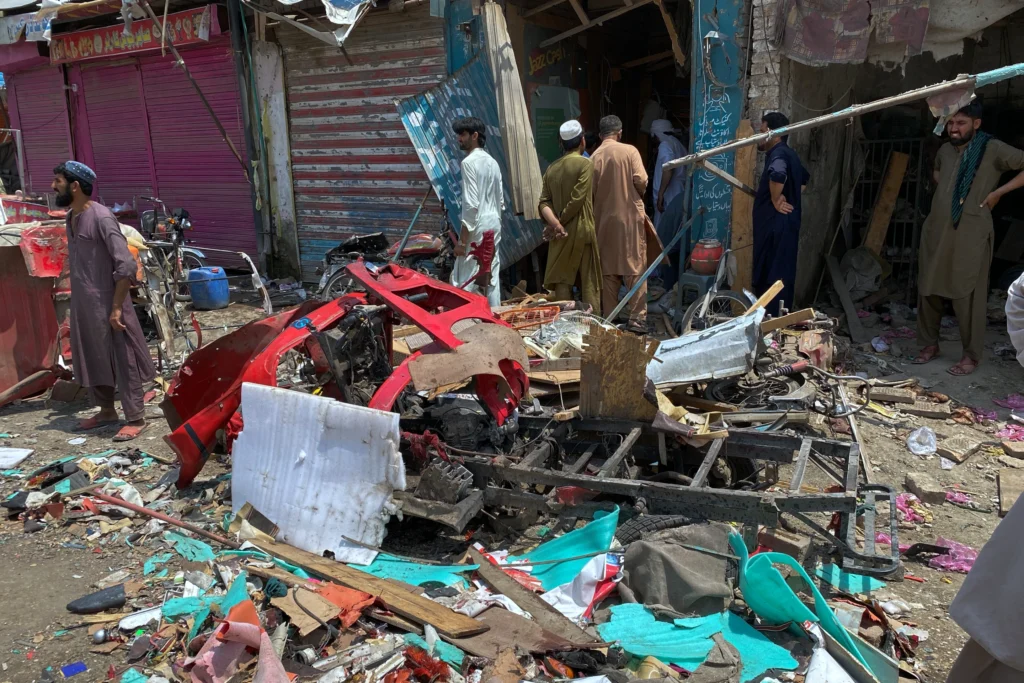
Authorities indicated that the blast appeared to target police personnel stationed nearby, though most of the victims were civilians caught in the open market. The force of the explosion damaged surrounding shops and scattered debris across the area, leaving a trail of destruction in one of the district’s commercial centers.
Emergency teams rushed to the scene shortly after the blast, transporting the wounded to nearby medical facilities. Hospital officials confirmed that women and children were among those receiving treatment, with several victims in critical condition.
No group immediately stepped forward to claim responsibility for the attack. However, suspicion in similar incidents has often centered on Tehrik-e-Taliban Pakistan, which has intensified attacks on security forces in recent years. The group issued a statement distancing itself from the bombing, saying it had no involvement.
Local coverage from Pakistan Today cited police and hospital officials who initially placed the death toll lower before confirming additional casualties as rescue efforts continued. Emergency responders from Rescue 1122 deployed ambulances and personnel to the site, while hospitals declared emergency measures to manage the influx of injured victims.
The explosion occurred near a police facility in the Sarai Naurang area, a densely populated part of the district. Authorities said the device had been planted in or near a three-wheeled vehicle commonly used for transport, turning it into a deadly improvised bomb.
Tuesday’s attack comes just days after another major assault in the nearby Bannu district, where a coordinated bombing and gun attack on a security post left at least 15 police officers dead. That incident prompted the government in Islamabad to summon a senior Afghan diplomat to register a formal protest, citing concerns over cross-border militant activity.
Prime Minister Shehbaz Sharif condemned the latest bombing and expressed condolences to the victims’ families. In a statement, he said the government remained determined to eliminate militant violence and directed authorities to swiftly identify those responsible and bring them to justice.
Pakistan has long accused neighboring Afghanistan’s leadership of allowing armed groups to operate from its territory. Officials in Kabul have consistently rejected those claims, maintaining that they do not permit attacks against other nations from their soil.
The Lakki Marwat bombing highlights a troubling resurgence of militant activity in Pakistan’s northwest, particularly in districts close to the Afghan border where security challenges have persisted for years. The use of a vehicle-borne explosive device in a crowded civilian area reflects a shift toward tactics designed to maximize casualties and spread fear beyond traditional military targets.
Although the group most often linked to such attacks denied responsibility, the broader pattern of violence suggests a complex and evolving militant landscape. Splinter factions, loosely affiliated networks and opportunistic actors have increasingly blurred lines of accountability, making it more difficult for authorities to pinpoint perpetrators quickly.
The timing of the blast, coming days after a deadly assault in Bannu, signals a possible escalation aimed at testing the state’s security response and exploiting perceived vulnerabilities. Analysts note that repeated attacks in quick succession can strain local law enforcement capacity and undermine public confidence in safety measures.
Beyond immediate security concerns, the incident underscores deeper regional tensions between Pakistan and Afghanistan. Accusations of cross-border militancy continue to complicate diplomatic relations, even as both countries face pressure to prevent further instability. The absence of a formal ceasefire or coordinated border security framework leaves room for continued friction and sporadic violence.
The targeting of a marketplace also raises broader concerns about civilian exposure in conflict zones. Markets in these regions often serve as vital economic hubs, and attacks on such spaces disrupt livelihoods while amplifying fear among residents. For many communities, the psychological impact of these incidents can be as damaging as the physical destruction.
Security experts warn that without sustained counterterrorism efforts and improved intelligence coordination, similar attacks could persist. The challenge for Pakistani authorities will be balancing immediate response measures with long-term strategies that address the root causes of militancy, including governance gaps and economic instability in border regions.
Investigators continued to examine the blast site and gather evidence as officials worked to determine responsibility. Authorities said updates would follow as the situation develops.





