

BUNIA, Democratic Republic of Congo — The World Health Organization declared the Ebola outbreak spreading through eastern Congo and into Uganda a global public health emergency of international concern on Sunday, as the death toll climbed to at least 87 people and health workers scrambled to contain a disease moving across three health zones in one of Africa’s most conflict-torn provinces.
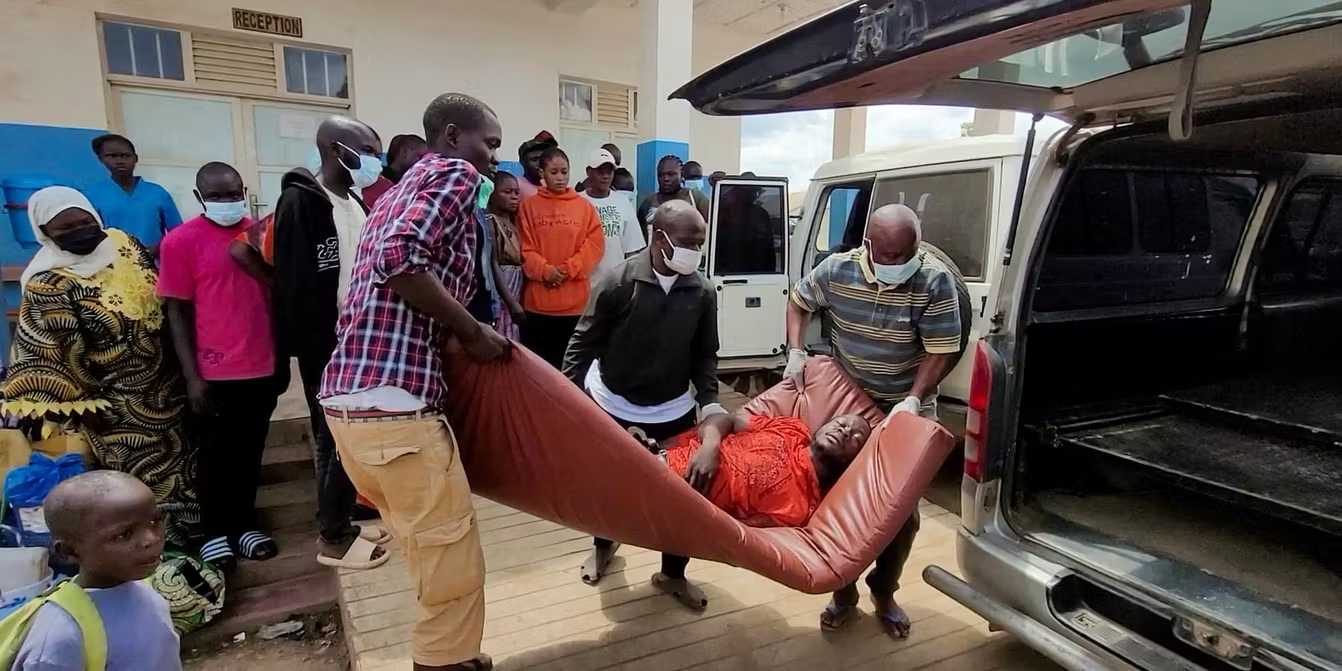
The declaration, the WHO’s highest level of international alarm short of a pandemic emergency designation, came after 246 suspected cases and eight laboratory-confirmed infections were recorded across Ituri province’s Bunia, Rwampara, and Mongwalu health zones, the WHO said in a statement. The agency confirmed the outbreak involves the Bundibugyo virus, a variant of Ebola that has been less common in Congo’s previous outbreaks.
Congo’s Health Minister Samuel-Roger Kamba identified the likely index case as a nurse who died at a hospital in Bunia, with the illness traced back to April 24 — meaning the virus had been circulating for nearly three weeks before the outbreak was officially announced Friday.
This is Congo’s 17th Ebola outbreak since the disease first emerged in the country in 1976.
In Bunia, the human reality behind the numbers was stark. Residents described daily burials and mounting fear in a city where people were dying faster than they could be identified.
“Every day, people are dying, and this has been going on for about a week,” Jean Marc Asimwe, a Bunia resident, told the Associated Press. “In a single day, we bury two, three or even more people. At this point, we don’t really know what kind of disease it is.”
How It Spread and Where It Stands
Africa CDC Director-General Dr. Jean Kaseya said at an online briefing Saturday that the outbreak originated in Mongwalu, a high-traffic mining area in Ituri province, before traveling with patients who sought medical care in Rwampara and then Bunia. Of the 87 deaths confirmed by Saturday, 57 occurred in Mongwalu, 27 in Rwampara, and three in Bunia itself.
By Saturday, the Africa Centres for Disease Control and Prevention tallied 336 suspected cases and 13 confirmed cases, with four deaths among those confirmed. Only 13 blood samples had been tested at the National Institute of Biomedical Research, of which eight came back positive for the Bundibugyo strain. Five samples could not be analyzed because the volume was insufficient, the health minister said.
Kaseya warned of active community transmission, particularly concentrated in Mongwalu, which he said was “significantly complicating containment and contact tracing efforts.” Armed conflict in Ituri, where Islamic State-backed militants carry out regular attacks on civilians and infrastructure, was restricting surveillance teams and rapid response operations from reaching affected areas.
A confirmed case was also reported in Kinshasa, Congo’s capital, from a person who had traveled from Ituri, the WHO said — a development that illustrated how quickly a disease outbreak in a remote mining zone can reach a megacity more than 1,000 kilometers away.
Uganda: An Imported Death in Kampala
The outbreak crossed the border before the international alarm was raised. Uganda confirmed Friday that an Ebola case had been imported from Congo. The patient died May 14 at Kibuli Muslim Hospital in Kampala, Uganda’s capital. A second case was confirmed in Kampala over the same weekend, the WHO said, also connected to travel from Congo.
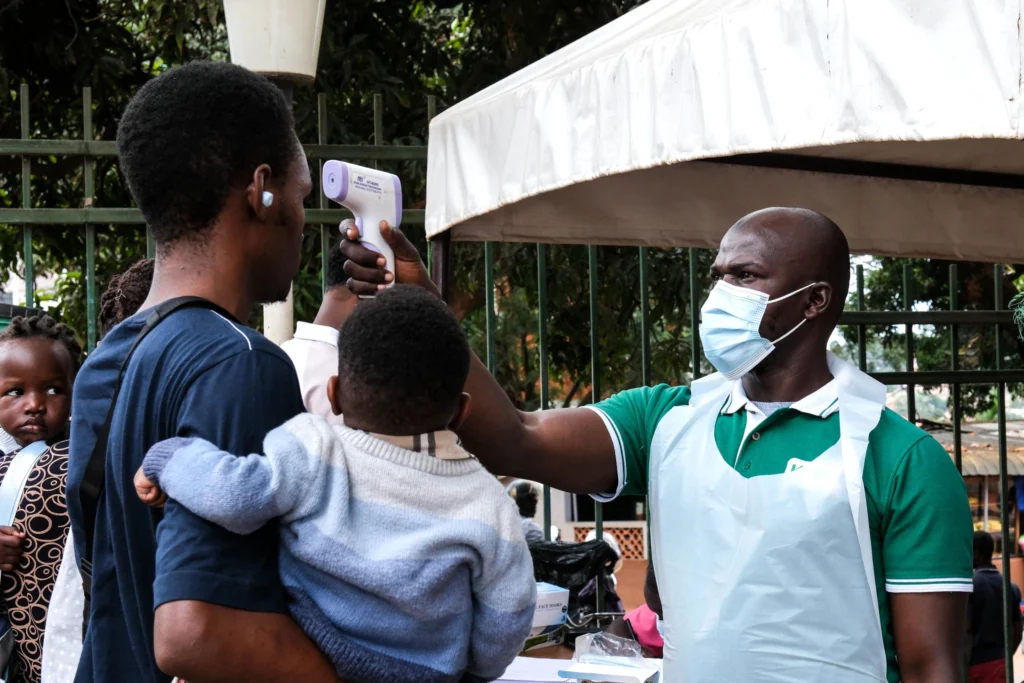
Uganda’s Health Ministry said the body of the patient who died in Kampala was later returned to Congo and that no local transmission had been confirmed in Uganda as of Saturday. Medical staff were screening people at the entrance of Kibuli Muslim Hospital on Saturday.
For residents near the hospital, the outbreak stirred memories of other losses. “I really get scared because I remember burying my father without looking at his body,” said Ismail Kigongo, a Kampala resident, recalling his father’s death during the COVID-19 pandemic.
Kenya, which borders Uganda and maintains active travel links across East Africa, said Saturday it assessed only a “moderate risk of importation” of Ebola given regional movement patterns. The Kenyan government said it had assembled an Ebola preparedness team and reinforced surveillance at all border crossings and points of entry.
The Challenge of Containing Ebola in a War Zone
Congo brings experience to every Ebola outbreak it faces. It also brings the same obstacles. Ituri province sits approximately 1,000 kilometers from Kinshasa. It is poorly connected by road, frequently cut off by violence, and has been ravaged for years by Islamic State-backed militants who target civilians and attack health infrastructure. Getting laboratory equipment, medical teams, and personal protective supplies to Mongwalu and Rwampara under those conditions is a genuine logistical and security challenge that no declaration from Geneva resolves on its own.
The Bundibugyo variant adds a layer of scientific complexity. Congo’s most deadly outbreaks have involved the Zaire strain, which carries a fatality rate of up to 90 percent in untreated patients but against which effective vaccines now exist. Bundibugyo, first identified in Uganda in 2007, has a somewhat lower fatality rate but has been less studied and the available vaccines have not been validated for this specific strain at scale.
Ebola spreads through direct contact with bodily fluids including blood, vomit, and semen from infected individuals. It does not travel through the air. But in communities where people care for sick relatives at home, where traditional burial practices involve physical contact with the deceased, and where awareness of transmission routes is limited, those biological facts provide cold comfort.
Resident Adeline Awekonimungu put the community’s expectation plainly. “My recommendation is that the government take this matter seriously and that it takes charge of the hospitals so that this matter can be brought under control,” she told the Associated Press in Bunia.
What a Global Emergency Declaration Actually Means
The WHO’s declaration of a public health emergency of international concern carries legal and procedural weight that its critics sometimes underestimate. It activates the International Health Regulations, obligating signatory countries to enhance surveillance and reporting. It signals to donors, pharmaceutical companies, and international responders that resources and attention are warranted at a level beyond what routine outbreak management provides. It enables WHO to coordinate a global response rather than simply advising national governments.
What it does not do is put medical teams in Mongwalu overnight or stop militants from blocking the roads they would need to use. The gap between declaration and operational reality in eastern Congo is measured in logistics, security clearances, and the willingness of armed groups to allow health workers to function. Those are not problems the WHO resolves by declaring an emergency. They are problems that require political engagement with the DRC government, the UN Mission in Congo, and the regional powers whose cooperation shapes access in Ituri.
The spread to Kampala, while described as imported and contained, is the detail that most worries global health authorities. Uganda is a regional transit hub. Kampala is connected by air to Nairobi, Addis Ababa, Johannesburg, Dubai, and beyond. Congo’s Ituri province is not. An outbreak that stays in Mongwalu is a Congo problem. An outbreak that reaches Kampala and then travels on a commercial flight to a city with international connections becomes a different category of challenge entirely.
Kenya’s “moderate risk” assessment and its preparedness team formation reflect exactly that logic. The disease has not left East Africa, but the infrastructure that could carry it elsewhere runs through the region. Every point of entry screening station that Kenya and Uganda staff effectively is a line of defense that reduces the distance between an Ituri outbreak and a global one.
The WHO has declared this emergency. The harder work is everything that comes after.
AP/Reuters





