

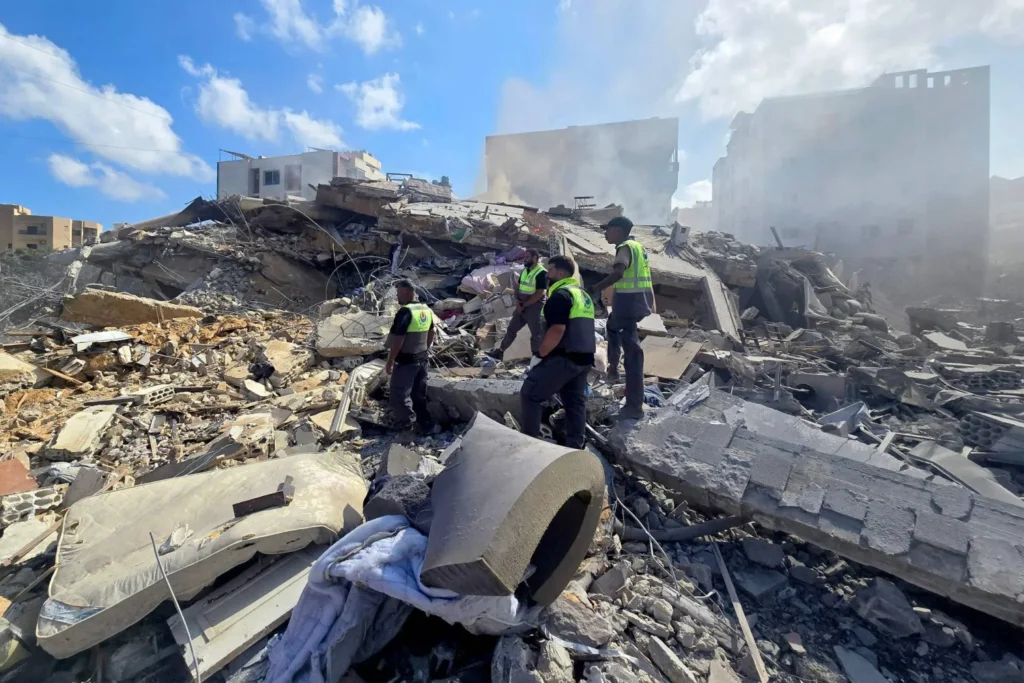
An Israeli airstrike killed 12 people in the eastern Lebanese village of Mashghara late Monday, rescue workers confirmed as they pulled bodies from the rubble overnight, while Israeli Prime Minister Benjamin Netanyahu ordered an intensification of military operations across Lebanon and the army called up an additional battalion — all of it happening three days before Israeli and Lebanese military delegations are scheduled to sit across from each other in Washington for direct talks.
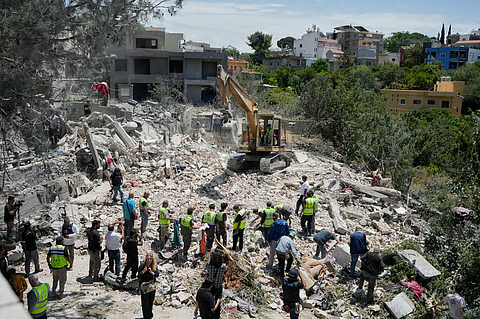
The strike hit Mashghara in the Bekaa Valley, Lebanon’s state-run National News Agency confirmed. The Israeli military did not comment specifically on the Mashghara strike but said Monday it was targeting Hezbollah infrastructure in eastern Lebanon. An Israeli security official, speaking on condition of anonymity in line with military regulations, confirmed the additional battalion had been called up without providing further details.
Netanyahu had set the tone hours before the strike, posting a video statement on Telegram in which he announced he had authorized a sharper escalation of Israeli operations against Hezbollah across the country.
“I have ordered an even greater acceleration of our operations,” Netanyahu said. “What this requires of us now is to increase the blows, to increase the intensity. We will smite them hip and thigh.”
Hezbollah Fires Back
The escalation was not one-directional. Hezbollah said it carried out multiple strikes Monday against Israeli military positions in the north, framing the attacks as a direct response to what it characterized as Israeli ceasefire violations. The group claimed responsibility for at least four drone attacks on the Shomera barracks, as well as separate strikes on two other barracks in northern Israeli towns and an attack on a military post in Misgav Am. All were carried out around midday at short intervals.
Hezbollah said it would continue fighting until Israel halted its daily airstrikes and withdrew its troops from Lebanese soil. In recent weeks, the group has publicly promoted its use of fiber-optic drones, a newer guidance technology that Israeli forces have struggled to intercept. Hezbollah said those drones have successfully hit both Israeli troops and border villages in northern Israel.
Israel, responding to the drone threat, updated its defensive guidelines in northern areas, instructing residents not to gather in large groups.
Talks Scheduled, War Intensifying
The widening violence is set against a diplomatic backdrop that would appear to make this moment one of the least conducive to escalation. Lebanese and Israeli military representatives are due in Washington for direct talks in three days, the first direct military-to-military engagement between the two countries in the current conflict. The Lebanese government has expressed hope that the talks will produce a ceasefire framework. Hezbollah has openly opposed the talks and has not committed to honoring any outcome they might produce.
Lebanese President Joseph Aoun defended his decision to participate in the Washington process Monday, saying his demand for a complete Israeli withdrawal from southern Lebanon remained non-negotiable. Israel has maintained a border strip of Lebanese territory it describes as a necessary buffer zone for northern Israeli communities.
The combination of an Israeli escalation order, a battalion call-up, and twelve people killed in the Bekaa Valley on the eve of those talks does not suggest either side is treating the upcoming Washington meeting as a reason to hold fire in the meantime.
A Million Displaced, a City on Edge
Lebanon has been living under the weight of this war since Hezbollah fired rockets into northern Israel on March 2 in a declaration of solidarity with Iran, drawing Israeli bombardment that has continued without interruption since. More than a million people have been displaced across the country. The Lebanese Health Ministry counted at least 3,185 people killed in Israeli strikes since the war began, with more than 9,600 wounded.
The intensification of Netanyahu’s language Monday, and the strikes that followed, sent a wave of anxiety through Beirut. In the capital’s Hamra neighborhood, Tony Aboud captured the psychology of a civilian population that has learned to measure its fear in press conferences.
“By just saying a few words on TV he causes everyone to panic and flee their homes,” Aboud said. “I don’t know what’s going to happen and how long we can live like this.”
Israel has updated its guidance to northern residents not to congregate in large gatherings, a precautionary posture that signals the military expects Hezbollah to continue launching attacks against Israeli territory even as the Israeli air campaign presses deeper into Lebanese territory.
Escalation Before Negotiation
The timing of Netanyahu’s escalation order, coming days before Washington talks that both governments have publicly committed to attending, reflects a negotiating logic that has characterized Israeli military strategy across multiple conflicts: arrive at the table from a position of demonstrated military dominance rather than from one of suspended operations.
From Israel’s perspective, the calculus is straightforward. Hezbollah has not agreed to disarm, has not stopped firing, and has publicly rejected the Washington talks. Continuing to strike Hezbollah infrastructure before those talks reinforces Israel’s leverage by showing that restraint is not being offered in exchange for a seat at the table. Whatever agreement emerges, if any does, will need to address the security concerns that Israeli military commanders are trying to resolve by force right now.
From Lebanon’s perspective, the logic runs in reverse. A government trying to negotiate a ceasefire while the country it governs is absorbing escalating Israeli strikes faces a domestic credibility problem that intensifies with every strike. Lebanese President Aoun is asking his people to trust a diplomatic process with a country that is simultaneously killing Lebanese civilians and calling up additional troops. The harder Israel hits before Washington, the harder it becomes for the Lebanese government to defend the talks to a traumatized public.
Hezbollah, watching from outside the diplomatic process it has rejected, has its own strategic interest in the escalation: every Israeli strike that kills civilians in the Bekaa Valley strengthens Hezbollah’s argument that Israel cannot be negotiated with and that armed resistance is the only language the Israeli government respects. The more violent the prelude to Washington, the weaker the Lebanese government’s negotiating position looks, and the stronger Hezbollah’s case for resistance becomes.
Twelve people died in Mashghara Monday night while all of this was being calculated in Jerusalem, Beirut, and Washington. Their names have not yet been released.
AP/Euronews/EnglishAawsat





