

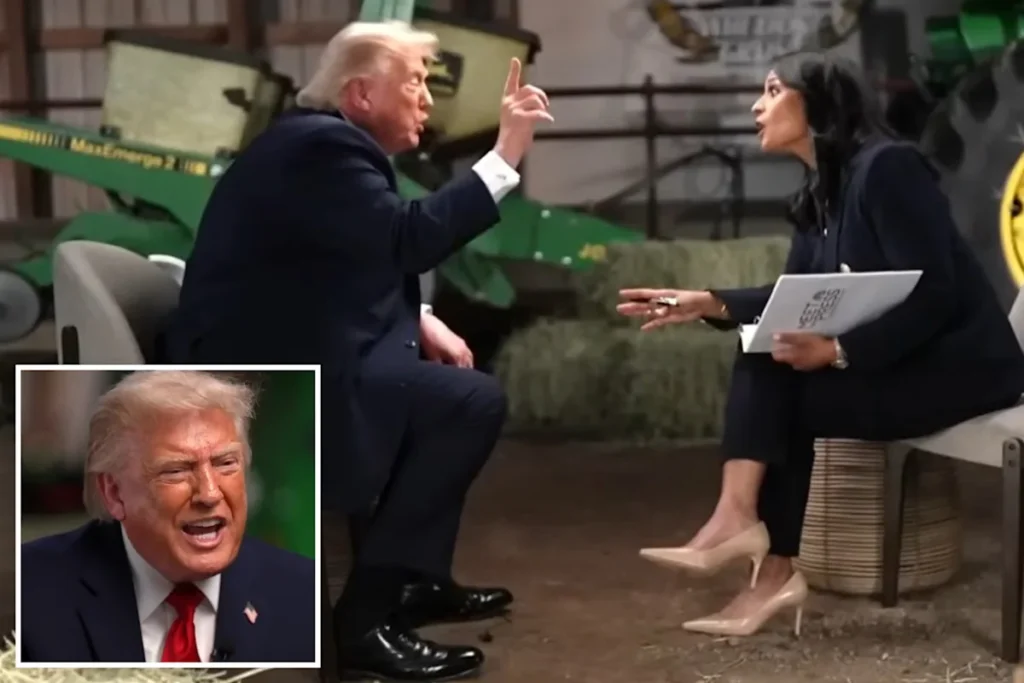
President Donald Trump abruptly ended a televised interview with Kristen Welker on NBC’s Meet the Press after a heated exchange over his continued claims about the 2020 election and a controversial proposal involving federal funds.
The interview, broadcast Sunday, grew tense as Welker pressed Trump on assertions of widespread voter fraud, claims that have been repeatedly challenged in courts and public investigations. The exchange escalated when the president dismissed the questioning and signaled he was ending the discussion.
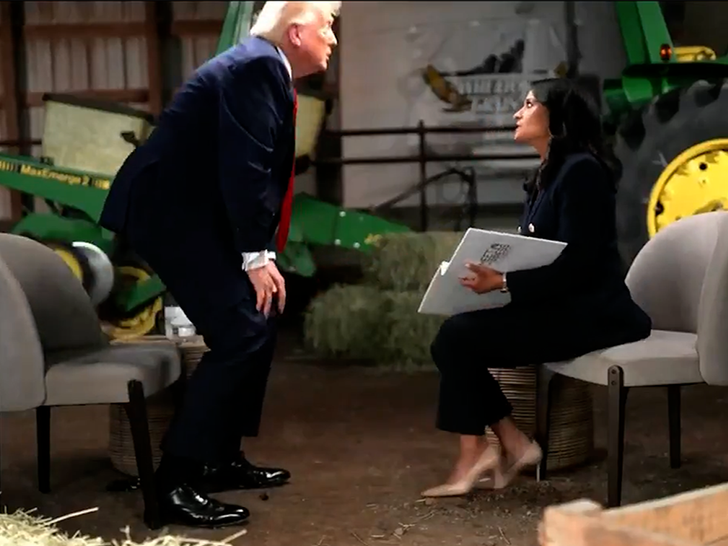
“Let’s call it quits, because I’ve had enough. Thank you, darling,” Trump said before cutting the interview short.
Earlier in the interview, Trump voiced support for a proposed allocation of nearly $1.8 billion for what he described as an “anti weaponization fund.” The initiative was intended to compensate individuals prosecuted by the Justice Department during the administration of Joe Biden, including those involved in the events of January 6.
Trump indicated he would welcome congressional approval of the measure and expressed disappointment at the prospect of it failing. He argued that many individuals targeted by federal prosecutions had suffered severe personal and financial consequences.
“If it was up to me, I’d pay them the kind of money that they deserve,” Trump said during the recorded segment.
However, the proposal has faced resistance on Capitol Hill. Lawmakers from both parties raised concerns, and administration officials later indicated the plan would not move forward. Government attorneys also confirmed in court filings that the proposal would not be revived.
The interview turned confrontational when Welker questioned Trump about evidence supporting his election fraud allegations. Trump responded with personal criticism of the interviewer, intensifying the tone of the discussion.
He also revisited grievances over federal investigations into his handling of government documents after leaving office, including the search of his Mar a Lago residence, which he described as excessive.
“They went after me more than anybody else,” Trump said, linking the investigation to broader claims of political bias.
Beyond domestic issues, Trump addressed foreign policy, including the ongoing conflict involving Iran. He suggested that military action could be used to eliminate nuclear material if diplomatic efforts fail, while maintaining that negotiations remain possible.
He rejected suggestions that recent actions contradicted his previous opposition to prolonged conflicts, stating that the current situation would not become an extended war.
The funding proposal tied to January 6 prosecutions has triggered divisions among Republican lawmakers. Some have warned that attaching such a measure to broader legislation could jeopardize its passage.
Representative Brian Fitzpatrick publicly opposed the idea, stating that support for the proposal was not sufficient to advance it. Former Senate Republican leader Mitch McConnell also criticized the concept, describing it in stark terms during internal party discussions.
Democratic leaders, including Senate Majority Leader Chuck Schumer, pointed to the dispute as evidence of internal divisions within the Republican caucus.
The abrupt end to the interview highlights the continuing sensitivity surrounding the 2020 election and its aftermath. Trump’s insistence on revisiting disputed claims keeps the issue central to his political messaging, even as legal and institutional challenges have repeatedly undercut those assertions.
The proposed compensation fund introduces another layer of controversy. While framed by supporters as a corrective measure, critics view it as an attempt to redefine accountability tied to January 6. The strong reaction within Congress suggests that even among allies, there are limits to how far such proposals can advance.
The clash also underscores the evolving relationship between political leaders and major media platforms. High profile interviews remain a key avenue for public communication, but increasingly serve as arenas for direct confrontation rather than traditional question and answer exchanges.
Taken together, the episode reflects a broader political environment marked by deep divisions, where policy debates, legal disputes and media dynamics intersect in ways that shape both public perception and legislative outcomes.
TheIndependent




