

The Nigerian government flew home its first batch of citizens from South Africa on Thursday, launching a government-backed evacuation effort that has exposed a sharp diplomatic rift between two of Africa’s most populous nations and drawn renewed attention to the worsening treatment of foreign nationals in South Africa’s volatile immigration climate.
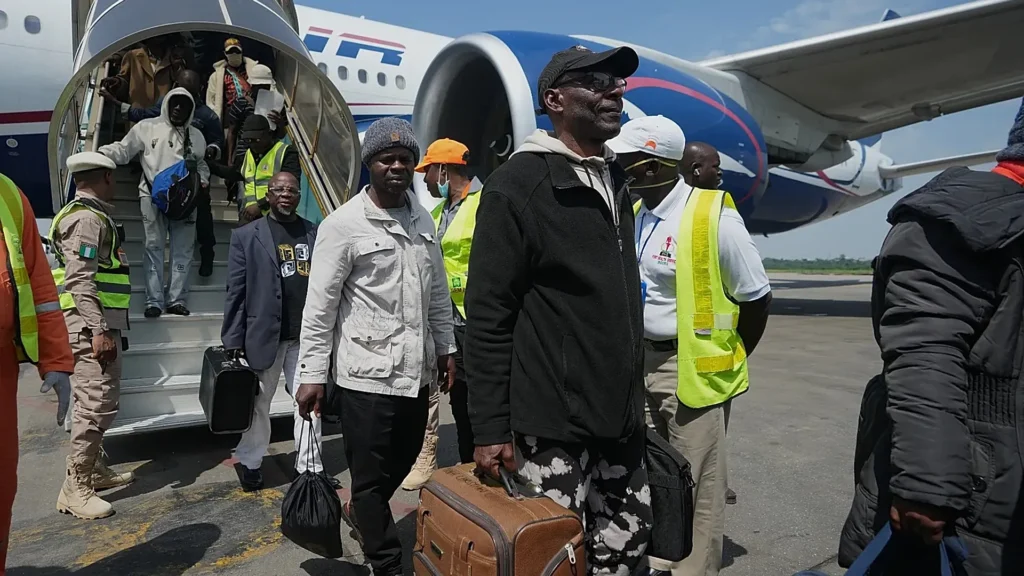
A chartered Air Peace flight carrying 262 passengers and three government officials touched down in Lagos, according to Nigeria’s Ministry of Foreign Affairs, marking the opening move in what officials described as a broader rescue operation for Nigerians who said they feared for their lives amid a fresh wave of anti-immigrant violence. More than 1,000 Nigerian nationals had registered for voluntary return, the ministry confirmed.
What We Know So Far
The repatriation followed weeks of intensifying anti-immigration protests across South Africa that began in April and escalated into physical attacks on foreign nationals in several areas. South African officials acknowledged the protests but have stopped short of labeling them a systemic crisis, even as multiple African governments moved to extract their citizens.
South Africa’s Home Affairs Department confirmed that 586 Nigerians had been processed for repatriation after being classified as undocumented. A second flight was scheduled for the following Monday. Home Affairs Minister Leon Schreiber confirmed that those removed were issued emergency travel documents through the Nigerian High Commission and were officially designated as undesirable persons, a legal classification that bars them from re-entering South Africa for five years.
Among those who arrived Thursday was Emilia Godwin, a 45-year-old mother who told TheCable she had lived in South Africa since 2014 but said she endured years of discrimination, physical intimidation, and bureaucratic harassment before the Nigerian government’s intervention gave her a way out.
“I am still saying it now that I am in my country and I have my mouth to speak — they are wicked. They don’t like us,” Godwin told reporters after landing.
She described conditions aboard public transport and in daily life as deeply hostile, alleging that Nigerians were routinely mocked, pulled, and beaten. “We are just like slaves there. We don’t have a mouth to talk,” she said.
Godwin also revealed that immigration officials at Johannesburg’s Oliver Tambo International Airport subjected her to prolonged questioning about her daughter’s parentage before allowing her to board. It took direct intervention from her brother, a staffer at the Nigerian Embassy in Johannesburg, to clear her departure, she said.
What Authorities Are Saying
Nigerian Foreign Minister Bianca Odumegwu-Ojukwu framed the evacuation as a presidential directive to protect citizens whose safety could no longer be guaranteed. “The price of your peace and the safety of your children is worth any sacrifices you have to make, or any assets you have to leave behind when fleeing a conflict zone or hate-infested environment,” she said in a statement directed at returnees.
Humanitarian Affairs Minister Bernard Doro pushed back against South Africa’s characterization of the departing Nigerians as illegal immigrants. “If there were issues of illegality, that would be determined on a person-to-person basis. You cannot just crown the entire Nigerians living in South Africa as living there illegally,” Doro told reporters.
South Africa’s Home Affairs Minister Schreiber maintained that those removed had violated immigration law and urged all foreign nationals to keep their status current. “Foreign nationals must ensure that their immigration status remains compliant with South African immigration laws at all times and to regularize their stay,” he said.
Some returnees, however, offered a more complicated picture. Several told the Associated Press they had been unable to renew their residency papers for years, not because they ignored the law, but because of what they described as deliberate bureaucratic obstacles placed specifically in the path of Nigerian applicants.
“I was in South Africa for 11 years, and I was treated badly. They did not give us resident permits because we were Nigerians,” returnee Eminaba Beatrice told the AP.
Sahara Reporters covered additional testimony from returnees describing systematic targeting and abuse.
Why This Matters
Nigeria’s evacuation is not an isolated diplomatic gesture. It follows Ghana’s repatriation of approximately 1,000 nationals from South Africa, most of whom South African officials also classified as undocumented. Liberia’s President Joseph Boakai, as local media reported, said his government was prepared to take similar steps if the safety of Liberian nationals could not be assured.
The wave of repatriations points to a structural breakdown in how South Africa manages its relationship with other African nations at a time when the country’s ruling government has struggled to address unemployment rates that remain among the highest in the world. Anti-immigrant sentiment in South Africa has historically surged during periods of economic stress, with foreign traders and workers frequently accused by local activists of displacing South African job seekers.
What distinguishes the current crisis from previous xenophobic episodes is the scale of the diplomatic response. Never before have three separate African governments simultaneously organized state-sponsored evacuations from South Africa’s shores. That coordinated reaction signals not just humanitarian concern, but growing frustration among African governments with Pretoria’s handling of a problem that has simmered for more than a decade.
From an economic standpoint, the implications are significant. Nigerian entrepreneurs and traders form a substantial part of the informal commercial network in South African cities, particularly in Johannesburg’s central business district. Their departure, even if partial, removes spending power, business activity, and tax revenue from local economies. More critically, it accelerates a reputational cost for South Africa as a destination for African investment and labor mobility, at a time when the continent is supposed to be moving toward deeper economic integration under the African Continental Free Trade Area agreement.
What Happens Next
A second group of Nigerians is expected to depart South Africa on Monday, the Home Affairs Department confirmed. With more than 1,000 Nigerians registered for voluntary return and 586 already processed, the full scale of the evacuation remains unresolved.
The five-year re-entry ban placed on those removed adds a punitive dimension that Nigerian officials are likely to challenge through diplomatic channels. Whether Abuja will escalate the matter to the African Union or pursue bilateral pressure on Pretoria remains to be seen, but the public posture of both foreign ministers suggests the two governments are operating from fundamentally different narratives about the same crisis.
For returnees like Emilia Godwin and Eminaba Beatrice, the diplomatic language matters far less than the lived reality they left behind. Both women said they had no plans to return. Their testimonies, gathered independently by TheCable, the Associated Press, and Sahara Reporters, form a human record of a crisis that statistics alone cannot fully capture.
What South Africa does next, whether it accelerates deportations, eases documentation bottlenecks, or engages its neighbors in formal dialogue, will determine whether this moment becomes a turning point or simply another chapter in a long and unresolved story.
AP/SaharaReporters/Euronews




