

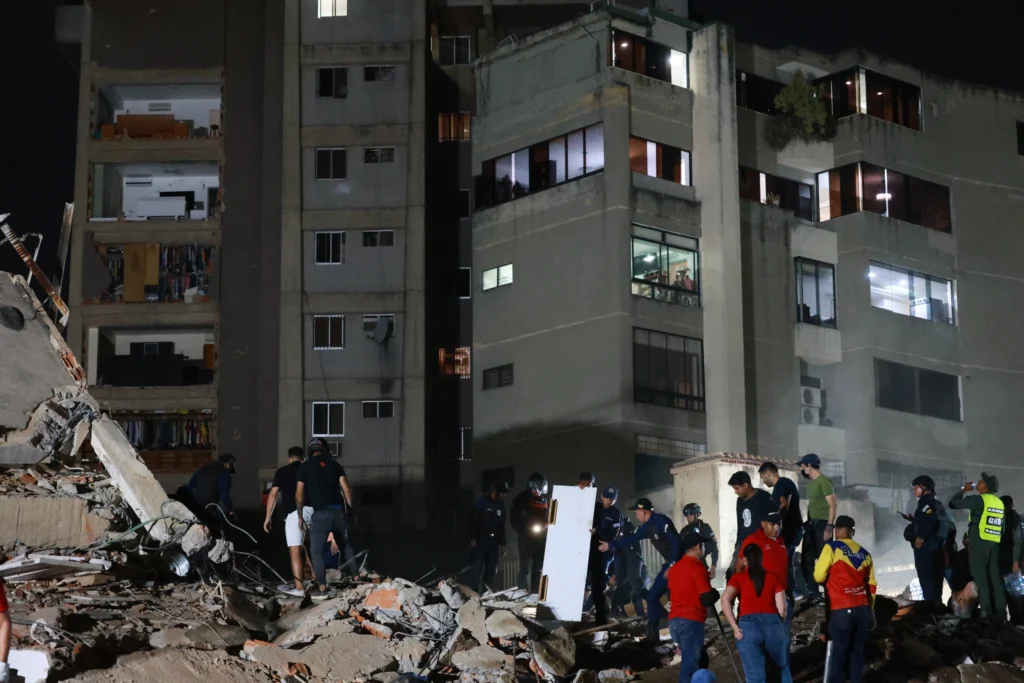
Two powerful earthquakes struck Venezuela’s Caribbean coast within seconds of each other Wednesday evening, killing at least 32 people, injuring more than 700, and collapsing buildings across multiple states in the worst seismic disaster to hit the South American nation in more than a century.
Acting President Delcy Rodriguez declared a state of emergency late Wednesday and warned that the confirmed death toll did not yet include casualties from La Guaira state, the hardest hit area, where dozens of buildings had collapsed and rescue operations were still in their early stages.
The full scale of the disaster remained unknown Thursday morning.
What We Know So Far
The U.S. Geological Survey confirmed two separate earthquakes struck in rapid succession shortly after 6 p.m. local time. The first registered a magnitude of 7.2, with its epicenter west of Moron on Venezuela’s Caribbean coast, approximately 168 kilometers west of Caracas, at a depth of 22 kilometers. The second, measuring 7.5, struck less than a minute later with its epicenter 16 kilometers southwest of Moron at a depth of 10 kilometers, the Associated Press confirmed.
The twin strikes were among the strongest to hit Venezuela since 1812, when an estimated 30,000 people were killed in earthquakes that devastated Caracas and Merida, according to USGS historical records.
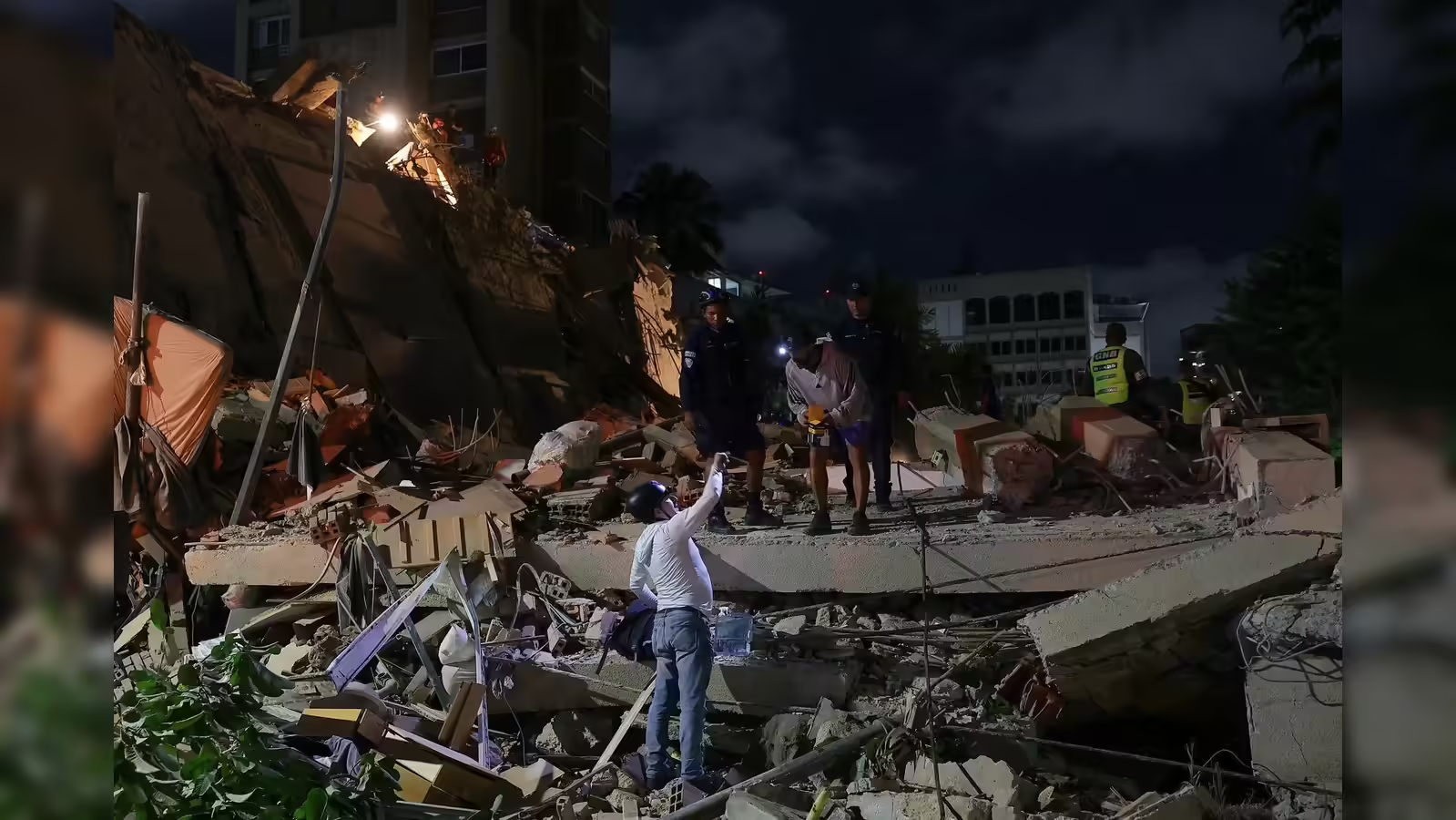
Rodriguez confirmed in an address shortly before 1 a.m. Thursday that the preliminary toll of 32 dead and 700 injured excluded La Guaira entirely. “Dozens of buildings have collapsed, and we are currently carrying out very intense rescue efforts to save as many lives as God allows us to save,” she said on state television.
Three children, covered in dust but alive, were pulled from rubble in La Guaira in footage broadcast early Thursday by Venezuelan state broadcaster VTV. Images also showed a hospital in the city of Tucacas, roughly 200 kilometers northwest of Caracas, with visible structural damage and medical personnel gathered outside.
The earthquakes shut down Simon Bolivar International Airport near Caracas, suspended subway services, and cut natural gas supply to the capital. Parts of Caracas lost power and cellphone signal, deepening the distress of families trying to locate relatives. Rodriguez said school classes would be canceled for several days and that some school buildings would serve as emergency shelters and donation centers.
In Falcon state on the coast, Governor Victor Clark confirmed 32 people had been hospitalized and 15 remained trapped in the hours immediately after the quakes. Nearly two dozen aftershocks followed the initial strikes, the Venezuelan Red Cross said, adding that its own headquarters had sustained critical damage and that strong aftershocks were posing additional risks to rescue teams working in the field.
The tremors were felt as far as Brazil’s Amazon region, roughly 1,700 kilometers from Caracas. Buildings were evacuated in the Brazilian cities of Manaus, Belem, and Macapa, according to TV Globo. The quakes were also detected across Colombia’s Caribbean and northeastern regions, though no injuries or structural damage were reported there.
The U.S. Pacific Tsunami Warning Center issued tsunami alerts following the earthquakes but lifted them quickly after the threat passed.
What Authorities And Officials Are Saying
Rodriguez addressed the nation with a message of solidarity and urgency. “I also want to say that this is a true tragedy. From here, we send our message of solidarity, and to those families who have lost loved ones, we reaffirm our condolences and our support in these difficult hours,” she said.
Interior Minister Diosdado Cabello urged motorists to clear the way for emergency vehicles and cautioned residents to remain outside given the risk of further structural collapses from aftershocks. “Be very careful with children and the elderly. Call each other and check that no one has been harmed,” Cabello said.
Rodriguez said Qatar had already dispatched rescue personnel expected to arrive the following day, alongside teams from Mexico and El Salvador. U.S. Secretary of State Marco Rubio announced on X early Thursday that the United States was immediately deploying search and rescue teams, medical resources, and humanitarian assistance to Venezuela. Jeremy Lewin, the U.S. undersecretary of state for foreign assistance, said a disaster assistance team and task force had been mobilized to coordinate aid with Venezuela’s interim government.
Offers of support came from Argentina, Bolivia, Brazil, Chile, Ecuador, El Salvador, Mexico, Panama, and Uruguay. El Salvador President Nayib Bukele posted on X: “We send you all our solidarity and our prayers. Stay strong, Venezuela.” Ecuadorian President Daniel Noboa ordered the immediate delivery of humanitarian aid, writing that “humanity must always guide the actions of a leader.” Bolivian President Rodrigo Paz said his country stood ready to assist despite having declared its own state of emergency less than a week earlier following anti-government protests at home.
Venezuela’s Red Cross warned in a statement that “damage assessments remain preliminary, and the full human impact is not yet known,” and said its teams were actively supporting search and evacuation efforts while delivering relief supplies despite the damage to their own facilities.
Rodriguez said she had spoken by phone with Rubio and expressed gratitude to leaders including Trump, though she did not disclose details of the conversation.
USGS Death Toll Projections
Beyond the confirmed figure, the scale of the potential disaster emerged in sharp relief from projections released by the USGS PAGER system, an automated modeling tool that uses seismic data and population exposure to estimate fatalities and economic impact based on historical earthquake patterns.
Updated modeling released Thursday showed a 39 percent likelihood that the final death toll would fall between 1,000 and 10,000, Reuters confirmed. A further 37 percent probability was assigned to a death toll between 10,000 and 100,000. Earlier projections had shown a 30 percent chance of deaths exceeding 100,000, a figure that was revised downward as more data became available.
The USGS estimated economic losses equivalent to between one and four percent of Venezuela’s gross domestic product.
Those projections carry significant weight given how slowly official casualty figures emerged in the hours after the quakes. Rodriguez herself acknowledged that the La Guaira figures, which could substantially alter the total, had not yet been incorporated into early counts.
Why This Matters
Venezuela’s vulnerability to this disaster is not simply geological. The country sits at the convergence of the Caribbean and South American tectonic plates, a seismically active boundary that has historically generated destructive earthquakes, including the catastrophic 1812 event and a 1967 quake that killed 240 people in central Caracas.
But the human cost of Wednesday’s earthquakes will be shaped as much by Venezuela’s pre-existing crisis as by the geology beneath it. The country has endured years of severe economic deterioration, infrastructure collapse, and mass emigration. More than 7.7 million Venezuelans have left the country during its protracted political and economic crisis, and those who remained have been living with a healthcare system, communications network, and emergency response capacity all operating well below their intended function.
Opposition leader Maria Corina Machado, in exile after leaving Venezuela in December to accept the Nobel Peace Prize, posted on X urging strength and solidarity. Former opposition presidential candidate Edmundo Gonzalez, exiled in Spain, went further. “The rescue teams, the healthcare system, the communication systems arrive at this tragedy destroyed,” Gonzalez wrote on X. “Venezuela will need international support. And it will need it because its own state has abandoned it.”
Venezuela holds the world’s largest estimated oil reserves, but Reuters confirmed that initial assessments suggested the country’s oil infrastructure had not been immediately affected. Authorities in Maracaibo, near the critical Lake Maracaibo oil hub, reported no injuries. British oil firm Shell said all its Venezuelan employees were accounted for with no injuries. The country’s oil ministry, state oil company PDVSA, and its main foreign partner Chevron did not immediately respond to requests for comment. One industry source noted that extended power outages could affect crude output until electricity was restored.
What Happens Next
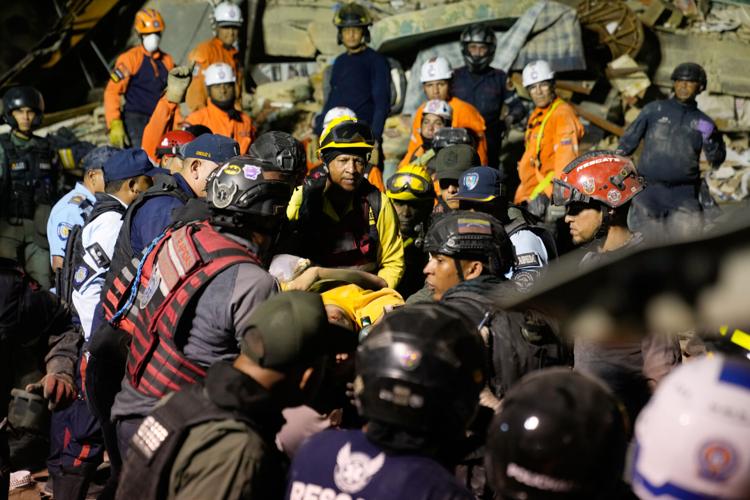
Search and rescue operations were continuing Thursday across La Guaira, Caracas, and multiple other states. International teams from Qatar, Mexico, and El Salvador were expected to arrive within 24 hours, with additional offers of assistance pending coordination between Caracas and foreign governments.
Rodriguez said aftershocks remained a serious concern and urged all residents to stay outside structurally damaged buildings until safety assessments could be completed. The Venezuelan Red Cross confirmed that strong aftershocks were ongoing and complicating rescue efforts.
The airport closure and the disruption to the capital’s communications and transport networks will slow the delivery of international assistance and the gathering of accurate casualty information from the hardest-hit areas in the days ahead.
With official figures still excluding La Guaira at the time of initial reporting, and with USGS modeling projecting a probable final toll running into the thousands, what is already Venezuela’s gravest natural disaster in over a century appears likely to deepen before a clearer picture emerges.
Reuters/AP




