

At least 36 civilians were killed and more than 160 others were wounded in overnight Pakistani airstrikes in eastern Afghanistan, Afghan officials said Monday, while Pakistan said its military operation targeted militant hideouts along the shared border following a series of deadly attacks inside its territory.
The latest exchange marked another sharp escalation between the neighboring countries, whose relations have deteriorated in recent months amid repeated cross border military operations and failed diplomatic efforts to restore calm.
Afghanistan’s Taliban administration accused Pakistan of carrying out strikes against civilian areas and condemned the attacks as an act of aggression.
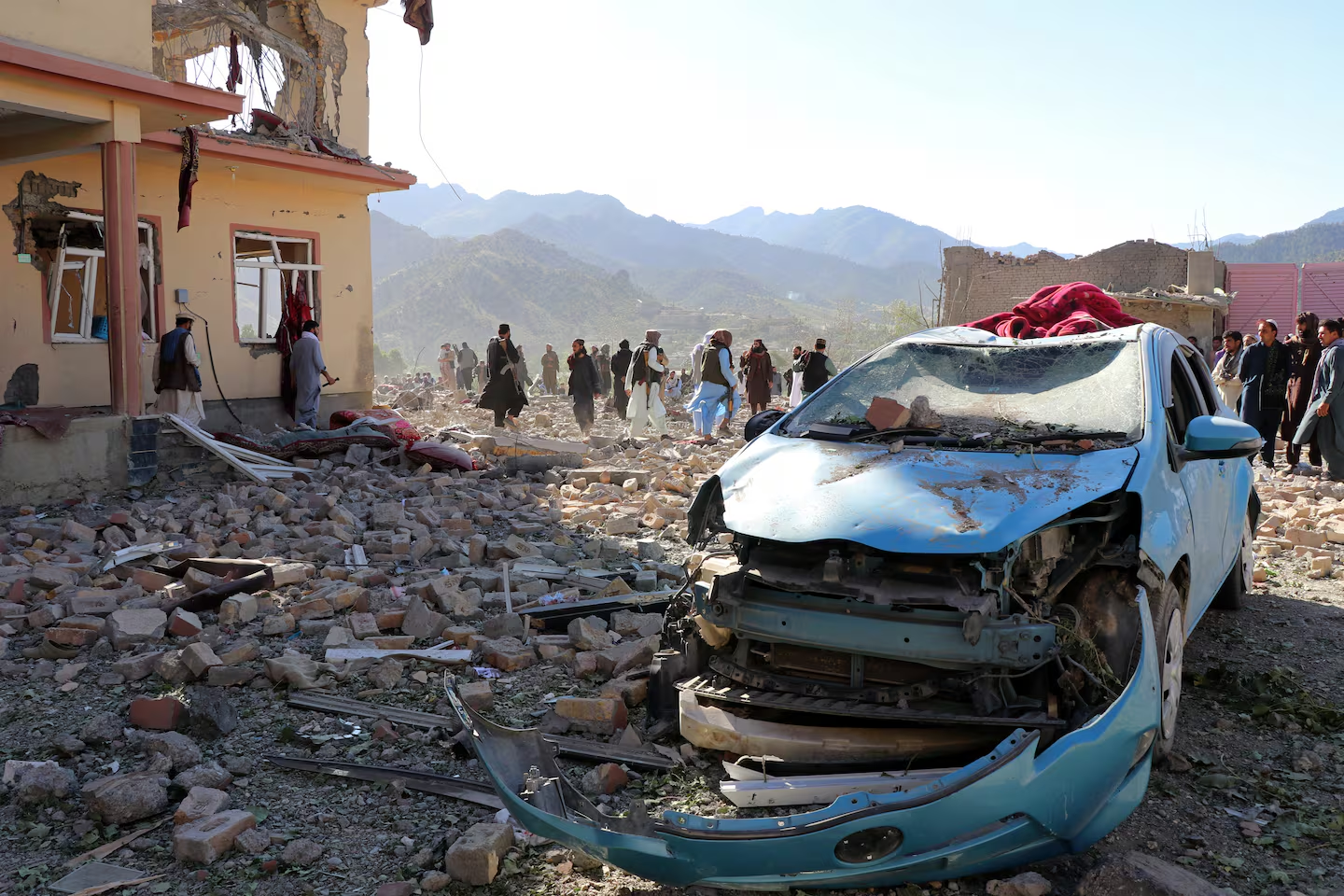
Hamdullah Fitrat, deputy spokesman for the Taliban government, said Pakistani forces first struck a home in the Chamkani district of Paktia province, killing an elderly man and a child and injuring several members of the same family.
He said residents rushed to the scene to rescue survivors before another strike hit the gathering, killing 28 villagers and wounding 158 others.
According to Fitrat, another strike targeted a home in Giyan district in Paktika province, where six people, most of them women and children, were killed.
He added that a separate strike hit a civilian home in Kunar province, causing no human casualties but killing about 30 livestock.
Pakistan presented a sharply different account of the military operation.
Information Minister Attaullah Tarar said Pakistani security forces carried out coordinated ground operations along the border late Sunday before launching strikes against what he described as militant hideouts and safe havens.
Tarar said the operation killed 29 militants and was conducted in response to multiple attacks carried out by armed groups inside Pakistan.
The Pakistani operation followed an attack on the regional headquarters of the paramilitary Rangers in Karachi that killed three soldiers.
Pakistan’s military said security forces killed three attackers and arrested another suspect, who it identified as an Afghan national. Officials said the suspect was wounded during the operation.
Jamaat ul Ahrar, a faction that split from the Tehrik e Taliban Pakistan, claimed responsibility for the Karachi assault.
Pakistan has faced a steady rise in attacks targeting police officers, soldiers and security installations in recent years. Authorities have consistently blamed the Tehrik e Taliban Pakistan and allied militant groups for much of the violence.
Although the Tehrik e Taliban Pakistan operates separately from Afghanistan’s Taliban rulers, the two groups maintain ideological and historical ties, an issue that has remained a major point of tension between Islamabad and Kabul.
Sunday’s military operation came less than three weeks after Pakistan launched another series of airstrikes against locations it identified as militant bases inside Afghanistan.
Those strikes ended roughly a month of relative calm following an earlier period of heavy fighting that Pakistani officials described as an open war between the neighboring countries.
The conflict has intensified despite repeated diplomatic efforts to reduce hostilities.
Since February, hundreds of people have been killed in cross border clashes after Afghanistan launched retaliatory strikes following earlier Pakistani air attacks.
Several rounds of negotiations have failed to produce a lasting ceasefire.
China also sought to mediate the dispute by hosting talks between Pakistani and Afghan representatives in April. Beijing later announced that both sides had agreed to avoid further escalation and continue pursuing a political solution, though the latest violence has cast doubt on the durability of those commitments.
Military analysts say the continuing exchanges underscore the increasingly fragile security situation along one of Asia’s most volatile frontiers. The persistence of militant attacks inside Pakistan, combined with cross border military operations and competing narratives from both governments, has complicated efforts to restore stability. Continued escalation could also heighten humanitarian concerns for border communities and increase pressure on regional powers seeking to prevent a wider conflict.
What we know so far
Afghan officials said Pakistani airstrikes killed at least 36 civilians and injured more than 160 people in Paktia, Paktika and Kunar provinces. Pakistan said its forces targeted militant positions and killed 29 fighters during coordinated ground and air operations.
What authorities are saying
Afghanistan’s Taliban government condemned the strikes as an act of aggression and accused Pakistan of targeting civilians. Pakistan’s Information Minister Attaullah Tarar said the military operation was a response to recent militant attacks inside Pakistan, including an assault on the Rangers headquarters in Karachi.
Why this matters
The latest violence deepens an already volatile conflict between Pakistan and Afghanistan, raising concerns about regional stability, civilian safety and the effectiveness of diplomatic efforts to prevent a broader confrontation. The continued exchange of military operations also threatens to undermine border security and counterterrorism cooperation.
What happens next
Investigations into the civilian casualties are expected to continue as both governments maintain conflicting accounts of the operation. Diplomatic pressure is likely to increase as regional partners seek to prevent further military escalation and revive negotiations aimed at securing a lasting ceasefire.
The latest cross border strikes illustrate the widening gap between military objectives and diplomatic efforts in the Pakistan Afghanistan relationship. While Pakistan argues that militant sanctuaries require direct action, Afghanistan’s accusations of civilian casualties risk fueling public anger and making future negotiations more difficult. Unless both governments establish credible mechanisms for security cooperation and independent verification of border incidents, the cycle of retaliation is likely to continue, increasing instability across the region.
Story sources: The Associated Press.





