

President Donald Trump secretly left last month’s NATO summit in Turkey aboard a different military aircraft than the one the public was told he used, an operation prompted by an assassination threat from Iran, The Washington Post reported Monday.
The Associated Press said it had not independently verified the Post’s account, which relied on material the newspaper reviewed along with a U.S. official familiar with the operation and another person with knowledge of the president’s travel. Both spoke on condition of anonymity because they were not authorized to discuss the matter publicly.
Trump had traveled to the Ankara summit aboard a newly retrofitted jet gifted to the United States by Qatar. Before departing Turkey, he announced he would instead fly partway home aboard the older, legacy Air Force One, a decision he described publicly as a chance for U.S. troops in Britain to see the historic plane.
What We Know So Far
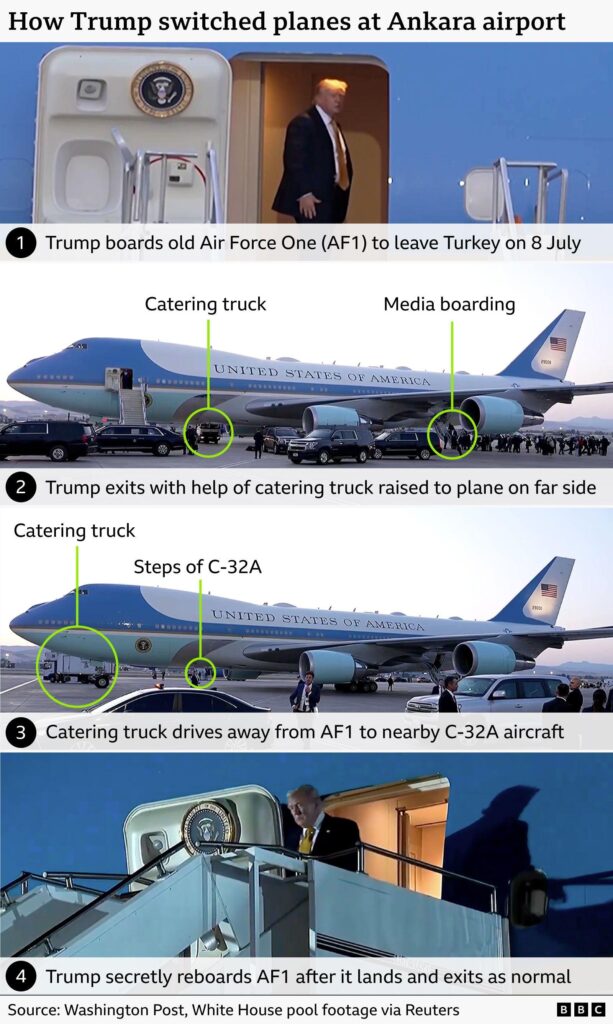
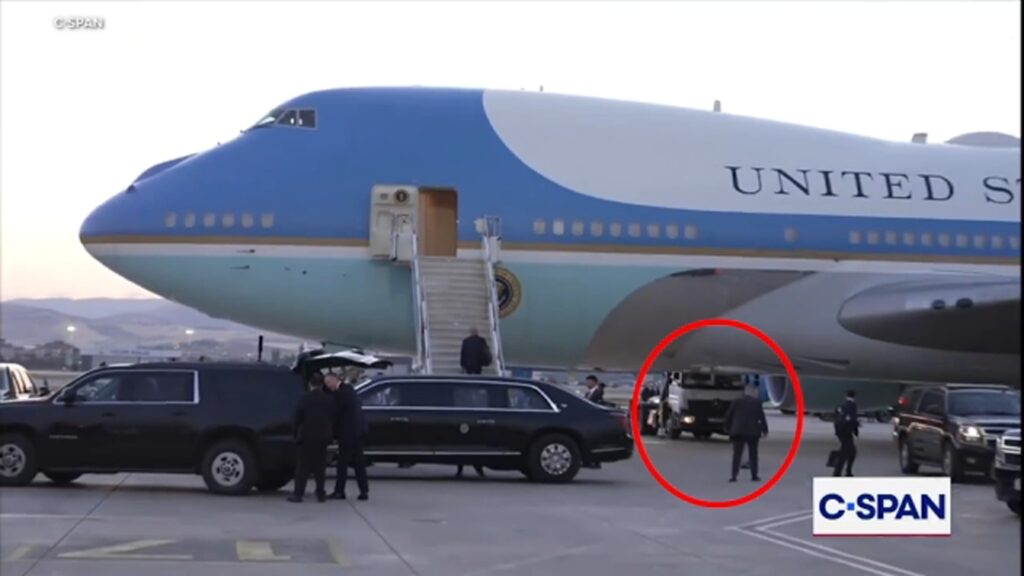
According to the Post, Trump boarded the legacy Air Force One in view of television cameras on July 8, waving to onlookers as he climbed the stairs. Minutes later, he and several aides were secretly transferred to a smaller aircraft, a military C-32A, using an elevated airport catering truck positioned on the opposite side of the plane from where journalists and staff boarded.
The catering truck, typically used to load meals before flights, was raised to the level of the aircraft door, allowing Trump to exit unseen before being driven to the C-32A parked nearby. Video reviewed by the Post showed the truck out of view for roughly 40 seconds during the transfer. Defense Secretary Pete Hegseth boarded the C-32A separately using its own external stairs, in what the Post’s source described as an effort to make the flight appear routine.
Journalists who believed they were traveling with Trump aboard the legacy Air Force One were told to lower their window shades before takeoff and were not informed of the switch, according to the Post’s reporting. The C-32A flew to Britain under the call sign “Reach 18” rather than an Air Force One designation, with tracking systems that would normally allow the aircraft to be followed in flight switched off, an aviation tracking account reported that night. The legacy Air Force One, despite not carrying the president, took on the “AF1” call sign midflight, according to publicly available tracking data.
After landing at Royal Air Force Mildenhall, news photographers captured Trump descending from the presidential plane, suggesting he had rejoined the legacy aircraft out of view of the traveling press pool before making his public appearance. He then boarded the newer Qatari gifted jet to complete the journey to Washington.
White House communications director Steven Cheung did not directly address questions about the alleged operation but said in a statement that the administration uses every tool available to address threats against the president, citing what he called Trump’s many enemies.
What Authorities Are Saying
Trump, speaking to reporters aboard the aircraft on the return leg to Washington, was asked whether there had been a credible threat from Iran involving Air Force One. “I have a threat all the time. I’m number one on their list,” Trump said, adding that any danger extended to those traveling with him as well.
Former Secret Service acting director Ronald Rowe defended the secrecy surrounding the operation, saying protective methods should remain shielded from public view even as the president’s general activities stay transparent. “We need to keep the ‘secret’ in Secret Service,” Rowe said.
Paul Eckloff, a former Secret Service special agent, said the maneuver likely reflected either specific intelligence or heightened caution given volatility surrounding the wars involving Iran and Ukraine, describing the move as unusual rather than unprecedented.
Democratic Sen. Richard Blumenthal called the episode surreal and said it warranted a congressional investigation, describing the circumstances as troubling.
Why This Matters
The operation adds significant detail to how seriously U.S. security officials treated the Iran threat during a period when American forces were actively striking Iranian targets. The maneuver occurred the night after the U.S. military renewed strikes on Iran at Trump’s direction, following the breakdown of negotiations between Washington and Tehran, underscoring how closely the security response was tied to the active conflict.
The episode also revives scrutiny of the Qatari gifted jet’s security features. Reports from The New York Times had previously indicated the aircraft lacks some defensive countermeasures found on the legacy Air Force One, including missile defense capability against heat seeking weapons, details that prompted the Trump administration to issue and later withdraw subpoenas targeting journalists in an effort to identify their sources. The administration has said the new jet meets all necessary security requirements, while critics have raised broader ethical and constitutional concerns about accepting a foreign government’s gift of an aircraft valued at hundreds of millions of dollars.
Deploying a decoy aircraft is not without precedent. A similar technique was used in 2000 when President Bill Clinton visited Pakistan, exiting a plain white jet after Air Force One had landed nearby. Officials familiar with presidential security said Air Force One has served as a decoy on other occasions over the past three decades when serious threats or dangerous destinations warranted it, since the aircraft’s high visibility can make it a liability despite its security features.
The extent of transparency the administration has since offered to the public and to other government officials about the operation remains unclear, raising questions about how many senior officials knew the president’s actual location during the hours in question.
What Happens Next
Trump’s Qatari gifted jet is expected to undergo additional security upgrades in the coming weeks, a step Trump has said was already planned before the reported Turkey operation. The administration has not said whether that timeline has shifted following renewed public scrutiny of the plane’s defenses.
Blumenthal’s call for a congressional investigation could bring further public disclosure of the operation’s details, though it remains unclear whether the White House will cooperate with any formal inquiry given its limited response to the Post’s questions so far. Continued reporting on the Iran threat and the administration’s security posture is likely as the broader conflict with Tehran remains unresolved.
Reporting drawn from The Associated Press, The Washington Post, The New York Times, CBS News and The Times of Israel




