

Ukraine launched hundreds of drones across Russia on Sunday in one of its largest aerial attacks of the war, part of an intensifying campaign against Russian military and economic targets nearly four and a half years into Moscow’s full scale invasion.
Russia’s Ministry of Defense said it destroyed 822 Ukrainian drones overnight. Moscow Mayor Sergei Sobyanin said about 600 drones were detected heading toward the Russian capital, with roughly 200 of those, about a third, destroyed over the Moscow region itself.
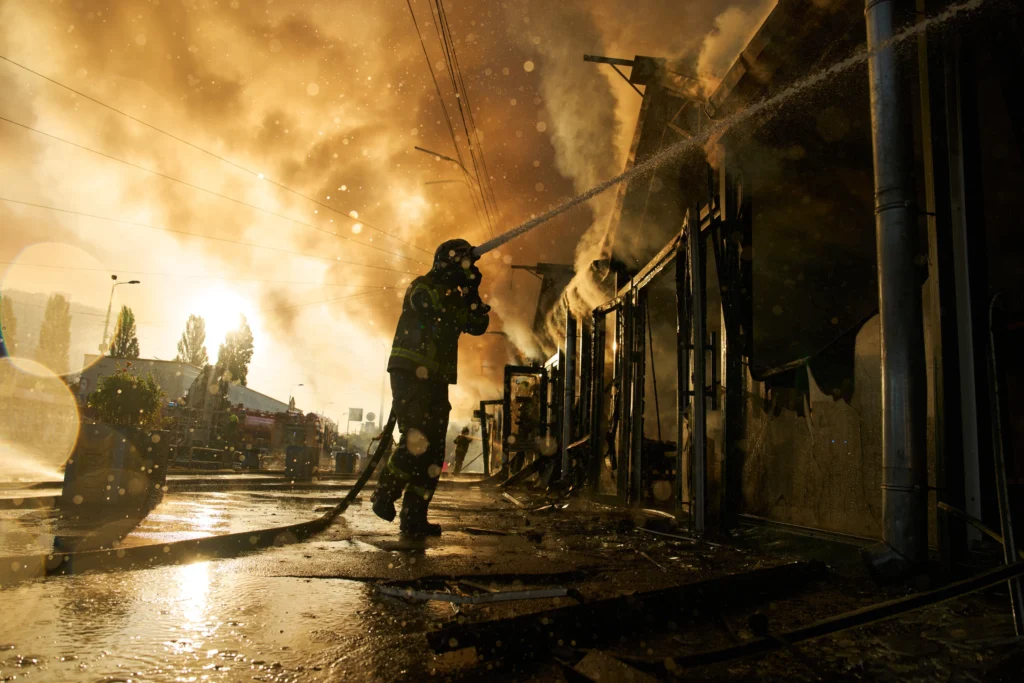
Casualty figures in Russia varied across reports and had not been fully reconciled. The Associated Press reported six deaths in Russia, while the BBC reported seven deaths nationwide. Broken down by region, the reported deaths included 1 in the Moscow region, 5 in the Rostov region, and 1 near Belgorod, a combined total of 7 that aligns with the BBC’s nationwide figure.
What We Know So Far
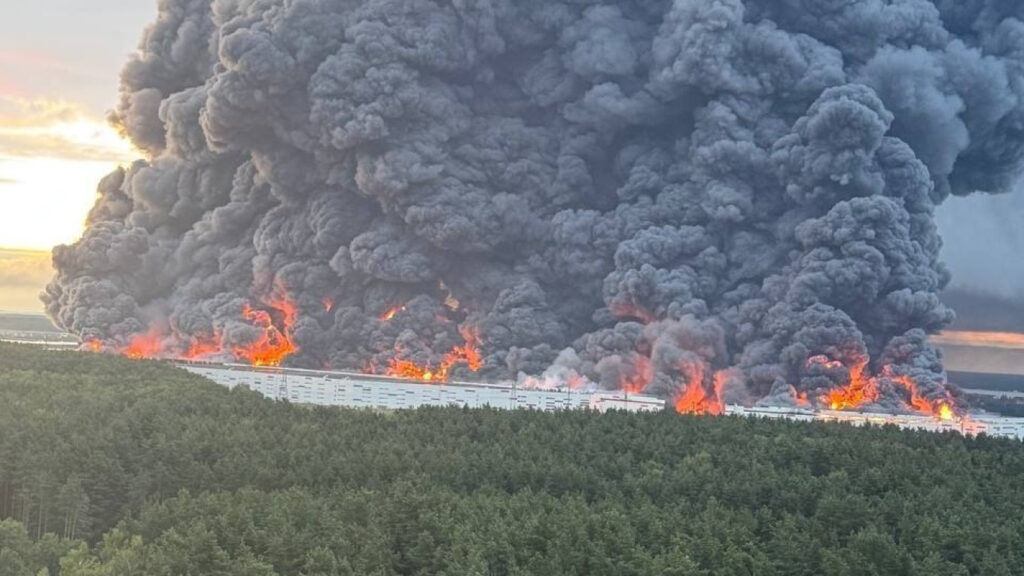
In the Moscow region, Governor Andrei Vorobyov said an 83 year old man was killed after a Ukrainian drone struck a private home, with additional injuries reported in the town of Podolsk. He also confirmed a Ukrainian strike sparked a fire at a warehouse belonging to Wildberries, Russia’s largest online retailer, in the town of Koledino. Distance estimates for the warehouse’s location relative to Moscow varied between reports, ranging from about 15 to 28 miles from the city center. Video of the aftermath showed a large plume of smoke rising over the site.
Ukraine has repeatedly targeted Wildberries facilities in recent weeks, accusing the company of handling military related goods and framing the strikes as part of a broader effort to damage Russian economic infrastructure that Kyiv says underpins Moscow’s war effort.
In Russia’s Rostov region, Governor Yury Slyusar said a drone attack involving more than 150 drones targeted three towns, killing five people, damaging homes and a railway station, and sparking a forest fire. Ukraine’s military said it also struck a missile fuel production facility in the region overnight, a claim Russia did not immediately address. A separate drone strike on a bus near Belgorod killed one person, according to the regional governor.
Russian strikes on Ukraine over the same period killed at least 5 people. Ukrainian President Volodymyr Zelenskyy said a Russian missile attack on Kryvyi Rih killed 2 people and wounded 14 others, and that 1 additional person was killed in Sumy. Ivan Fedorov, head of the Zaporizhzhia regional military administration, said 2 people, a man and a woman, died when their home was struck. Fires broke out across Kyiv, wounding 6 people, including a child, according to Kyiv Mayor Vitali Klitschko, who said air raid sirens had sounded four times since Saturday night.
The mayor of Kryvyi Rih said a 44 year old man previously reported missing was later found dead in rubble there, though it is unclear from available reporting whether this death is the same as one of the 2 deaths Zelenskyy cited for Kryvyi Rih or an additional death not yet reflected in that count. The mayor also said 14 workers at a steel plant were wounded in the same strikes, matching the 14 wounded figure Zelenskyy separately cited. Russia’s Defense Ministry said it had targeted a metallurgical plant in Kryvyi Rih, a steelworks it said was producing weapons components, the Kremenchuk oil refinery it said supplied fuel to Ukraine’s military, and several military industrial sites in Kyiv, including a manufacturing facility tied to Ukraine’s domestically produced Flamingo missiles. Russia separately said it struck a dry cargo vessel near Odesa that it claimed was carrying military equipment.
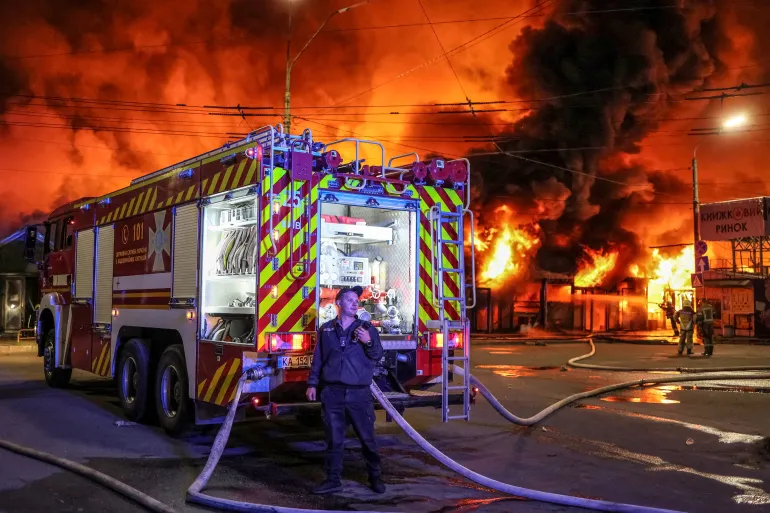
A strike on a book market in Kyiv’s Pochayna district destroyed stalls and merchandise. Valentina, 69, whose husband owned a stall there, told the BBC she recognized his books scattered on the ground and said she never expected the war to reach her family this directly. Nearby, vinyl record shop owner Luba, 42, said she lost stock worth roughly 500,000 hryvnias, describing many of the destroyed records as rare and irreplaceable.
Zelenskyy said Saturday that Ukraine had used Flamingo missiles to strike a rocket research and production center in Samara, Russia, located roughly 560 miles from the Ukrainian border, underscoring the growing range of Kyiv’s domestically produced weapons. He said 13 Ukrainian regions came under attack over the course of the week, with Russia launching more than 1,550 attack drones, nearly 1,560 guided aerial bombs and 62 missiles during that period.
NATO Jet Downs Drone Over Romania
Romania’s Ministry of National Defense said a Spanish Air and Space Force F-18 fighter jet shot down a drone that entered Romanian airspace early Sunday. Surveillance systems detected the drone at 4:44 a.m. about 15 miles north of the city of Galati, near the border with Moldova, which sits between Ukraine and Romania. The ministry said the drone had entered from Moldovan airspace and was shot down at 5:01 a.m. after the Spanish aircraft, conducting NATO air policing duties, received engagement approval. Debris fell in an unpopulated area near the Ukrainian border. Officials did not specify the drone’s origin.
Romania’s acting Foreign Minister, Oana Toiu, said the Spanish deployment supporting the country had been scaled up at the request of Romania and NATO to reinforce the alliance’s eastern flank following prior drone incidents, marking Spain’s fourth such deployment. The incident follows a string of earlier episodes, including Romanian pilots shooting down three drones over three consecutive days in recent weeks using F-16 fighter jets, part of a broader pattern of dozens of drone incursions Romania has reported since Russia’s full scale invasion began, some of which have resulted in drones crashing and exploding on Romanian territory.
Why This Matters
The scale of Sunday’s Ukrainian drone attack, among the largest of the war, reflects Kyiv’s intensifying strategy of using long range drones and missiles to target Russian military industry, energy infrastructure and logistics hubs supporting the war effort, including civilian adjacent targets like Wildberries that Ukraine says serve military supply functions. The strikes are increasingly reaching deep into Russian territory, as illustrated by the Samara strike roughly 560 miles from the border, signaling growing confidence in the range and reliability of Ukraine’s domestically produced missile systems.
Zelenskyy’s remarks characterizing Russian strikes as deliberately targeting civilian infrastructure, paired with vivid accounts from Kyiv shop owners who lost their livelihoods in the bombing, underscore how the war’s aerial phase increasingly affects ordinary economic life far from the front line, even as ground combat remains largely static along a lengthy front line with only marginal territorial changes for either side.
The Romanian drone incident adds to a growing pattern of spillover incidents affecting NATO territory near the Ukrainian border, highlighting the alliance’s reliance on rotating partner deployments, in this case Spanish fighter jets, to reinforce its eastern flank as such incursions continue.
What Happens Next
Both Russia and Ukraine appear positioned to continue trading long range strikes, with each side targeting the other’s military industrial capacity and logistics networks as ground combat remains largely stalled. Zelenskyy’s disclosure of the week’s full attack figures, including more than 1,500 drones and dozens of missiles launched by Russia, suggests the pace of aerial exchanges shows no sign of slowing.
Continued drone incursions into NATO territory near Ukraine’s borders, as seen in Romania, are likely to keep prompting alliance level responses, including further rotational deployments of partner aircraft to reinforce airspace monitoring and interception capacity along the eastern flank.
Reporting drawn from the Associated Press, The Moscow Times, Reuters and the BBC





