

The Supreme Court opened a path Monday for the Trump administration to move forward with an executive order restricting mail-in voting, though it remains unclear how much can take effect before the fast-approaching midterm elections.
The court’s 6-3 conservative majority did not rule on the legality of the order itself. Instead, it found that the 23 mostly Democratic-led states and the District of Columbia that sued lacked legal standing to challenge it at this stage, since federal agencies had not yet finalized rules to implement it when the states filed suit. “The Court’s disposition of this application does not mean that any measure taken by the Government to implement the Order will necessarily be lawful. On that score, time will tell,” the majority wrote in an unsigned order.
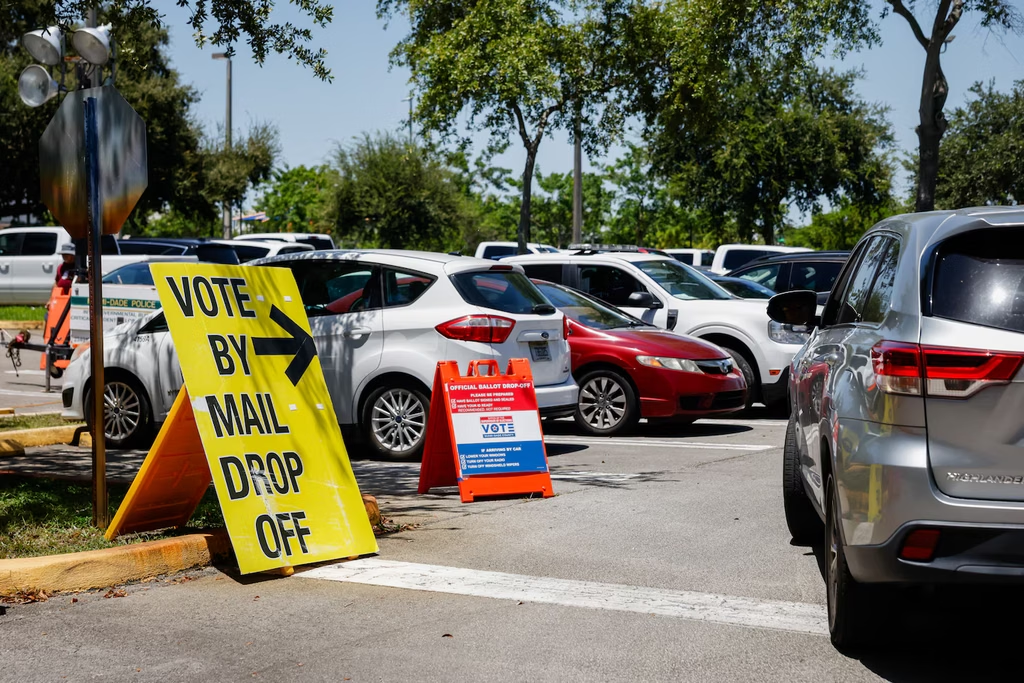
The ruling lifted a June injunction issued by U.S. District Judge Indira Talwani in Massachusetts, who had found that Trump lacked constitutional authority to direct changes in how states administer federal elections. A separate, broader injunction Talwani issued in August, blocking the Postal Service nationwide from enforcing the order’s tighter mail ballot rules in a case brought by voting rights groups, remains in place and was not addressed by Monday’s ruling.
What We Know So Far
Trump’s executive order, signed in March, directs the Department of Homeland Security to compile lists of citizens eligible to vote in each state and instructs the U.S. Postal Service to deliver mail ballots only to voters on those approved lists. It also directs the Justice Department to prioritize investigating and prosecuting election officials who issue ballots to people deemed ineligible. The Postal Service released a finalized rule implementing the order late Friday, requiring states to provide voter lists and to use unique barcodes on outbound and return ballot envelopes, with plans to make the rule official Wednesday.
The timeline is tight. North Carolina begins sending ballots to overseas and military voters on September 4, with other states following in the coming weeks. Election officials have expressed concern about implementing sweeping new procedures on such short notice, including redesigning and reprinting ballot envelopes that counties typically order a year or more in advance. Jennifer Morrell, chief executive of the Elections Group, which supports election officials nationwide, called the timing reckless given how close the changes come to the election.
The administration has relied on a federal database to determine citizenship that court records show contains incomplete and inaccurate information, and some eligible voters have had their registrations improperly revoked after being misidentified as noncitizens. Noncitizen voting does occur but remains rare; New Jersey recently disclosed it had inadvertently registered thousands of noncitizens due to a software error, including about 340 who went on to cast ballots in recent years. Research on the broader question, including a 2025 Brookings Institution study, found only about four cases of fraud out of every 10 million mail ballots cast. Roughly 30 percent of all ballots in the 2024 presidential election were cast by mail, according to federal data, a method that has grown increasingly popular among voters of both parties.
A coalition of Republican-leaning states filed a competing brief supporting the federal government, arguing states would still have input on the final voter lists used to implement the order.
What Authorities Are Saying
Justice Ketanji Brown Jackson, writing in dissent, said the ruling needlessly injects chaos and uncertainty into the midterm elections and described it as letting “another shoe drop in the Kafkaesque nightmare that our precedents have been steadily creating for certain plaintiffs who seek to bring election-related challenges.” Justice Sonia Sotomayor, joined by Justice Elena Kagan, wrote separately that states should not have to wait to challenge the order, noting that Monday’s decision did not address whether Trump’s actions to influence the 2026 elections are lawful.
New York Attorney General Letitia James called the decision a painful setback but said it would not be the final word, vowing continued legal action. Arizona Attorney General Kris Mayes said the ruling was procedural and that states would keep fighting the order, writing on social media that states, not the Postal Service or the president, run elections. California Gov. Gavin Newsom said the ruling allows the administration to move ahead for now with what he called a plan to disenfranchise voters, and said California would sue again.
Senate Minority Leader Chuck Schumer said the order was designed to make it harder for Americans to vote in pivotal elections that will determine control of Congress, and pledged Democrats would fight attempts to alter mail voting rules before November.
David Becker, executive director of the nonpartisan Center for Election Innovation and Research, said the court created chaos by waiting weeks after the administration’s filing, and just days before mail ballots go out, to rewrite the rules. Richard Hasen, a UCLA law professor who directs the school’s Safeguarding Democracy Project, called the ruling narrow and technical, predicting the underlying issue could return to the court soon and that further delay would leave states even less time to comply if the order eventually takes full effect.
Why This Matters
Mail voting has long been a target for Trump, who has claimed without credible evidence that it enables widespread fraud, including blaming it in part for his 2020 loss to Joe Biden. Studies, including the Brookings analysis cited above, have consistently found fraud involving mail ballots to be extremely rare, even as mail voting has grown more popular across the political spectrum. The Supreme Court itself previously ruled 5-4 against a Trump-backed challenge to counting ballots that arrive after Election Day, in a case decided through full briefing rather than the emergency docket used in Monday’s ruling.
Restricting mail-in voting carries direct political stakes heading into the midterms, since Democratic voters have traditionally used mail ballots at higher rates than Republican voters, meaning new restrictions could disproportionately affect Democratic turnout in a cycle where control of both chambers of Congress remains closely contested.
The order is part of a broader push by Trump to reshape federal election administration, including pressing Congress to pass the SAVE America Act, which would require proof of citizenship to register and photo identification to vote, firing members of a bipartisan federal election commission, and threatening to withhold funding from states that do not comply with new voting procedures before November. Talwani’s original ruling found that the Constitution gives states the primary role in administering elections, with Congress holding limited authority to set national standards and the president holding an even narrower role, a framework that remains central to the ongoing legal dispute even after Monday’s procedural ruling.
What Happens Next
The case returns to the lower courts, where litigation is expected to continue over both the standing question the Supreme Court addressed and the separate, still-active nationwide injunction blocking the order’s mail ballot provisions. Voting rights groups suing over the order have accused the administration of violating that injunction by publishing the Postal Service rule anyway, and asked Talwani over the weekend to declare the rule void and bar further implementation; the judge has ordered government lawyers to respond by Tuesday morning, telling them they were ignoring the confusion the rule’s publication would cause.
Given the tight window before ballots go out in North Carolina and other states, further emergency litigation is likely in the coming days. Legal experts including Hasen have suggested the core legal questions the Supreme Court avoided addressing on the merits are likely to return to the justices before the midterms are resolved, particularly if lower courts issue conflicting rulings as the compliance deadlines approach.
Reporting drawn from the Associated Press, Reuters and The Washington Post




