

The U.S. military is sending roughly 9,000 additional troops and a third aircraft carrier strike group toward the Middle East, a U.S. official told the Associated Press Thursday, as President Donald Trump again warned that new strikes against Iran remain on the table. Iranian officials, meanwhile, are privately preparing a harsher response should that happen, Reuters reported, citing sources close to the discussions.
The official, who spoke to AP on condition of anonymity to discuss sensitive military operations, said the deployment includes the USS Theodore Roosevelt carrier strike group with the cruiser USS Chosin, and the USS Makin Island amphibious readiness group, which includes the USS John P. Murtha and USS Anchorage. Together the ships carry more than 7,000 sailors and 2,000 Marines. Three carriers could be in the region as early as the end of October, the official said, which would bring the U.S. naval presence to more than 20,000 sailors and Marines along with hundreds of aircraft, an unusually high concentration of force.
AP’s reporting noted that the carriers USS George H.W. Bush and USS George Washington are already in the region, along with the USS Boxer amphibious readiness group. The Washington, typically deployed to the Pacific, was moved to the Middle East to relieve the USS Abraham Lincoln, whose crew had been at sea for more than 260 consecutive days. The Navy last had three carrier strike groups in the Middle East simultaneously in April, the first time that had happened since 2003, per AP.
What We Know So Far
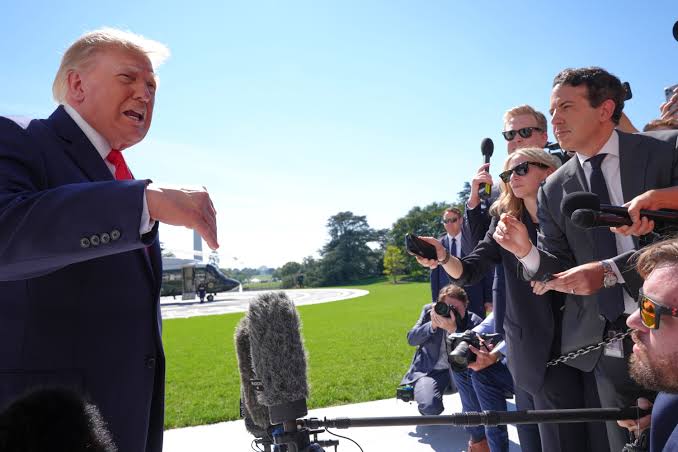
Trump told reporters at the White House Thursday that early indications suggest a link between Iran and the FlyDubai co-pilot who stabbed his captain and attempted to crash an Israel-bound flight on Wednesday, AP reported. “I would say the answer, based on what I’m hearing, is ‘yes,’ but we’re working on it right now,” Trump said. He added that the United States would retaliate if the link to Iran is confirmed. “Oh, they’ll be hit very hard, don’t worry. You just ask them. They know what happened. They’ll be hit very hard,” he said. Israeli Prime Minister Benjamin Netanyahu, in a Fox News interview cited by AP, said investigators believe the suspect underwent what he called Islamist, radical indoctrination, though he offered no further detail.
Speaking to Time magazine in an interview conducted Monday and published Thursday, Trump said it is possible he will intensify bombing in Iran after the November 3 elections, though he declined to specify targets. He told the magazine he rejected Iran’s latest ceasefire proposal, which included an offer to reopen the Strait of Hormuz, because the overall terms were not good enough, adding that positions he might have accepted a year ago no longer apply today.
Asked whether the increasingly unpopular war could hurt Republican prospects in November, Trump first said it was possible, AP’s account of his remarks showed, then argued it should help his party since preventing Iran from obtaining a nuclear weapon is a goal shared by what he called 100 percent of people worldwide.
Separately, the AP noted that British authorities announced the arrest of a 27-year-old dual UK-Iranian national in central London on suspicion of plotting a terror attack, following an earlier security incident at RAF Fairford, the U.S.-run air base in England that American bombers have used to strike Iran. British authorities have linked that base incident to Tehran. Five British men in their 20s, arrested over the weekend near Fairford on suspicion of explosives and terror offenses, have since been released on bail.
Iran Prepares a Harsher Response
Three senior Iranian officials and an insider familiar with internal discussions told Reuters that Iran’s military commanders are reviewing plans to expand potential retaliatory targets beyond U.S.-linked assets in the Middle East to include countries supporting U.S. military operations and possibly locations outside the region entirely. The planning reflects a conviction within Iran’s leadership that any renewed American campaign must be met with a stronger response than Iran has mounted previously, even as Tehran continues pursuing diplomacy it privately views as unlikely to succeed, the sources said. No final decision has been made, but planning has intensified since President Masoud Pezeshkian returned from New York last week, Reuters’ sources indicated.
Two of the officials said Iran has instructed allied groups in Lebanon, Yemen and Iraq to be ready to support a coordinated response if the U.S. launches a renewed large-scale attack, with guidance to prepare for actions ranging from the Strait of Hormuz to American interests both inside and outside the Middle East. Iran’s Foreign Ministry did not immediately respond to Reuters’ request for comment.
Hamidreza Azizi, a senior Iran analyst at the International Crisis Group, told the news agency that Tehran remains uncertain whether Trump would pursue another major campaign or more limited strikes, such as attacks on nuclear facilities. “They seem determined not to respond symbolically to a symbolic move and instead to escalate in the hope of reestablishing deterrence,” Azizi said.
Diplomatic Channel Remains Open Despite Low Odds
Even while preparing for broader conflict, Iran has kept a negotiating channel active, Reuters found. At last week’s UN General Assembly, Tehran submitted a proposal to Washington through Qatari mediators that, Iranian officials said, could reopen the Strait of Hormuz and halt regional hostilities within seven days if accepted. The proposal calls for an end to fighting, lifting the U.S. naval blockade on Iranian ports, releasing at least $12 billion in frozen Iranian funds, and waiving oil sanctions, Iranian authorities said. Trump said Saturday he had rejected the proposal, though Iranian state media reported that a U.S. response was delivered to Tehran through Qatar on Tuesday and remains under review.
Washington wants Iran’s disputed nuclear program included in the negotiations, Iranian sources indicated to Reuters, while Tehran insists nuclear talks can only begin after its seven conditions are met first, not concurrently. “Even if Iran does not reject the U.S. response outright and indirect talks continue, it is very unlikely that the two sides will reach an agreement,” one official said. Alex Vatanka, director of the Iran program at the Middle East Institute, offered a similar assessment, telling Reuters that Iran cannot afford continued U.S. blockades that could take the oxygen out of the regime’s economy, and that further escalation remains conceivable given those constraints.
The War’s Toll
The conflict, which began with U.S.-Israeli attacks on February 28, has alternated between lulls and renewed strikes over roughly seven months, killing thousands of civilians, degrading Iran’s military capabilities and damaging its economy, even though an April 8 ceasefire formally ended the initial 40-day war, Reuters’ reporting showed. For the United States, the war has not achieved Trump’s shifting stated objectives while depleting Pentagon missile stockpiles, the news agency found.
Iran and its regional allies have sought to raise the cost of the conflict for Washington by widening it geographically, disrupting oil flows through the Strait of Hormuz and increasing risk to global energy markets, per Reuters. Iran has launched drone and missile attacks against U.S. allies in the Gulf, while its Houthi allies in Yemen have targeted Saudi interests and advanced toward the Bab el-Mandeb Strait, opening a second pressure point on global energy routes and giving the group leverage over the southern entrance to the Red Sea. An insider close to Iran’s decision making process described the combined pressure of military confrontation and economic restrictions as increasingly difficult for the country’s clerical leadership to sustain.
Domestic Pressure Inside Iran
A former senior Iranian reformist official, speaking to Reuters, said the country’s leadership fears a repeat of the nationwide protests that erupted in January, when worsening economic conditions triggered unrest that authorities ultimately crushed, killing thousands of protesters. “Facing unrest at home, while the system is under U.S. pressure and bombs, could pose a very serious challenge to the legitimacy of the ruling establishment,” the official said.
As the anniversary of January’s unrest approaches, Reuters reported, Iranian authorities have tightened controls while encouraging loyalist supporters to maintain public mobilization through nightly gatherings. Rights groups say the government has intensified its crackdown on dissent during the war: Amnesty International said in May that more than 6,000 people had been arrested since hostilities began, and a September United Nations investigators’ report cited mass arrests, torture and increased use of the death penalty.
Why This Matters
The scale of the naval buildup AP’s source described, potentially reaching three aircraft carriers and more than 20,000 personnel in the region, signals that the Trump administration is preparing for the possibility of a significantly expanded campaign even as diplomatic channels remain nominally open. Iran’s parallel preparation for a harsher, more geographically dispersed response, documented in Reuters’ sourcing, suggests that any renewed large-scale U.S. strikes could trigger an escalation considerably broader than the conflict’s first seven months.
The claims linking Iran to the FlyDubai attack and the UK air base incidents, laid out in AP’s coverage, illustrate how quickly intelligence assessments are shaping public rhetoric around potential retaliation, even as investigations into both incidents continue. Iran’s internal political calculus, as Reuters’ sourcing describes it, balancing economic strain, the risk of domestic unrest, and the desire to avoid appearing weak in the face of American pressure, adds significant uncertainty to how Tehran might actually respond if the conflict escalates further.
The human rights toll inside Iran that Reuters documented, including thousands of arrests and reports of torture and expanded use of the death penalty, underscores how the external conflict has coincided with intensified internal repression, a dynamic that could further strain the legitimacy of Iran’s government even as it projects resolve externally.
What Happens Next
Trump has suggested a decision on further strikes could come after the November 3 U.S. midterm elections, AP reported, while declining to specify what form renewed action might take. Iran’s military and political leadership are continuing internal deliberations on the scope and timing of any retaliatory response, Reuters’ sources said, with no final decision made as of the latest reporting.
The fate of the Qatari mediated proposal remains uncertain, with Iran’s response to the U.S. counteroffer still under review in Tehran, according to Reuters. Given the skepticism officials on both sides expressed to the news agency about reaching an actual agreement, continued military buildup and preparation for escalation appear more likely in the near term than a diplomatic breakthrough.
Reporting drawn from the Associated Press and Reuters




