

President Donald Trump said Friday he has struck a deal with Russian President Vladimir Putin to obtain Russian diesel, a stunning reversal of years of U.S. pressure on Moscow over its war in Ukraine and an effort to ease high fuel prices weeks before the midterm elections, the Associated Press reported.
Trump announced the agreement on social media after a phone call in which he had been expected to discuss a suspected case of plague in Russia. He said Russia will immediately supply more than 300,000 tons of diesel, followed by another 500,000 tons in November and 1 million tons “immediately thereafter,” with 3 million more tons to come “within a short period of time.” More would follow, he said, “based on the condition of their diesel refineries,” which Ukrainian attacks have damaged.
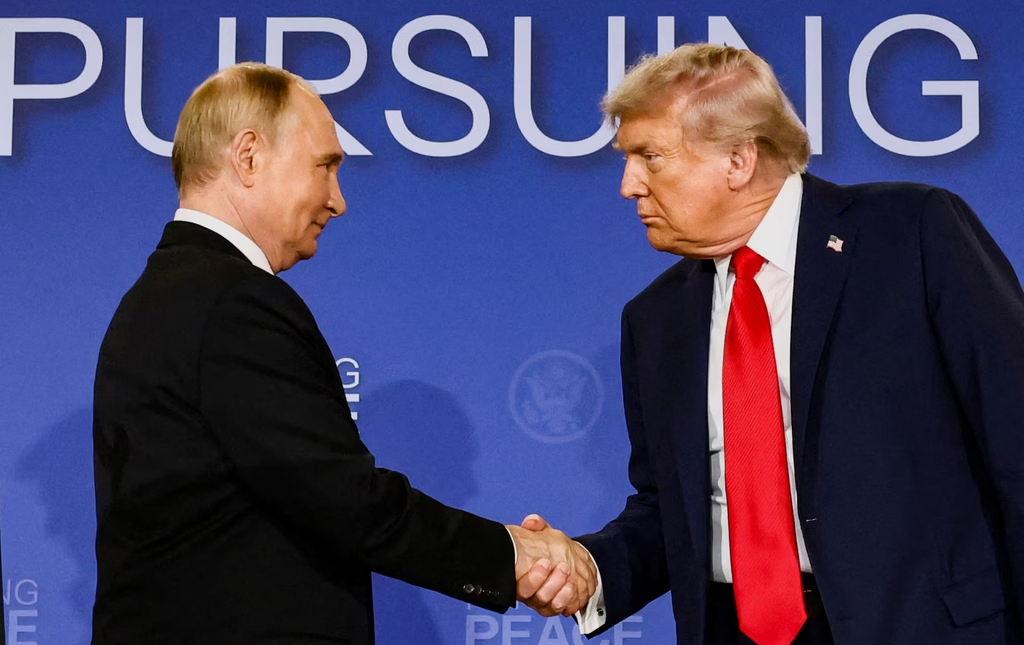
The announcement contrasts sharply with a sweeping Russia sanctions law Trump signed last month, which aims to choke off the oil and gas revenue that funds Moscow’s war. Shortly after Trump’s post, the Treasury Department said it was immediately issuing a temporary license easing sanctions on Russian diesel. It is the first such license since the Ukraine war began in February 2022 to run longer than the standard 30-day window, the AP noted, and it keeps U.S. sanctions from applying until April 2027 to diesel loaded onto tankers as of Friday.
What We Know So Far
The White House did not say who would pay for the diesel or when it would arrive. Trump did not address sanctions or the war in his post. “Lower prices for Americans, especially our Great Farmers, Ranchers, and Truckers, is my Greatest Priority,” he wrote. Leaving the White House for a campaign rally, he thanked Putin and said the country has “massive amounts of oil coming into our country, and it’s diesel, which is what we want.”
Trump’s announcement came as his envoy Steve Witkoff and son-in-law Jared Kushner were meeting Ukrainian officials in Miami about a proposal to end the war.
A Kremlin statement said the two leaders gave “significant attention” to resolving the Ukrainian crisis and also discussed Iran and bilateral ties. Putin said Russia “confirmed its readiness to supply oil and oil products to the American and global markets.” Kremlin aide Yuri Ushakov would not say whether Washington made concessions or what Moscow was promised. Deputy Prime Minister Alexander Novak told the state news agency Tass that Russia is lifting diesel export restrictions ahead of schedule and could begin supplies to the United States this month while keeping its domestic market fully supplied.
Reuters reported that Putin envoy Kirill Dmitriev asked U.S. officials during a Washington visit last month to grant export licenses to all major Russian oil companies, according to sources familiar with the situation. Russia has banned diesel exports since July because Ukrainian strikes on refineries have strained domestic supply, and the International Energy Agency says its diesel output has fallen about 30%.
Reaction
Ukrainian President Volodymyr Zelenskyy, in a statement released by his embassy in Washington, called the deal “a weak decision by strong partners.” He said he believed Ukraine’s team was being used as a smokescreen and argued that the deal allows Russia to prolong the war and will be repaid with more attacks.
Senate Democratic leader Chuck Schumer, Sen. Jeanne Shaheen and Sen. Elizabeth Warren called the announcement a betrayal of Ukraine, European allies and U.S. national security. “Enough is enough,” they wrote, urging Trump to end the Iran war instead of funding Russia’s war machine. Sen. Richard Blumenthal, a co-sponsor of the sanctions law, which is named for Sen. Lindsey Graham, said the agreement is contrary to Congress’s intent and makes the United States complicit in Putin’s war. Rep. Don Beyer, the senior House Democrat on the Joint Economic Committee, called the announcement “infuriating.”
Rep. Don Bacon, a Republican, said the sanctions should be used to squeeze Putin’s war machine and not to put “more money in his hands,” Reuters reported.
The law envisions sanctions on Russian officials, banks and a shadow fleet of tankers, bans new U.S. investment in Russia, and directs tariffs of up to 100% on the top five importers of Russian oil or gas, with exceptions for some countries. The AP said Trump’s move raises doubts about whether the White House will impose new sanctions. The United States has not imported Russian oil or gas since 2022, according to the Energy Information Administration.
Prices and Analysts
Diesel prices are near a record, with the national average at $6.28 a gallon, according to AAA, after a record $6.52 on Sept. 22. Reuters said prices are up 70% since the U.S.-Israeli war on Iran began Feb. 28, and that diesel futures fell almost 5% to $4.64 a gallon after the news. The 300,000 tons Trump cited equal roughly 2.25 million barrels, while the U.S. exports about 1.5 million barrels of diesel a day, Reuters noted.
Analysts were skeptical the deal would lower prices much. “What does this do to prices? I think probably not much,” said Clayton Seigle of the Center for Strategic and International Studies, who added that the arrangement is a great benefit to Russia, which is trying to move summer-grade diesel before winter. Jim Mitchell of Wood Mackenzie called it “clearly not a fix,” but another stream for a very tight market.
Separately, three industry sources told Reuters that Trump plans to direct department heads in the coming days to find ways to control diesel prices, possibly through a presidential memo that would push officials to bypass state and local rules blocking energy production and use the Defense Production Act to boost output. Trump has also pressed allies to release emergency reserves and widened access to tax-exempt red-dyed diesel, steps that have not yet brought prices down.
Differing Accounts
The Kremlin’s description of the call does not mirror Trump’s. Trump framed it as a deal for Russia to supply diesel to the U.S. and global markets, while the Kremlin spoke of readiness to supply oil and products to American and global markets and did not say what, if anything, was exchanged. The two outlets also described the Treasury license differently, with the AP calling it a license for Russian diesel to be supplied to the global market and Reuters describing it as allowing importation of Russian diesel until April 7. Zelenskyy’s remark was rendered as “a weak decision by strong partners” by the AP and “a weak decision on the part of strong partners” by Reuters.
Why This Matters
Diesel prices, a key driver of inflation, are a political risk for Republicans ahead of the Nov. 3 elections that will decide control of Congress, and the war in Iran and the war in Ukraine have tightened global supply. The deal sets the administration’s effort to lower prices against the sanctions regime Congress passed overwhelmingly and Trump signed only last month.
What Happens Next
The White House has not said when Russian diesel could reach the United States, and Moscow said supplies could begin this month. The Treasury license runs into April, and Trump is expected to issue his diesel-price directive in the coming days.
Reporting drawn from the Associated Press and Reuters




