Nigerian anti-narcotics officers have arrested a 34-year-old Ugandan woman who allegedly tried to smuggle more than a kilogram of cocaine out of Lagos after traveling to the city with members of her church for a prayer session, authorities said Sunday.
Farida Nansubuga was detained Tuesday at Murtala Muhammed International Airport in Ikeja, Lagos, as she prepared to board a flight home to Uganda, the National Drug Law Enforcement Agency said. Officers recovered 87 wraps of cocaine weighing 1.15 kilograms from her pelvic area, where the drugs had been strapped under two layers of underwear, the agency said, as published by Nigeria’s Punch newspaper.
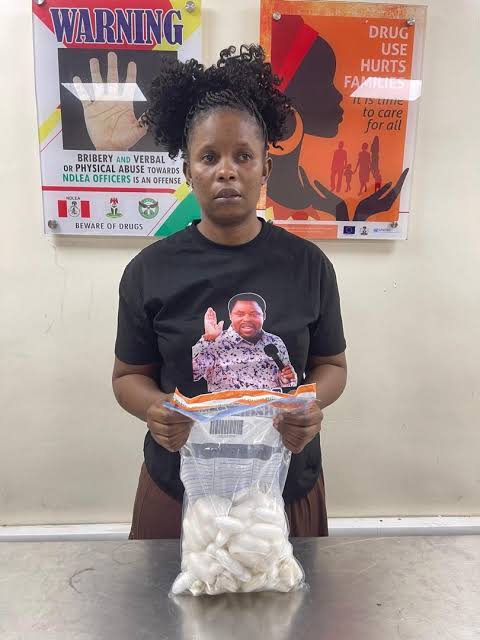
NDLEA Director of Media and Advocacy Femi Babafemi said in a Sunday statement that Nansubuga arrived in Nigeria on Oct. 29 with a church delegation to attend a prayer session at the Synagogue Church of All Nations in the Ikotun-Egbe area of Lagos State.
When the rest of the group returned to Uganda, she remained behind, allegedly to collect the drugs on behalf of a friend in Uganda identified only as Joy, Babafemi said.
“She came to Nigeria with members of her church for spiritual renewal at a prayer session in Lagos. But when it was time to go home, 34-year-old Ugandan, Ms Farida Nansubuga, chose a different path. While the rest of her delegation flew back to Uganda, she stayed behind, not to pray some more, but to pick up a consignment of cocaine, which she hid in her private part in a bid to smuggle it into her country,” the statement read in part.
She was stopped at the Terminal 2 screening point during a joint passenger screening exercise carried out by NDLEA operatives and aviation security personnel. She had been scheduled to fly on a Ugandan airline, the agency said.
Drugs handed over at a hotel
Preliminary investigations indicated that a contact in Nigeria arranged a vehicle to take Nansubuga to a hotel on the morning of her planned departure, where an unidentified man gave her the drugs, Babafemi said. She allegedly told investigators she had been instructed to hide the cocaine under her clothing to avoid detection at the airport.
“During preliminary interview, the suspect said she arrived in Nigeria on 29th October 2026 with members of her church for a prayer session at The Synagogue Church of All Nations, Ikotun Egbe area of Lagos. She claimed that after the prayer session, the other members of her delegation returned to Uganda while she stayed back to collect the illicit consignment on behalf of a friend, simply identified as Joy, who resides in Uganda,” Babafemi said.
Although no fixed payment had been agreed, she told investigators she expected at least $1,000 once the drugs were delivered in Uganda, the agency said.
There was no indication that the church or other members of the delegation were involved, and the agency did not suggest otherwise.
NDLEA Chairman Brig. Gen. Mohamed Buba Marwa (retd.) praised the officers behind the arrest and said the case showed how traffickers exploit religious travel.
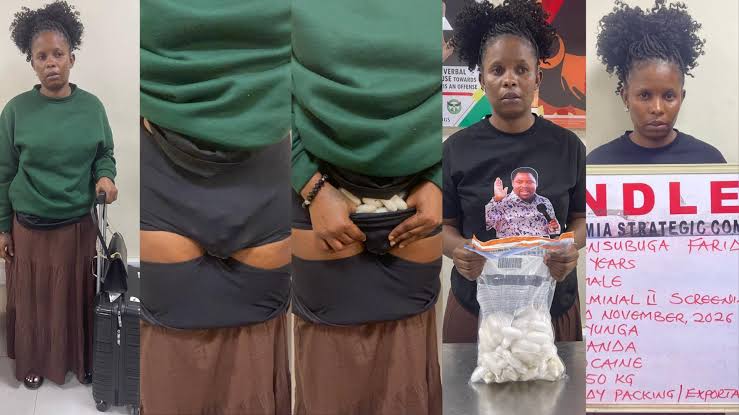
“The case of the Ugandan woman is a sad reminder that drug cartels will stop at nothing, including exploiting faith and religious travel, to recruit couriers for their deadly trade. I urge officers across all commands to sustain the tempo of their supply and demand reduction efforts,” Marwa said.
Opioids disguised as Paracetamol
The arrest was one of several drug seizures the agency announced across the country.
At the same airport, officers on Friday intercepted 750,000 tablets of Tapentadol 250mg weighing 526 kilograms, with an estimated street value of 900 million naira. The shipment had been declared as Paracetamol.
“In another interception at the Lagos airport, NDLEA operatives on Friday, 6th November uncovered 750,000 tablets of Tapentadol 250mg, weighing 526 kilograms with a street value of N900 million, in a consignment from India declared as Paracetamol Tablets 500mg. The consignment, made up of eleven cartons packed in two wooden structures, arrived at the import shed of the airport on Tuesday 3rd November aboard an Ethiopian Airlines flight from Ahmedabad, India,” Babafemi said.
Officers also found 32 parcels of a potent cannabis strain known as Loud, weighing 16.15 kilograms, hidden in two wooden sofas in a cargo shipment from Houston, the agency said.
In separate interceptions involving UK-bound shipments, operatives found 600 tablets of Tramadol 225mg concealed in women’s headwear and 46 blocks of cannabis weighing 22.2 kilograms packed in two cartons.
Punch also published a video showing officers cutting through crates, foam and padding to retrieve sealed packages of suspected narcotics concealed inside imported sofas.
Faith, trust and the courier trade
The Nansubuga case highlights a recruitment pattern that anti-narcotics agencies across Africa have long warned about: trafficking networks rely on ordinary travelers whose profiles draw little suspicion. A woman traveling as part of a church delegation, with a documented religious purpose for her visit, fits that profile closely. The alleged arrangement, a hotel pickup on the morning of departure and a vague promise of roughly $1,000, suggests a network that keeps its couriers at arm’s length, limiting what any arrested carrier can reveal.
The modest expected payment underscores a familiar imbalance. Couriers bear the greatest legal risk, potentially facing long prison terms, while organizers stay hidden. Investigators’ ability to identify the hotel contact and the friend named Joy will determine whether the case reaches beyond a single arrest.
The Tapentadol seizure may prove the more significant development. Tapentadol and Tramadol are prescription opioids that have fueled a growing misuse problem in West Africa, where large quantities are diverted into informal markets.
A 526-kilogram shipment mislabeled as a common painkiller points to an organized supply chain exploiting pharmaceutical trade routes, and is likely to renew pressure on regulators to tighten oversight of imported medicines.
Together with the cannabis found in furniture from Houston and the drug-laden parcels bound for Britain, the seizures illustrate that Lagos’ airport functions as both an entry and exit point for multiple drug flows. The NDLEA’s string of announcements signals an aggressive enforcement posture, though the volume of interceptions also suggests that traffickers continue to test the airport’s defenses with inventive concealment methods.
Sources: Punch Newspaper, Nigeria (punchng.com).