

YOLA, Nigeria (BN24) — Suspected Islamist militants killed at least 25 people and set homes ablaze during coordinated assaults on two rural communities in northeastern Nigeria’s Adamawa State, residents and local officials said Wednesday.
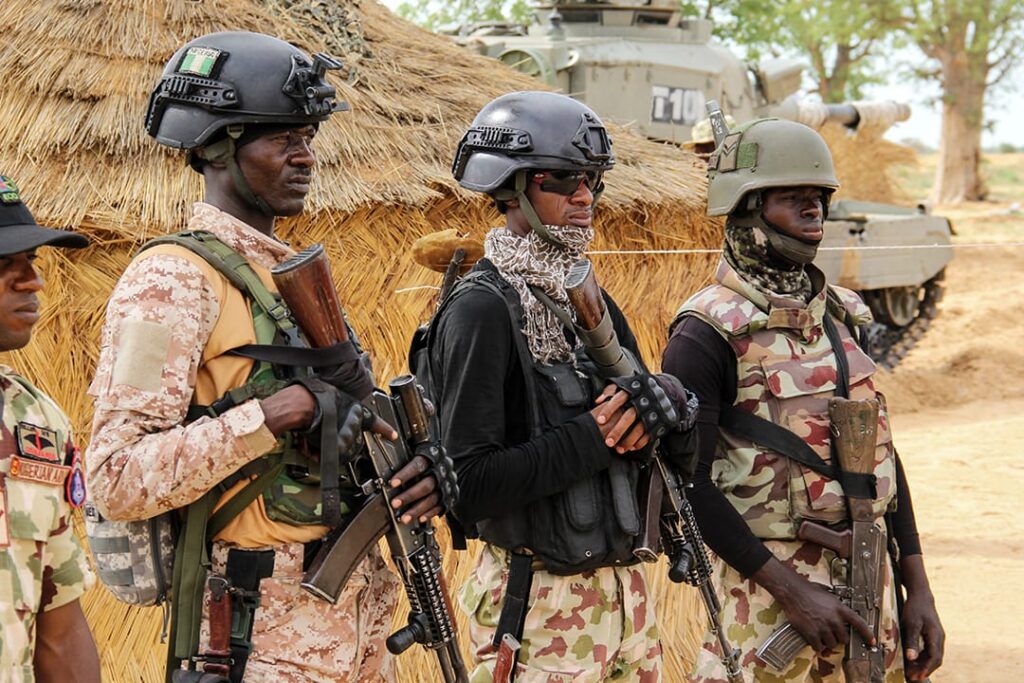
The violence unfolded Tuesday evening in the villages of Kirchinga in Madagali district and Garaha in neighboring Hong district, areas bordering the Sambisa Forest, a longstanding stronghold of Boko Haram and fighters aligned with the Islamic State West Africa Province, known as ISWAP.
Accounts from community leaders and residents indicate that the attackers moved into Kirchinga dressed in military-style uniforms, a tactic that initially confused villagers who believed they were security personnel conducting routine patrols.
Abubakar Lawan Kanuri, the village head of Kirchinga, recounted in an interview with Reuters that gunmen swept through the community after nightfall. He said 18 bodies were later retrieved following the assault.
In Garaha, seven people lost their lives when armed men riding more than 50 motorcycles descended on the village and targeted a nearby military outpost, according to resident Musa Isa. Isa told Reuters he narrowly avoided being caught in the violence.
“They came from different directions,” Isa said, describing a coordinated advance that overwhelmed the area. He indicated that three soldiers were among those killed when the base came under fire. Four civilians attempting to flee were shot, and a school building was set ablaze during the rampage.
Many residents have since fled Garaha and surrounding communities, seeking refuge in Mubi, one of the largest towns in the region.
The back-to-back raids underscore the persistent insecurity plaguing Nigeria’s northeast, the epicenter of a 17-year insurgency led by Boko Haram and later complicated by a split that produced ISWAP. Despite sustained military operations and repeated assurances from authorities that militant capabilities have been degraded, attacks on rural settlements and security installations continue to exact a heavy toll.
Adamawa State Gov. Ahmadu Umaru Fintiri denounced the violence as “cowardly acts of terrorism” and pledged that his administration would not allow armed groups to derail efforts to restore peace and stability. His remarks were conveyed in a statement issued by his spokesman, Humwashi Wonosikou.
Fintiri affirmed that security agencies had been directed to intensify operations in affected areas and to pursue those responsible for the bloodshed.
The Sambisa Forest, straddling parts of Borno and neighboring states, has long served as a hideout for insurgent factions. Although Nigerian forces have conducted repeated offensives in the area over the years, militants have demonstrated an ability to regroup and stage attacks on vulnerable communities, often exploiting difficult terrain and limited infrastructure.
Tuesday’s violence follows a pattern seen across the northeast, where insurgents frequently strike at dusk, targeting both civilian populations and military positions. The use of motorcycles allows fighters to move swiftly across rough ground, complicating efforts by conventional security forces to intercept them.
While large urban centers have seen relative improvements in security compared with the height of the conflict, rural districts remain exposed. Communities near forested or border regions are particularly susceptible to raids, abductions, and arson.
The humanitarian consequences of such attacks are severe. Displacement continues to strain host communities and urban centers like Mubi, where fleeing villagers seek shelter and assistance. Aid agencies have repeatedly warned that renewed waves of violence could worsen already fragile living conditions for internally displaced persons.
Reuters documented the casualty figures and eyewitness testimony in its coverage of the attacks, citing local leaders and residents directly affected by the violence.
The assaults on Kirchinga and Garaha highlight a troubling reality: even as Nigeria’s federal government emphasizes gains against insurgent networks, militant factions retain the operational capacity to mount coordinated, multi-pronged attacks. The scale of the motorcycle convoy reported in Garaha, more than 50 bikes, suggests a level of organization and mobility that challenges narratives of a weakened insurgency.
The tactic of wearing military uniforms, as described by the village head of Kirchinga in his remarks to Reuters, reflects a strategy designed to sow confusion and erode trust between civilians and security forces. When residents cannot easily distinguish between soldiers and attackers, it complicates early-warning efforts and may slow community responses.
Moreover, the targeting of a school and a military base in the same sweep signals a dual objective: undermine state authority while inflicting psychological trauma on civilians. Attacks on educational facilities have been a recurring feature of the insurgency, aimed at disrupting normal life and discouraging the return of displaced families.
The proximity of the affected villages to Sambisa Forest remains significant. Although the forest has been the focus of numerous military campaigns, its geography continues to provide cover for insurgent cells. Without sustained territorial control and improved intelligence networks, security operations risk becoming cyclical, pushing militants out temporarily but failing to prevent their return.
For Adamawa State, the renewed violence may also carry political implications. As governors in the northeast navigate pressure to demonstrate improved security and facilitate economic recovery, high-casualty incidents threaten public confidence. Calls for enhanced federal support and cross-border cooperation could intensify, particularly if attacks spread or become more frequent.
Ultimately, the events in Kirchinga and Garaha illustrate the enduring complexity of Nigeria’s insurgency. While security forces have made measurable progress since the conflict’s peak, sporadic but deadly raids continue to destabilize rural communities. Whether authorities can translate tactical victories into sustained safety for civilians remains a central question for the region’s future.
As investigations proceed and security operations intensify, residents across Adamawa and neighboring states face renewed uncertainty, underscoring the fragile balance between progress and persistent threat in Nigeria’s northeast.





