

Afghanistan said Sunday it killed fifty-eight Pakistani soldiers in overnight border operations in response to what it called repeated violations of its territory and airspace, while Pakistan’s army gave far lower casualty figures, saying twenty-three troops were killed.
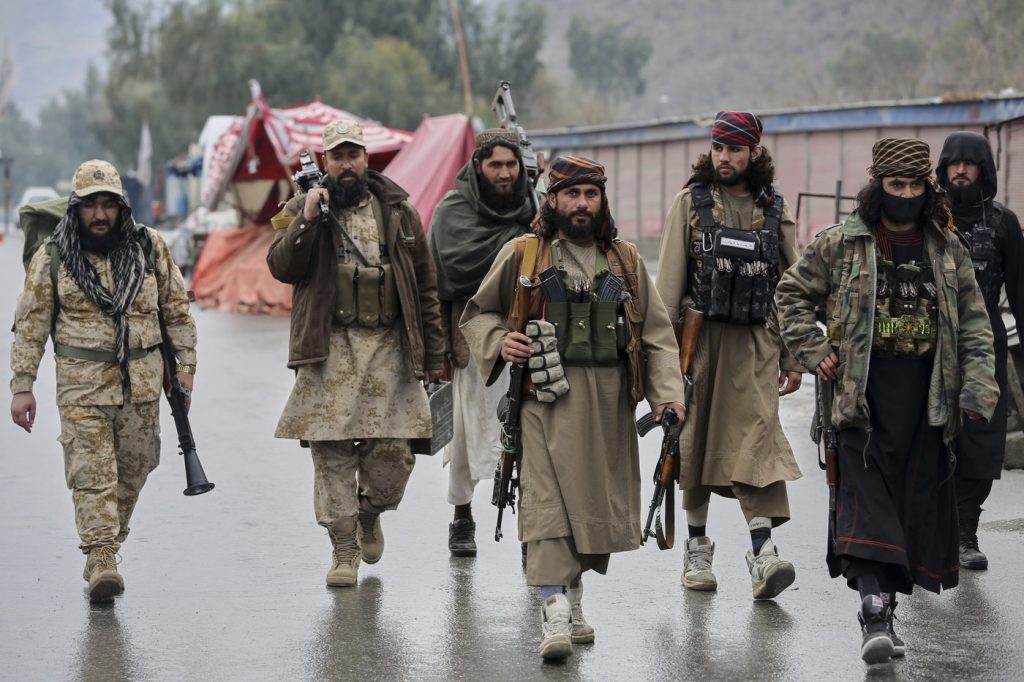
The Taliban government’s chief spokesman, Zabihullah Mujahid, said Afghan forces captured twenty-five Pakistani army posts, leaving thirty Pakistani soldiers wounded. He spoke at a news conference in Kabul announcing what he described as successful retaliatory operations.
“The situation on all official borders and de facto lines of Afghanistan is under complete control, and illegal activities have been largely prevented,” Mujahid said.
Earlier in the week, Afghan authorities accused Pakistan of bombing the capital, Kabul, and a market in the country’s east. Pakistan did not claim responsibility for the assault.
The Taliban government’s Defense Ministry said early Sunday morning its forces had conducted “retaliatory and successful operations” along the border. “If the opposing side again violates Afghanistan’s territorial integrity, our armed forces are fully prepared to defend the nation’s borders and will deliver a strong response,” the ministry added.
Saturday night’s heavy clashes underscore deepening tensions between the neighbors. Pakistan has previously struck locations inside Afghanistan, targeting what it alleges are militant hideouts, but these have been in remote and mountainous areas. The two sides have also skirmished along the border in the past.
The Torkham crossing, one of two main trade routes between the two countries, did not open Sunday at its usual time of eight in the morning. The crossing at Chaman in southwest Pakistan was also closed. People, including Afghan refugees leaving Pakistan, were turned away due to the worsening security situation.
An Associated Press reporter in Chaman heard jets over Spin Boldak, a city in Afghanistan’s southern Kandahar province, and saw smoke rising after an explosion.
Before the Afghan claim of casualties, Pakistani Prime Minister Shehbaz Sharif condemned the assault and said the country’s army “not only gave a befitting reply to Afghanistan’s provocations but also destroyed several of their posts, forcing them to retreat.”
Pakistani security officials shared videos purporting to show destroyed Afghan checkpoints, but the footage could not be independently verified because the media does not have access to these areas.
The Pakistani army said more than two hundred “Taliban and affiliated terrorists have been neutralized, while the number of injured is much higher.”
According to Pakistani security officials, Afghan forces opened fire in several northwestern border areas in the province of Khyber Pakhtunkhwa. One official in Islamabad told The Associated Press that Pakistan had taken control of nineteen Afghan border posts from where attacks were being launched. He spoke on condition of anonymity because he was not authorized to talk to the media.
“The Taliban personnel at these posts have either been killed or fled. Fires and visible destruction have been observed at the captured Afghan posts,” the official added.
Pakistan accuses Afghan authorities of harboring members of the banned group Tehreek-i-Taliban Pakistan. Islamabad says the group carries out deadly attacks inside Pakistan, but Kabul denies the charge, saying it does not allow its territory to be used against other countries.
Pakistan is grappling with surging militancy, especially in areas bordering Afghanistan. It also accuses its nuclear-armed neighbor and rival India of backing armed groups, without providing evidence.
The overnight border clashes could fuel regional instability, as India and Pakistan came close to war earlier this year after a tourist massacre in the disputed region of Kashmir. India has also boosted its relations with Afghanistan’s Taliban rulers, most recently announcing an upgrade of its technical mission in Kabul to a full embassy.
The Saudi Foreign Ministry called for “restraint, avoidance of escalation and the adoption of dialogue and wisdom to help de-escalate tensions and maintain the security and stability of the region.” Saudi Arabia recently reached a mutual defense pact with Pakistan. Qatar also urged restraint.
Taliban Foreign Minister Amir Khan Muttaqi, who is in India on an official visit, told journalists that Afghanistan respected the calls made by the two Gulf powers to stop what he called “retaliatory strikes” against Pakistan. But he also warned that Kabul reserved the right to protect itself.
“We want a peaceful resolution of the situation, but if the peace efforts don’t succeed, we have other options,” Muttaqi said.
The two countries share a twenty-six hundred eleven-kilometer border known as the Durand Line, but Afghanistan has never recognized it. The disputed boundary has been a source of friction since the line was drawn by British colonial authorities in eighteen ninety-three, dividing ethnic Pashtun populations on both sides.
The closure of the border crossings threatens to disrupt vital trade between the landlocked Afghanistan and Pakistan, which serves as a crucial transit route for Afghan commerce. The Torkham and Chaman crossings handle the bulk of trade and travel between the two nations.
Regional powers are watching the escalation with concern. The conflict comes as Afghanistan’s Taliban government seeks greater international legitimacy while Pakistan deals with increased militant violence in its border regions.
The dramatically different casualty figures reported by both sides could not be independently verified, as access to the border areas remains restricted for journalists and international observers.
AP




