

Thousands of anti-government demonstrators clashed violently with riot police in Albania’s capital Tuesday evening, hurling petrol bombs at governmental buildings and demanding the deputy prime minister’s resignation over corruption allegations that have plunged the nation into political crisis threatening Prime Minister Edi Rama’s thirteen-year grip on power.
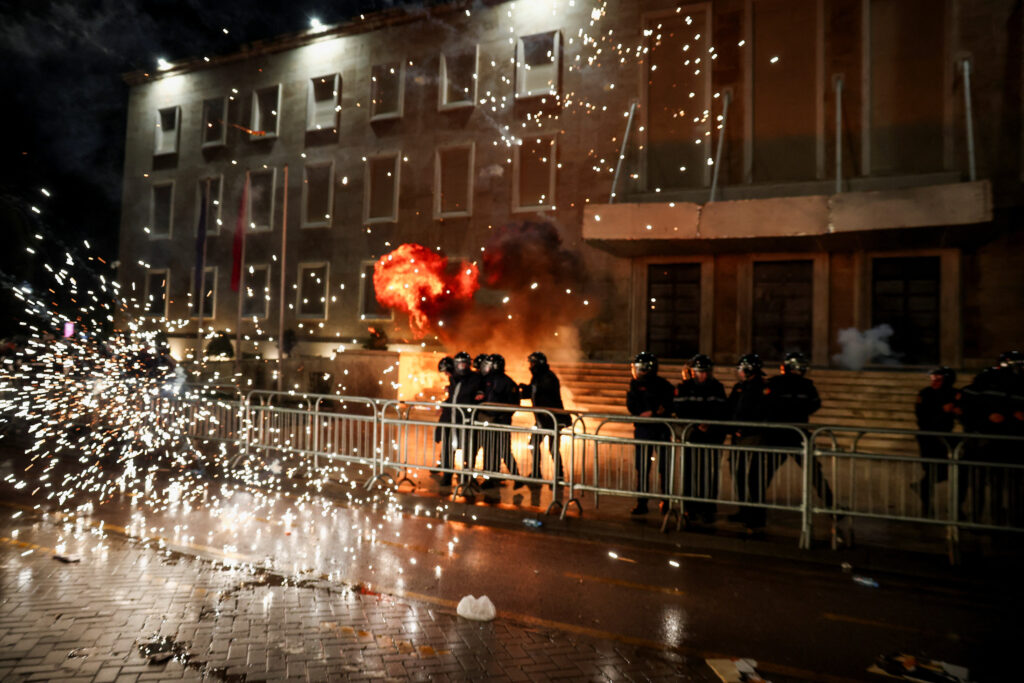
Protesters flooded streets near Rama’s office, waving national flags and chanting “Rama go home, this corrupted government should resign” as special police forces in riot gear deployed water cannons and tear gas to disperse crowds that had sealed off large portions of central Tirana. The confrontation represents the latest in escalating violent demonstrations that challenge the stability of Rama’s administration, which has governed since 2013 while positioning Albania as a candidate for European Union membership.
Political tensions have intensified dramatically since December when a special prosecution unit indicted Deputy Prime Minister Belinda Balluku for allegedly interfering in public tenders for major infrastructure projects and favoring certain companies in exchange for political or financial benefits. Balluku has categorically denied all wrongdoing, characterizing the accusations as politically motivated attacks.
The Special Prosecution Office—tasked with combating corruption and organized crime—requested that parliament lift Balluku’s immunity this week to enable her arrest and interrogation. However, the timing of any parliamentary vote remains uncertain, and whether legislators will vote at all appears doubtful given that Rama’s ruling Socialist Party controls a majority that could block the immunity removal.
By late evening Tuesday, broken glass, burned debris and abandoned protest banners littered the main square as smoke drifted across central Tirana. Several individuals sustained injuries as violence spread throughout the capital, with hospitals confirming treatment of patients suffering breathing problems from tear gas exposure and minor wounds from projectiles.
Riot police wearing helmets and carrying shields established defensive perimeters around government buildings as demonstrators attempted breaching barricades. Bottles, stones and firecrackers flew from the crowd toward security forces, who responded with coordinated water cannon deployments. Authorities have not released official casualty figures or arrest statistics.
Opposition leader Sali Berisha addressed thousands gathered outside the Prime Minister’s Office, accusing Rama of “declaring war on justice” to protect his inner circle from legal accountability. He alleged the government attempted manipulating courts and prosecutors to shield Balluku from prosecution.
“We were close to a coup within the state,” Berisha told the crowd, claiming popular mobilization prevented authoritarian consolidation. “The people stopped it.” He characterized Rama as “the most dangerous enemy of Albanians” and urged supporters to maintain street demonstrations until “corruption is defeated.”
His speech elicited loud chants and whistles as protesters pledged to continue nightly demonstrations, signaling sustained civil unrest rather than isolated protest events. The commitment to prolonged mobilization threatens governmental stability and potentially undermines Albania’s EU accession negotiations, which require demonstrating rule of law and anti-corruption effectiveness.
While Balluku’s indictment triggered the current protest wave, demonstrators emphasize their grievances extend far beyond one official’s alleged misconduct. Many protesters accuse the government of systemic corruption, misuse of public funds and systematically shielding senior officials from accountability regardless of evidence suggesting criminal conduct.
Opposition leaders contend Rama has repeatedly defended close allies facing legal scrutiny, eroding public trust in governmental institutions and the independence of Albania’s justice system. This pattern allegedly creates an atmosphere of impunity for well-connected officials while ordinary citizens face full legal consequences for infractions.
Protesters claim alleged corruption has contributed directly to high unemployment rates, rising living costs and mass emigration, with thousands of Albanians abandoning the country seeking better economic opportunities abroad. These economic grievances provide explosive fuel for political protests, as citizens attribute their deteriorating living standards to governmental malfeasance rather than global economic forces.
The corruption allegations against Balluku center on claims she interfered in procurement processes for major infrastructure development projects—investments critical to Albania’s modernization and EU integration objectives. Prosecutors allege she steered lucrative contracts toward favored companies, potentially in exchange for kickbacks or political support, corrupting processes designed to ensure competitive bidding and optimal value for public expenditures.
Such infrastructure tender manipulation, if proven, would represent serious violations of procurement regulations and potentially criminal abuse of office. The allegations strike at core governance failures that international institutions including the European Union monitor closely when evaluating candidate countries’ readiness for membership.
Albania has pursued EU accession for years, with the integration process requiring extensive reforms to judicial systems, anti-corruption mechanisms and democratic governance structures. The Balluku scandal and government response test whether Albania has genuinely implemented reforms or merely adopted superficial compliance while preserving corrupt practices beneath institutional facades.
Rama’s government faces a credibility crisis precisely when demonstrating clean governance matters most for EU aspirations. If parliament refuses lifting Balluku’s immunity despite prosecutorial requests backed by evidence, international observers will question Albania’s commitment to fighting high-level corruption regardless of political connections.
The Special Prosecution Office’s willingness to pursue a sitting deputy prime minister represents either genuine institutional independence or sophisticated political theater designed to create accountability appearances while ultimately protecting the accused through parliamentary obstruction. Which interpretation proves accurate will significantly influence Albanian and international perceptions of justice system integrity.
Rama has governed Albania since 2013, establishing himself as a dominant political figure who has presided over economic growth and infrastructure development while critics accuse him of authoritarian tendencies and tolerance for corruption among allies. His longevity in power provides stability that some Albanians value while others view as stagnation preventing necessary leadership renewal.
The prime minister positioned himself as instrumental to Albania’s EU integration efforts, cultivating relationships with European leaders and championing reforms ostensibly aligning Albanian governance with European standards. Tuesday’s violent protests threaten this carefully constructed image by highlighting persistent corruption allegations and public anger that contradicts narratives of successful reform implementation.
The demonstrations also reflect broader patterns across the Balkans where citizens increasingly mobilize against entrenched political elites perceived as corrupt and unresponsive. Similar protests have erupted in Serbia, Montenegro and Bosnia-Herzegovina, suggesting regional trends toward popular challenges of governmental authority when economic conditions deteriorate and corruption perceptions intensify.
For Albania specifically, the protests occur amid economic pressures including inflation affecting food and energy prices, infrastructure deficits despite construction projects, and brain drain as educated young Albanians emigrate seeking opportunities unavailable domestically. These material grievances combine with corruption outrage to fuel sustained mobilization.
The violence Tuesday evening—including petrol bomb attacks on government buildings—represents escalation beyond peaceful demonstration into civil disorder that could justify governmental crackdowns. However, aggressive police responses risk martyring protesters and galvanizing broader public sympathy for anti-government movements.
Rama’s government confronts difficult choices: lifting Balluku’s immunity and allowing prosecution might placate protesters but would sacrifice a close ally and potentially encourage further legal challenges against other officials; maintaining immunity protections validates corruption accusations and fuels continued unrest.
The parliamentary vote, if it occurs, will reveal whether Rama prioritizes protecting his deputy or attempting to defuse political crisis through accountability gestures. His Socialist Party’s majority provides the votes to block immunity removal, but exercising that power amid massive protests carries substantial political costs.
International observers including EU officials will scrutinize how Albania resolves this crisis as indicator of genuine anti-corruption commitment versus continued elite impunity. The outcome influences not only domestic stability but also Albania’s EU accession timeline and regional reputation.
As smoke cleared from Tuesday’s confrontations, the fundamental question remains whether Albanian institutions possess sufficient independence to hold powerful officials accountable or whether political connections provide effective immunity regardless of allegations. The answer will shape Albania’s political trajectory and determine whether current protests represent temporary unrest or the beginning of sustained civic mobilization demanding transformative change.
Reuters/IndiaToday




