

ARGUNGU, Nigeria (BN24) — Thousands of fishermen surged into the pale, silted waters of the Matan Fadan River on Saturday, marking the return of one of Nigeria’s most storied cultural traditions in a region long strained by insecurity.
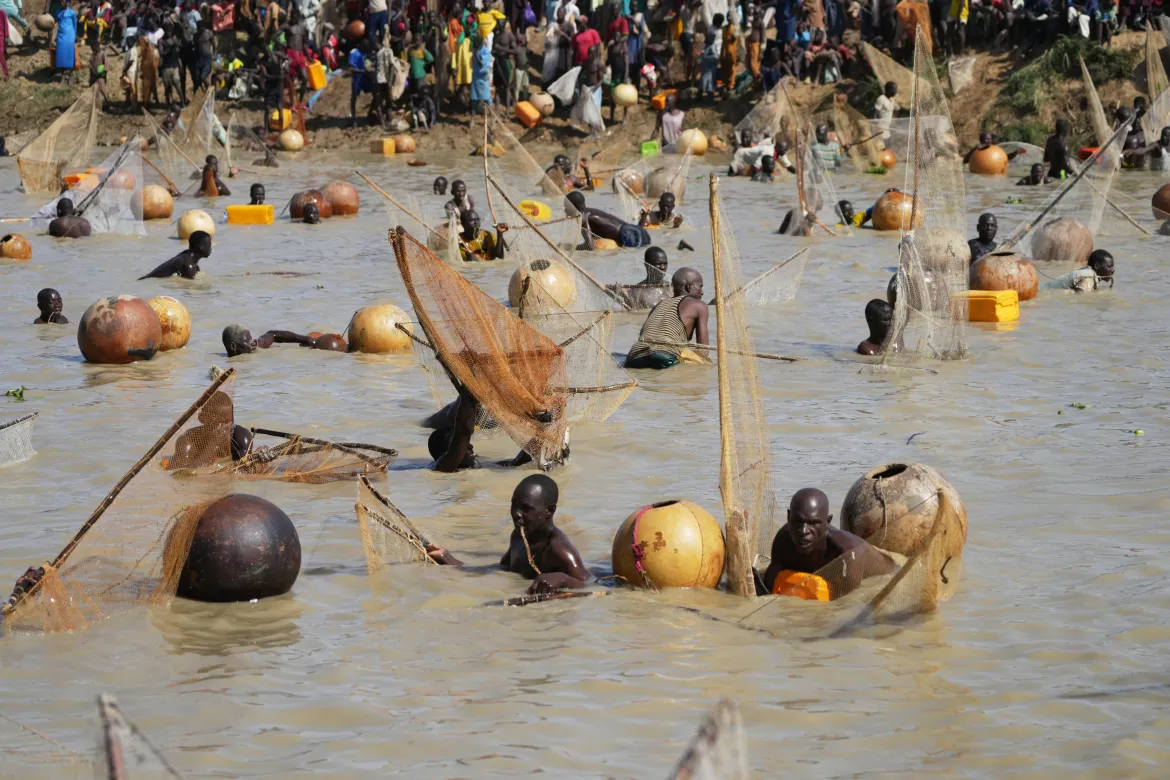
The river, recognized as a UNESCO heritage site, winds through thick vegetation in Argungu, a town in Kebbi state in Nigeria’s northwest. Along its banks, crowds gathered early, cheering as competitors waded forward armed with handwoven nets, calabash gourds, and, in some cases, nothing but bare hands.
Among the spectators was Nigeria’s president, Bola Tinubu, whose presence underscored the symbolic weight of the annual Argungu International Fishing Festival, l an event that many residents describe as a touchstone of identity and reconciliation.
Participants were restricted to traditional fishing methods, preserving a practice that dates back generations. Canoes drifted between clusters of fishermen, and nets spread wide across the narrow river. At the close of the competition, a fisherman hoisted a croaker weighing 59 kilograms (130 pounds), securing the grand prize and a cash award. Other participants retained their catches to sell in local markets, injecting income into the surrounding communities.
For Aliyu Muhammadu, 63, the day’s rewards extended beyond competition. “I thank God that I got something to take home to my family to eat. I am very happy that I came,” he said in an interview with The Associated Press.
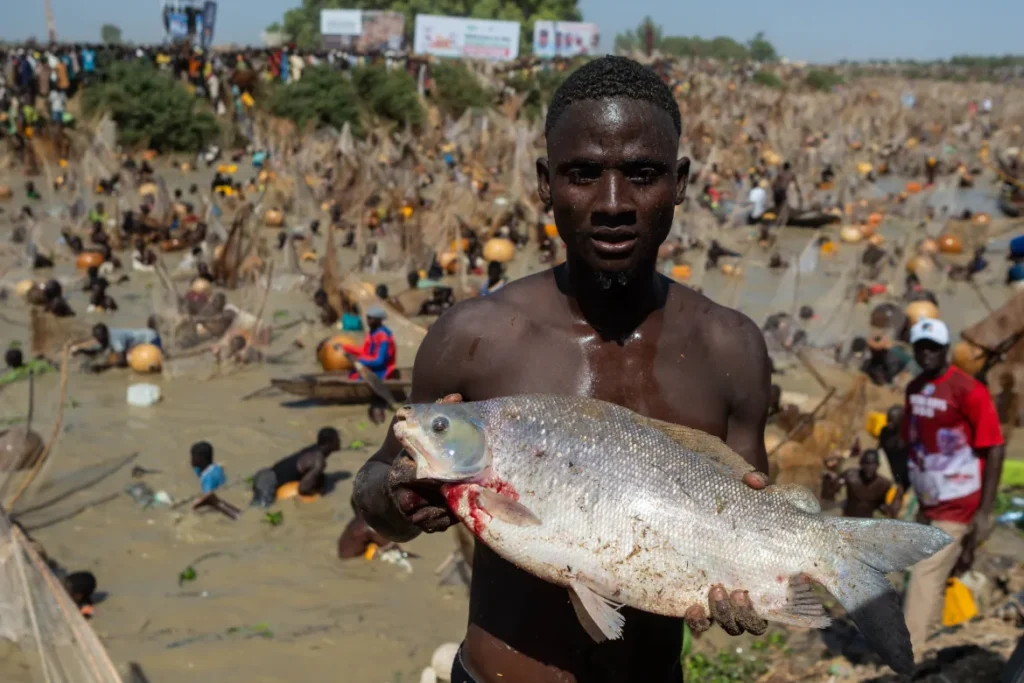
The river itself is opened for the contest only once a year. For the remaining months, it is closed and overseen by a traditional titleholder known as the Sarkin Ruwa, the chief of the water, who ensures its preservation and ecological balance.
The fishing contest serves as the centerpiece of a broader festival that includes traditional wrestling, music, and displays of regional craftsmanship. For residents, it is both a cultural exhibition and an affirmation of communal resilience.
The festival’s roots trace back to 1934, commemorating the end of nearly a century of hostilities between the Sokoto Caliphate, a 19th-century Islamic empire that once stretched from present-day Nigeria into parts of Burkina Faso, and the Argungu emirate. What began as a diplomatic gesture evolved into a lasting celebration of unity.
For decades, the gathering drew international visitors and boosted local commerce. However, the event was suspended in 2010 amid infrastructural decay and escalating violence across northern Nigeria. It resumed briefly in 2020 before another interruption. This year’s edition marks its latest revival.
Nigeria continues to grapple with a multifaceted security crisis, particularly in its northern regions. Armed groups, including Islamist insurgents and criminal gangs, have carried out attacks that have left thousands dead over the years. The violence has displaced communities and disrupted social and economic life. Incidents have increasingly spread toward the country’s southern areas.
Tinubu characterized the festival’s revival as evidence of improving stability. Yet for some residents, confidence remains fragile.
“Our challenge now is that people are scared of coming. A lot of people don’t attend the event like before because of insecurity,” Hussein Mukwashe, the Sarkin Ruwa of Argungu, said in comments to The Associated Press.
While attendance was strong, local officials acknowledged that turnout had yet to match peak years before the suspensions.
The festival’s return carries economic significance beyond its symbolism. Vendors lined the streets selling food, textiles, and crafts, while transport operators ferried visitors from neighboring towns. Hospitality businesses reported increased activity during the weekend. In a state where agriculture and fishing form the backbone of livelihoods, even a brief surge in commerce offers relief.
Beyond immediate gains, the revival also signals a strategic push to reposition cultural tourism as a stabilizing force. Nigeria, Africa’s most populous nation, has often struggled to balance security concerns with efforts to showcase its cultural heritage. Events like Argungu present an opportunity to reshape perceptions of the northwest, which is frequently associated with conflict.
Analysts note that cultural festivals can serve as instruments of soft diplomacy, fostering unity within diverse societies. In the case of Argungu, the historical reconciliation it commemorates resonates with contemporary calls for national cohesion. Nigeria’s complex ethnic and religious landscape has, at times, been strained by political and economic pressures. Public celebrations that draw cross-regional participation can reinforce shared identity.
However, sustained revival will depend on more than ceremonial reopening. Infrastructure upgrades, consistent security assurances, and environmental stewardship will be essential to maintaining momentum. The ecological management of the Matan Fadan River, overseen by the Sarkin Ruwa, remains critical as climate variability and water resource pressures intensify across West Africa.
Security experts caution that while isolated events can proceed safely under heightened protection, broader stability requires long-term strategies addressing unemployment, governance gaps, and regional cooperation.
Still, on Saturday, optimism edged out apprehension. Children perched on shoulders to glimpse fishermen wrestling oversized catches from murky waters. Elders exchanged greetings along dusty pathways. Drummers punctuated the air with rhythmic beats as wrestlers prepared for matches nearby.
For many in Argungu, the festival’s return is less about spectacle and more about reclaiming normalcy.
As Muhammadu clutched his catch, the significance of the day appeared personal as much as political. In a region where headlines often focus on violence, the sight of thousands gathering for celebration offered a different narrative one of continuity, endurance, and cautious hope.
Whether the festival’s resurgence marks a lasting turning point remains uncertain. Yet for now, the waters of the Matan Fadan River once again reflect a community determined to honor its past while navigating an uncertain present.





