

BISSAU, Guinea-Bissau — Military officers in Guinea-Bissau announced Wednesday that they had seized power in the small West African nation, suspending the electoral process and arresting President Umaro Sissoco Embalo just one day before authorities were scheduled to announce results from a hotly contested presidential election that both leading candidates claimed to have won.
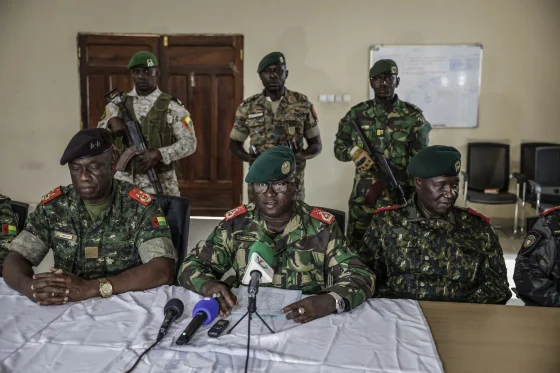
“The High Military Command for the re-establishment of national and public order decides to immediately depose the president of the republic, to suspend, until new orders, all of the institutions of the republic of Guinea-Bissau,” spokesperson Dinis N’Tchama declared in a statement broadcast on state television, marking the latest military takeover in a region experiencing unprecedented democratic backsliding since 2020.
Embalo confirmed his ouster in a phone interview with French broadcaster France 24 shortly after the military announcement. “I have been deposed,” the president stated, adding that he was being held at army general staff headquarters. Two security sources told Reuters that military officers were detaining him at the office of the army chief of staff, though the coup leaders did not specify his custody status in their public statements.
The military takeover unfolded amid chaotic scenes in the capital Bissau, where sustained gunfire erupted near the electoral commission headquarters, presidential palace and interior ministry for approximately one hour before subsiding. Witnesses described panic as civilians fled through streets where heavily armed and masked soldiers established checkpoints, closing roads leading to government buildings while enforcing border closures and overnight curfew announced by the self-proclaimed military command.
Disputed Election and Competing Victory Claims
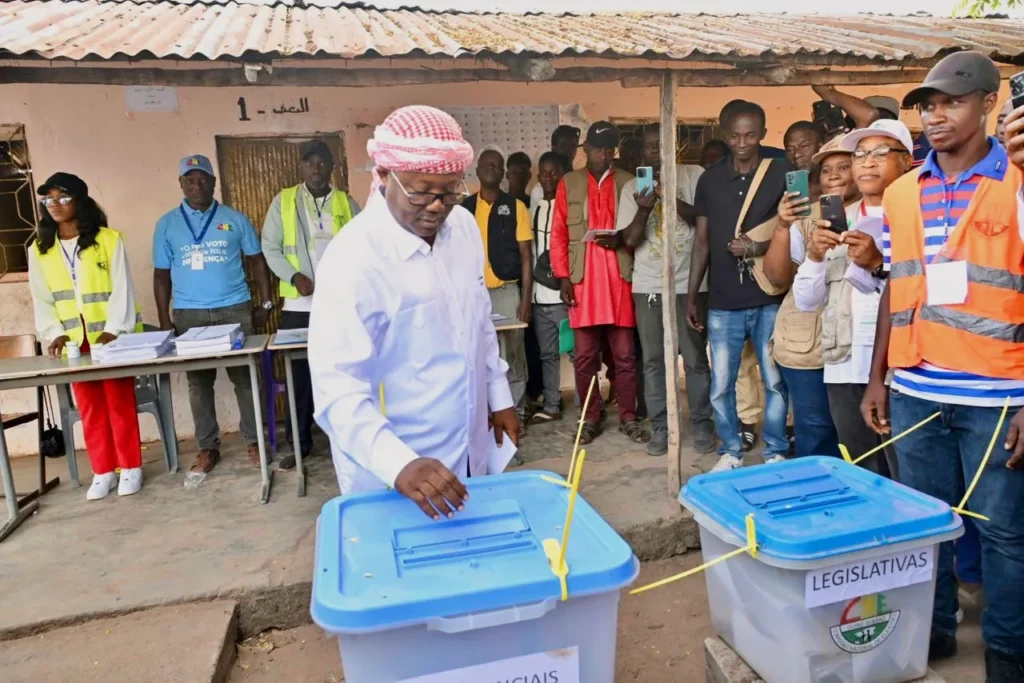
Sunday’s presidential election pitted incumbent Embalo against opposition challenger Fernando Dias in a contest marred by legitimacy questions after authorities barred the main opposition African Party for the Independence of Guinea and Cape Verde from participating. Both candidates declared victory Tuesday despite provisional results not being scheduled for release until Thursday, creating volatile political atmosphere that preceded Wednesday’s military intervention.
The military statement accused unnamed “national politicians” and “well-known national and foreign drug barons” of plotting to destabilize the country through electoral manipulation, though N’Tchama provided no evidence supporting these allegations. “The scheme was set up by some national politicians with the participation of a well-known drug lord, and domestic and foreign nationals,” he asserted, echoing familiar patterns where military forces justify coups by citing corruption or security threats without substantiating specific claims.
Soldiers announced immediate suspension of the electoral process and media outlet activities alongside border closures, effectively isolating the nation of approximately two million people from external oversight or intervention during the uncertain transition period. The United States mission to Guinea-Bissau issued security advisory Wednesday confirming military checkpoints throughout Bissau and reporting that security forces had deployed tear gas, warning that “a continuation of the sporadic gunfire that was reported earlier in the day in Bissau cannot be ruled out.”
Opposition Leaders Detained Amid Confusion
Fernando Dias, Embalo’s primary challenger, released video statement distributed by his campaign late Wednesday claiming he remained free and in a safe location after armed men attempted to take him into custody. However, his assertion contradicted subsequent reports from multiple sources including Al Jazeera correspondent Nicolas Haque, who reported from neighboring Senegal that both Dias and former Prime Minister Domingos Simoes Pereira had been arrested.
Pereira, who lost to Embalo in the contested 2019 presidential runoff and endorsed Dias in the current election, had been barred from this year’s race after authorities claimed his party failed to submit applications properly. The African Party for the Independence of Guinea and Cape Verde confirmed via Facebook statement that soldiers had arrested both Dias and Pereira, though the military command did not acknowledge these detentions in official announcements.
The confusion surrounding who precisely was detained, their locations and conditions reflected the chaotic nature of the takeover and limited information flow as military authorities restricted communications. Haque reported Wednesday afternoon that “the military is trying to cut off the Internet” while enforcing the overnight curfew, tactics commonly employed during coups to prevent coordination among opposition forces and limit information reaching international audiences.
Denis N’Canha, the army officer leading the coup according to Al Jazeera reporting, previously served as head of the presidential guard, creating the particularly paradoxical situation where “the man supposed to protect the president himself has put the president under arrest,” as Haque observed. This pattern of security forces turning against leaders they ostensibly protect has characterized several recent African coups where military units exploit their proximity to power for executing takeovers.
Legitimacy Crisis and Constitutional Disputes
Embalo had faced legitimacy crisis heading into the election, with opposition forces arguing his presidential term had expired and refusing to recognize his authority. Guinea-Bissau’s constitution establishes five-year presidential terms, meaning Embalo’s tenure that began in February 2020 should have concluded on February 27 this year according to opposition calculations. However, the Supreme Court ruled his term should extend until September 4, creating legal ambiguity that opposition parties rejected while demanding elections.
The delayed presidential election, originally scheduled months earlier, finally occurred this month amid this constitutional dispute. Embalo had been seeking to become the first president in three decades to win consecutive terms in Guinea-Bissau, a distinction reflecting the nation’s political instability where military interventions, coups and constitutional crises have repeatedly disrupted democratic transitions since independence from Portugal in 1974.
Civil society coalition Popular Front accused Embalo and the army of staging a “simulated coup” designed to block release of election results and enable him to cling to power. “This maneuver aims to prevent the publication of the electoral results scheduled for tomorrow, Nov. 27,” the coalition stated Wednesday, claiming Embalo planned to name new president and interim prime minister before calling fresh elections where he intended to compete again despite constitutional term limits.
These accusations of manufactured crisis echoed criticisms Embalo has faced throughout his presidency, with opponents charging that he fabricates security threats as pretexts for authoritarian crackdowns. Gunfire rang out for hours in Bissau during December 2023 in what Embalo’s government characterized as attempted coup, prompting him to dissolve parliament. The country has functioned without legislature since that dissolution, concentrating power in the presidency while eliminating institutional checks.
Drug Trafficking and State Fragility
Guinea-Bissau’s status as notorious cocaine trafficking hub between Latin America and Europe provides critical context for understanding its chronic political instability. The small coastal nation situated between Senegal and Guinea offers strategic geography for narcotics transit, with weak state institutions and endemic corruption creating permissive environment for transnational organized crime networks to operate with relative impunity.
An August 2024 report by the Global Initiative Against Transnational Organized Crime described Guinea-Bissau’s cocaine trade as potentially more profitable than ever before under Embalo’s administration, raising questions about government complicity or incapacity to confront trafficking networks. In September 2023, judicial police announced seizing 2.63 metric tons of cocaine from a plane that landed in Bissau from Venezuela, demonstrating both the scale of trafficking and occasional enforcement actions.
The military statement’s reference to “well-known national and foreign drug barons” participating in alleged destabilization plots reflects the intimate connections between Guinea-Bissau’s political elite, security forces and organized crime networks. These relationships create perverse incentives where various factions compete for control over lucrative trafficking routes and corruption proceeds rather than governing in citizens’ interests, perpetuating cycles of instability that undermine democratic institution-building.
Regional Pattern of Democratic Backsliding
Wednesday’s coup marks the latest military takeover in West Africa since 2020, when the region began experiencing unprecedented wave of successful coups reversing decades of gradual democratic progress. Three landlocked Sahel nations—Mali, Niger and Burkina Faso—are now ruled by military leaders who seized power pledging to provide enhanced security against armed group insurgencies that previous civilian governments failed to suppress.
In neighboring Guinea, General Mamadi Doumbouya overthrew the president in 2021, criticizing the previous government for broken promises while vowing to eliminate bad governance and corruption. In Gabon, mutinous soldiers took power in 2023 shortly after the president was declared election winner from which international observers had been barred for the first time, with coup leader General Brice Oligui Nguema subsequently being elected president in April.
This regional pattern demonstrates how military forces exploit governance failures, security challenges and contested elections as justifications for interventions that consistently promise improved leadership while rarely delivering sustainable improvements. The coups reflect deeper crises of legitimacy affecting West African states where populations increasingly question whether democratic institutions serve their interests, creating political space for military actors to present themselves as alternative to dysfunctional civilian rule.
International Response and Calls for Constitutional Order
The African Union and West Africa’s Economic Community of West African States issued joint statement Wednesday evening expressing “deep concern” over the coup announcement and calling for immediate release of detained officials involved in the electoral process. “It’s regrettable that this announcement came at a time when the missions had just concluded meeting with the two leading presidential candidates, who assured us of their willingness to accept the will of the people,” the observers stated.
The observation missions, which included Mozambique’s former President Filipe Jacinto Nyusi and Nigeria’s former President Goodluck Jonathan, urged regional bodies to take necessary steps restoring constitutional order. “We urge the armed forces to immediately release the detained officials to allow the country’s electoral process to proceed to its conclusion,” their statement read, though such appeals have proven ineffective in preventing or reversing recent West African coups.
United Nations Secretary-General Antonio Guterres followed the situation “with deep concern” according to spokesperson Stephane Dujarric, who told reporters that Guterres “appeals to all national stakeholders in Guinea Bissau to exercise restraint and exercise and respect the rule of law.” The secretary-general pledged to closely monitor developments, though the UN’s capacity to influence outcomes in such situations remains limited absent coordinated international pressure backed by concrete consequences.
Portugal, Guinea-Bissau’s former colonial power, called for government institutions to resume normal operations and for vote counting and result proclamation to proceed. The Portuguese government urged all parties to “refrain from any act of institutional or civic violence,” though Lisbon lacks leverage to compel compliance given limited economic or security relationships with its former colony.
Historical Context and Coup-Prone Legacy
Guinea-Bissau has experienced at least nine coups and attempted coups between 1974, when it gained independence from Portugal, and 2020 when Embalo took office. The president claimed to have survived three coup attempts during his tenure, though critics accused him of manufacturing crises as excuses for authoritarian crackdowns that consolidated his power while eliminating opposition and dismantling institutional constraints.
The most recent reported coup attempt before Wednesday came in late October, when authorities announced that senior officers had been arrested on suspicion of attempting to topple the government. These frequent coup plots—whether genuine or fabricated—reflect the military’s central role in Guinea-Bissau’s politics and the fragility of civilian authority over security forces that maintain autonomous power bases and commercial interests independent of government control.
The lead-up to Sunday’s vote was fraught with tensions surrounding Embalo’s legitimacy and opposition complaints about his extended tenure. The barring of the main opposition party from participating eliminated the president’s most formidable challenger while raising serious questions about the election’s credibility that civil society groups and international observers had flagged before voting occurred.




