

VATICAN CITY (BN24)— In an extraordinary testament to redemption and faith, Pope Leo XIV has declared Bartolo Longo, a former Satanic priest who later devoted his life to God, as one of the newest saints of the Catholic Church. The canonization, announced Sunday at St. Peter’s Basilica, included six others, among them three nuns, a Venezuelan physician known as the “doctor of the poor,” and an archbishop martyred during the Armenian genocide.
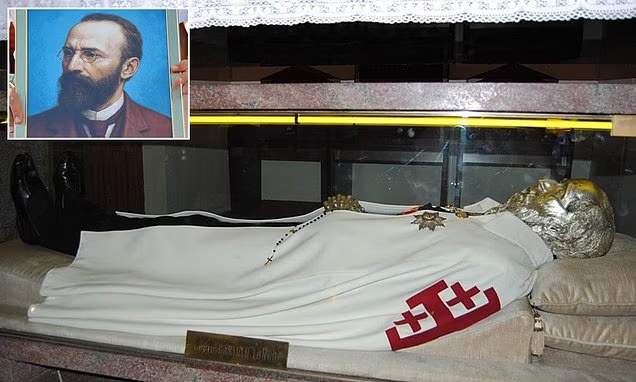
Born in 1841 in the southern Italian town of Latiano, Longo was raised in a devout Catholic family and trained as a lawyer at the University of Naples. His spiritual life took a dark turn following his father’s death, when he became deeply involved in occult practices. Historical records and Church documents describe that he allegedly served as a Satanic priest, performing rituals, practicing extreme fasting, and even claiming to have made a pact with a demon.
However, Longo’s life underwent a profound transformation after meeting Professor Vincenzo Pepe, who guided him back to Catholicism. Renouncing his past, Longo vowed celibacy and dedicated himself to acts of penance and charity. He joined the Dominican Third Order in 1871 and committed his life to spreading devotion to the Rosary and serving the poor.
Over the following decades, Longo became known for his charitable works in the city of Pompeii. He founded the Pontifical Shrine of the Blessed Virgin of the Rosary of Pompeii, which later became one of Italy’s most visited Marian pilgrimage sites. He also established an orphanage for girls in 1887 and an institute for the sons of prisoners in 1892, followed by another home for the daughters of prisoners in 1922.
Longo’s dedication extended to his voluntary service at the Neapolitan Hospital for Incurables, where he cared for patients for two years. His deep compassion and reformative zeal earned him the nickname “Apostle of the Rosary.”
Miracles attributed to Longo’s intercession began to emerge during his lifetime. According to accounts recorded by the Catholic News Agency, the day he unveiled a portrait of Our Lady of the Rosary in Pompeii, a 12-year-old girl suffering from incurable epilepsy was reportedly healed completely. This event fueled public devotion to the Virgin Mary and solidified Pompeii’s reputation as a center of faith and healing.

Longo died in 1926, leaving behind a powerful legacy of faith and transformation. His journey from a man who claimed to have “sold his soul to the devil” to one who became a servant of the Church has been held up by Vatican officials as an example of the power of repentance and divine grace.
During the canonization Mass on October 19, Pope Leo XIV highlighted Longo’s life as a symbol of hope for those struggling with sin and doubt.
“Today we have before us seven witnesses, the new Saints, who, with God’s grace, kept the lamp of faith burning,” Pope Leo said. “May their intercession assist us in our trials and their example inspire us in our shared vocation to holiness.”
Archbishop Tommaso Caputo of Pompei, speaking with EWTN following the canonization, reflected on Longo’s transformation and enduring legacy. “Longo arrived in Pompeii to take care of the properties of the countess,” Caputo said. “Walking through those streets was dangerous because of the presence of bandits and malaria, he felt an inner inspiration. From that moment, he became an instrument of the Virgin’s mercy.”
Longo’s canonization represents one of the most remarkable conversion stories in Church history. His life, once defined by darkness, has become a testament to forgiveness, redemption, and the transformative power of faith, a journey from Satanic ritual to sainthood that now holds a permanent place in the annals of Catholic history.





