

BRUSSELS (BN24) — Belgian authorities have taken three individuals into custody on suspicion of involvement in crimes against humanity and war crimes connected to Cameroon’s protracted separatist conflict, federal prosecutors confirmed Tuesday.
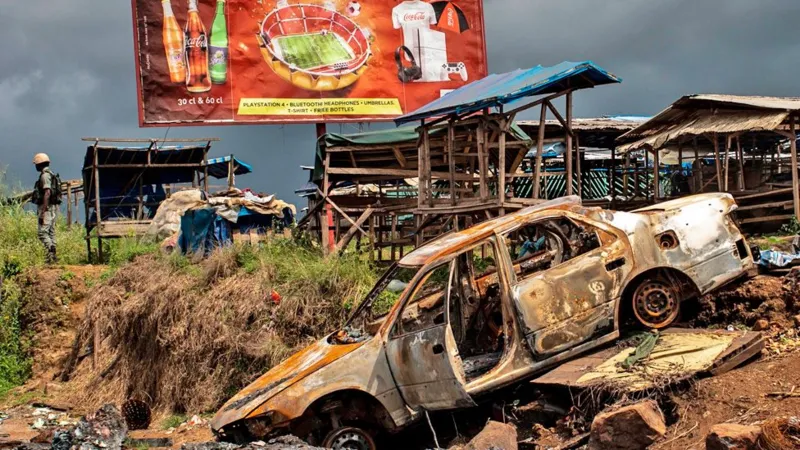
The detainees are believed to be senior figures within the Ambazonia Defence Forces (ADF), an armed separatist movement seeking independence for Cameroon’s English-speaking North-West and South-West regions. Cameroon is predominantly French-speaking, and tensions between its linguistic communities have fueled nearly a decade of violence.
In a statement, Belgium’s federal prosecutor’s office disclosed that the suspects are accused of coordinating or supporting militant operations from Belgian territory. Authorities contend that funds were allegedly raised in Belgium to sustain the armed campaign and to procure weapons and ammunition. Investigators also allege that operational directives for attacks in Cameroon may have been transmitted from within Belgium.
The arrests followed coordinated searches conducted Sunday in the port city of Antwerp and the Flemish municipality of Londerzeel. Four individuals were initially apprehended. After questioning, an investigating judge ordered three of them held in pretrial detention. The fourth individual was released under conditions that were not immediately disclosed.
Belgian prosecutors indicated that the inquiry began last summer and centers on individuals residing in Belgium suspected of belonging to the leadership structure of the ADF. The office emphasized that the investigation remains ongoing.
The United Nations estimates that more than 6,500 people have died since violence erupted in Cameroon’s Anglophone regions nearly a decade ago. The conflict has drawn international concern over allegations of serious abuses committed by both separatist fighters and government forces.
The ADF is among several armed groups that emerged after tensions escalated in 2017. Separatist fighters declared the formation of an independent state known as “Ambazonia,” intensifying clashes with security forces loyal to President Paul Biya’s government. Human rights organizations have documented allegations of extrajudicial killings, arbitrary detentions, village burnings and attacks on civilians on both sides of the conflict.
According to UN figures, the crisis has displaced more than 490,000 people internally and left over 1.5 million in need of humanitarian assistance. Entire communities have been uprooted as fighting continues across rural and urban areas of the North-West and South-West regions.
Belgium’s action comes amid a broader pattern of international scrutiny. Authorities in Norway and the United States have previously initiated investigations targeting individuals suspected of financing or directing separatist activities from abroad. The cross-border nature of these inquiries reflects growing concern over diaspora-based fundraising and coordination efforts tied to armed movements in Cameroon.
Cameroon’s Anglophone crisis traces its roots to late 2016, when lawyers and teachers in the English-speaking regions launched strikes to protest what they described as the imposition of French in courts and schools. Demonstrators argued that the Francophone-dominated government had marginalized the minority Anglophone population, eroding cultural and legal protections inherited from British colonial administration.
When activists proclaimed the independence of Ambazonia in 2017, security forces responded forcefully. The confrontation quickly evolved into a sustained armed insurgency involving the ADF and other separatist factions.
President Paul Biya, who has led Cameroon for more than four decades, has maintained that his administration has undertaken meaningful steps to address grievances and restore stability. The government has highlighted decentralization reforms and dialogue initiatives aimed at easing tensions.
Nonetheless, Biya’s administration continues to face criticism from opposition figures and civil society groups over its handling of the unrest and broader concerns regarding political freedoms. Rights advocates argue that restrictions on dissent and press activity have compounded mistrust in affected regions.
Belgian authorities have not disclosed the identities of the detainees, citing the sensitivity of the investigation. Prosecutors underscored that those arrested are presumed innocent unless proven guilty in court.
The detentions in Belgium underscore how Cameroon’s internal conflict has increasingly taken on international dimensions. European nations hosting diaspora communities are facing mounting pressure to examine whether fundraising and advocacy efforts cross into material support for armed groups accused of serious violations.
The legal framework underpinning Belgium’s investigation reflects the principle of universal jurisdiction, which allows national courts to prosecute certain grave crimes regardless of where they were committed. By pursuing allegations tied to crimes against humanity and war crimes, Belgian authorities signal that accountability mechanisms may extend beyond Cameroon’s borders.
Such cases also highlight the complex role of diaspora networks. While many expatriate Cameroonians engage in peaceful political advocacy or humanitarian support, authorities across Europe and North America have become more vigilant about the potential misuse of financial channels to sustain armed insurgencies.
For Cameroon, international investigations may intensify diplomatic sensitivities. The government in Yaoundé has long framed the separatist movement as a security threat requiring firm action. However, external probes focusing on alleged abuses by all sides risk amplifying calls for independent monitoring and judicial reform within Cameroon itself.
The humanitarian toll remains stark. With hundreds of thousands displaced and social infrastructure strained, the conflict continues to hinder economic development in affected regions. Schools have periodically closed due to violence, depriving children of consistent education. Agricultural production a key livelihood source has also suffered disruptions.
Whether Belgium’s investigation will lead to prosecutions remains uncertain. Yet the case illustrates a broader shift: conflicts once viewed as localized are now subject to transnational legal and financial scrutiny. As authorities in multiple countries examine alleged overseas coordination of separatist activity, the legal exposure for individuals operating beyond Cameroon’s borders may increase.
At the same time, sustainable resolution of the Anglophone crisis ultimately depends on political dialogue and domestic reforms within Cameroon. International legal action may address accountability, but it cannot substitute for negotiated solutions to the grievances that sparked the conflict in 2016.
For now, Belgian prosecutors continue their inquiry, while Cameroon’s long-running crisis shows little sign of immediate resolution.





