

NEW YORK — Beyoncé Knowles-Carter has crossed into ten-figure wealth territory, cementing her position among an exclusive group of five musicians who have built personal fortunes exceeding $1 billion, according to Forbes estimates released Monday.
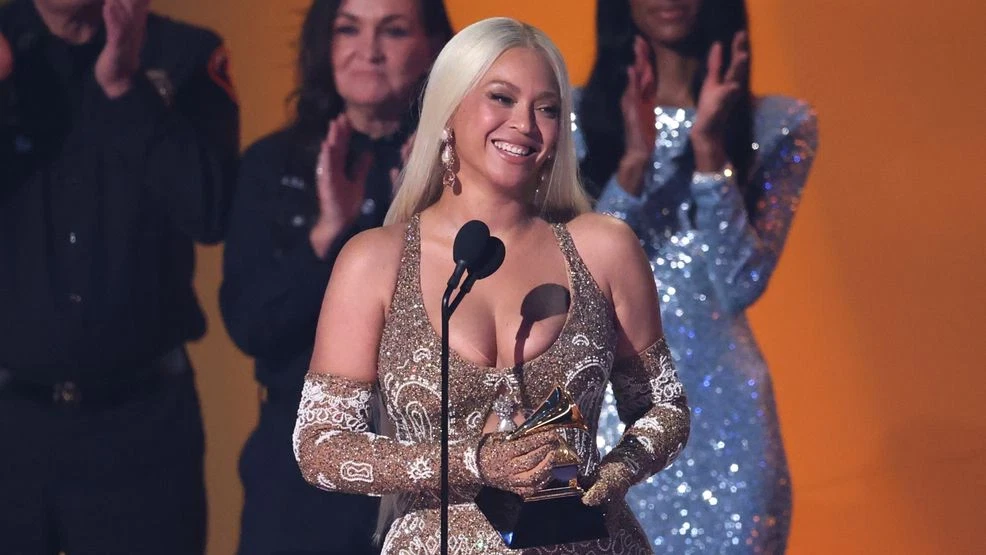
The achievement represents the culmination of a carefully constructed business strategy that extends far beyond traditional recording contracts, positioning the 35-time Grammy winner as both artist and entrepreneur in an industry where musicians historically surrendered control and profits to record labels, promoters, and management companies.
Forbes confirmed the milestone valuation following an extraordinary period of commercial success that saw Beyoncé dominate global touring markets while simultaneously expanding her business portfolio. The assessment places her alongside her husband Jay-Z, as well as Taylor Swift, Rihanna, and Bruce Springsteen in the rarefied atmosphere of music billionaires. Other publications have identified Paul McCartney, Andrew Lloyd Webber, and Selena Gomez as billionaires using different valuation methodologies, though Forbes maintains a more conservative approach to wealth estimation.
The transformation from successful performer to billionaire businesswoman accelerated dramatically in 2025, driven primarily by touring revenue that shattered industry expectations. Billboard Boxscore documented that her Cowboy Carter tour generated $407.6 million across 1.6 million tickets sold during a concentrated summer run. The trek claimed distinction as the highest-grossing country music tour in Billboard Boxscore history, a remarkable achievement given Beyoncé’s relatively recent entry into the genre.
What makes the Cowboy Carter tour particularly noteworthy is its efficiency. The tour reached the $400 million threshold in just 32 performances, establishing a new benchmark as the shortest tour ever to exceed that revenue mark. This stands in stark contrast to traditional touring models where artists perform hundreds of shows over extended periods to generate comparable revenue. The economics reflect both Beyoncé’s unprecedented ticket pricing power and her ability to create cultural events that transcend conventional concert experiences.
The financial foundation extends beyond a single touring cycle. According to NBC, her 2023 Renaissance World Tour encompassed 39 cities across 56 performances, attracting more than 2.7 million concertgoers and generating over $500 million in gross revenue. The Renaissance tour’s commercial performance positioned it among the most lucrative music tours ever mounted, comparable to ventures by legacy acts with decades-long careers.
Forbes emphasized that touring represents only one component of Beyoncé’s wealth portfolio, with the publication noting that “most of her personal wealth comes from her music, by controlling the rights to her enormously valuable catalog and earning a massive income from her global tours.” This ownership structure distinguishes her from earlier generations of performers who typically sold or licensed their catalogs to labels and publishers, forfeiting long-term value in exchange for immediate cash advances.
The strategic architecture underlying her wealth traces directly to Parkwood Entertainment, the company Beyoncé established in 2010. This entity functions as a vertically integrated entertainment conglomerate, maintaining in-house control over virtually every aspect of her creative and commercial output. According to Forbes, Parkwood Entertainment “produces all of her music, documentaries and concerts, fronting most of the production costs in order to capture more of the back-end economics.”
This business model represents a fundamental departure from traditional entertainment industry structure. Rather than partnering with separate entities for recording, management, tour promotion, merchandise, and visual content, Beyoncé internalized these functions within Parkwood. The approach requires substantial capital investment upfront but yields dramatically higher profit margins by eliminating intermediaries who would otherwise claim significant percentages of gross revenue.
The vertical integration strategy has proven particularly effective in the streaming era, where recorded music generates comparatively modest per-stream royalties. By controlling her catalog and supplementing recording income with touring, merchandise, visual content, and brand partnerships managed through Parkwood, Beyoncé captured revenue streams that would otherwise flow to multiple external companies.
Billboard noted that Beyoncé “crossed into 10-digit territory in 2025,” marking the culmination of a wealth trajectory that has accelerated in recent years. In December 2023, analysts documented her net worth expanding from $500 million to $800 million in a single twelve-month period, driven primarily by Renaissance tour proceeds. The subsequent leap from $800 million to billionaire status within another year illustrates the extraordinary earning power of contemporary superstar touring.
The business expansion extends beyond music into adjacent markets. Forbes cited her Cécred haircare line and SirDavis Whisky brand as contributing factors to her billionaire valuation, though these ventures represent relatively small percentages of overall wealth compared to music-related income. The diversification nonetheless demonstrates a comprehensive approach to brand monetization, leveraging her celebrity to enter premium consumer products markets.
Her “Renaissance: A Film by Beyoncé” topped box office charts during its December 2023 opening weekend, grossing $21 million according to NBC. The film provided additional revenue while extending the Renaissance project’s cultural reach beyond those who attended live performances. This multi-platform approach to content distribution maximizes return on the creative investment in developing tour production, music, and visual concepts.
The 2024 release of “Cowboy Carter” marked a bold artistic pivot into country music that proved both critically acclaimed and commercially successful. The album captured album of the year honors at the 2025 Grammy Awards, where Beyoncé claimed three total awards. The project demonstrated her ability to successfully navigate genre boundaries while maintaining commercial viability, a rare combination that few artists achieve.
The career trajectory extends back three decades to 1990, when a nine-year-old Beyoncé formed the singing-rapping group “Girl’s Tyme,” which evolved into Destiny’s Child. According to NBC, the group won two Grammy Awards in 1999 for “The Writing’s on the Wall,” establishing Beyoncé’s presence in mainstream popular music. Destiny’s Child’s commercial success provided the platform for her 2003 solo debut “Dangerously in Love,” which dominated international charts.
Since launching her solo career, Beyoncé has released eight studio albums, all of which reached number one on the Billboard 200 chart. She has scored nine number-one hits on the Billboard Hot 100, demonstrating consistent commercial performance across changing musical landscapes and evolving consumption patterns from physical media through streaming.
Her status as the most decorated artist in Grammy history reflects sustained critical recognition alongside commercial success. The 35 Grammy Awards span categories from traditional R&B and pop to visual media and innovative approaches to album releases, documenting her evolution as an artist willing to challenge industry conventions.
The billionaire milestone arrives during a period of unprecedented wealth concentration among elite touring artists. The live music industry recovered dramatically from pandemic shutdowns, with consumers demonstrating willingness to pay premium prices for experiences with superstar performers. Taylor Swift’s Eras Tour generated over $2 billion in gross revenue, establishing new benchmarks for what artists with sufficient cultural influence can command.
Beyoncé’s achievement also highlights the growing importance of catalog ownership in music industry wealth creation. As streaming platforms dominate music consumption, artists who control their master recordings and publishing rights capture significantly higher percentages of revenue compared to those operating under traditional label contracts where ownership typically resides with the record company.
The Cowboy Carter tour’s remarkable performance against traditional country acts illuminates the genre’s commercial potential when approached with major-market production values and marketing sophistication. Billboard noted the tour outperformed every country music trek in history despite Beyoncé being a relative newcomer to the genre, suggesting significant untapped commercial opportunity in country music when executed at stadium scale.
Industry analysts view Beyoncé’s business model as increasingly influential among younger artists seeking to maintain control over their creative output and financial destiny. The Parkwood Entertainment structure requires substantial initial capital and organizational capacity, making it difficult for emerging artists to replicate. However, mid-career artists with established fan bases and access to investment capital have begun adopting similar vertical integration strategies.
The billionaire valuation likely understates total wealth generated by her career, as Forbes methodologies typically exclude assets difficult to precisely value such as real estate portfolios, private equity investments, and illiquid holdings. The publication focuses on readily documentable income sources and business valuations, suggesting actual net worth could exceed stated figures.
Her achievement also reflects broader economic trends in entertainment where intellectual property ownership and direct-to-consumer distribution models generate substantially higher margins than traditional intermediated structures. Artists capable of financing their own production and distribution can capture economic value historically claimed by labels, promoters, and distributors.
The concentration of wealth among a small number of superstar musicians raises questions about the industry’s economic structure. While Beyoncé, Swift, and a handful of others generate billions, most professional musicians struggle to earn sustainable middle-class incomes from their craft. The streaming economy and tour market consolidation have created winner-take-most dynamics where cultural influence and economic returns concentrate at the very top of the talent distribution.
Looking forward, Beyoncé’s business trajectory suggests continued wealth accumulation as her catalog appreciates and touring remains viable. Artists in their forties and fifties can maintain extensive touring schedules, and Beyoncé’s production sophistication positions her to command premium pricing indefinitely. The strategic control over her intellectual property ensures that her music continues generating income long after active performance careers conclude.





