

YAOUNDE, Cameroon (BN24) — A military tribunal in Cameroon has sentenced three soldiers to prison terms ranging from five to 10 years for their role in the killing of at least 21 civilians in the country’s troubled Northwest region, marking one of the few instances in which members of the security forces have been convicted for abuses against civilians.
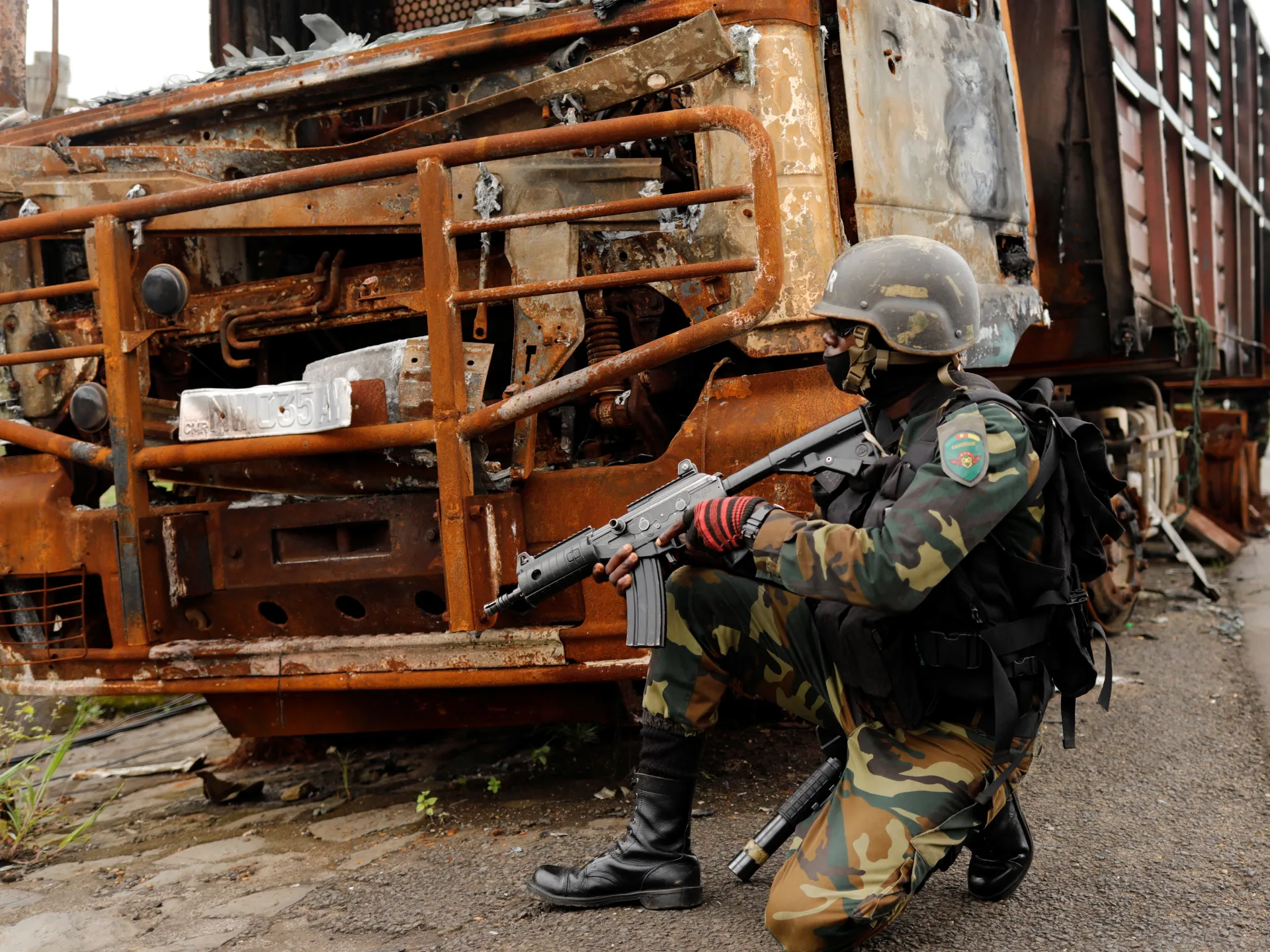
The convictions stem from a Feb. 14, 2020, operation in the village of Ngarbuh, where government troops, supported by a local militia made up of ethnic Fulanis, carried out a raid that left dozens dead. The victims included 13 children, as documented by Human Rights Watch, which also detailed accounts of homes set ablaze and residents beaten during the assault.
The military court found the soldiers guilty of murder, arson, and destruction of property. In addition to the three soldiers, a member of the allied militia was also sentenced on similar charges. The court delivered its ruling Thursday evening after proceedings that extended over six years, marked by repeated delays.
The case has drawn international scrutiny and domestic criticism in a country where prosecutions of military personnel for crimes against civilians remain rare.
In the immediate aftermath of the killings, Cameroonian authorities denied responsibility for the attack. Officials initially characterized the deaths as collateral damage from a confrontation with separatist fighters.
That position shifted months later, following mounting diplomatic pressure and the findings of a government-ordered inquiry initiated by President Paul Biya. The investigation acknowledged that government troops and militia members were involved in the civilian deaths — a rare public admission by the state amid the ongoing separatist crisis in the country’s English-speaking regions.
The Anglophone conflict, now approaching a decade, pits government forces against armed separatists seeking to establish an independent state in Cameroon’s Northwest and Southwest regions. Since 2017, clashes have intensified, with both sides facing accusations of serious human rights violations.
The United Nations estimates that at least 6,000 people have been killed and more than half a million displaced by the violence.
Lawyers representing the victims expressed dissatisfaction with the length of the sentences imposed by the court.
Sother Menkem, one of the legal representatives for the families, described the punishment as inadequate in remarks to the BBC. He argued that under Cameroonian law, serious felonies such as murder and arson carry a minimum sentence of 10 years and suggested that significantly longer prison terms were warranted given the scale of the killings.
“The sentence was so mild, I even qualify it as friendly because we are talking of a massacre,” Menkem told the BBC.
He maintained that the soldiers’ actions instilled lasting fear among residents of the area and contended that prison terms of 30 years or more would have been more proportionate to the gravity of the crimes.
Another lawyer for the victims, Richard Tamfu, criticized the court’s decision to reject demands for financial compensation for survivors and bereaved families. The ruling leaves affected families without court-ordered restitution despite the acknowledgment of wrongdoing.
Defense attorneys for the soldiers countered that their clients were performing their official duties during a security operation in a volatile conflict zone.
A man who lost several relatives in the attack told the BBC he needed time to process the court’s verdict. He has since relocated from the Northwest region for safety, underscoring the continuing instability in the area.
Human rights advocates have long argued that accountability in the Ngarbuh case should extend beyond those directly involved in the operation. Human Rights Watch and lawyers for the victims have maintained that the soldiers were acting under orders from superiors and have criticized the absence of senior military officers among the defendants.
The lack of prosecutions higher up the chain of command remains a point of contention and reflects broader concerns about structural impunity within Cameroon’s security apparatus.
The violence in Cameroon’s Anglophone regions traces back to grievances over political marginalization, language rights, and perceived inequities in governance. Protests in 2016 by lawyers and teachers in the English-speaking regions were met with force, escalating into armed confrontation the following year.
Since then, armed separatist groups have targeted security forces, schools, and civilians accused of cooperating with the government. State forces, in turn, have faced allegations of extrajudicial killings, arbitrary arrests, and the burning of villages.
The Ngarbuh killings became emblematic of the conflict’s brutality and fueled international calls for accountability. The rare admission of responsibility by the government was seen by observers as a potential turning point. However, critics argue that the limited scope of prosecutions and relatively short sentences suggest that systemic reform remains elusive.
The sentencing of the three soldiers carries symbolic weight in a country where convictions of security personnel are uncommon. It signals that, under sustained domestic and international pressure, the government is willing to pursue at least some measure of judicial action in high-profile cases.
Yet the modest prison terms and the absence of senior officers among those convicted may reinforce perceptions that accountability stops at lower ranks. In conflicts marked by hierarchical command structures, prosecutions limited to frontline personnel often raise questions about whether justice addresses the broader decision-making framework that enabled the abuses.
The case also reflects the delicate political calculus facing President Biya’s administration. Acknowledging wrongdoing may help ease diplomatic strain and bolster Cameroon’s international standing. At the same time, expanding prosecutions to senior officials could expose the military leadership to deeper scrutiny and potentially unsettle internal power dynamics.
For communities in the Northwest region, however, the verdict’s practical impact may be limited. Displacement remains widespread, and sporadic violence continues. Without comprehensive reforms including transparent investigations, reparations mechanisms, and credible oversight of security operations the trial may be viewed as an isolated response rather than a turning point.
As the Anglophone crisis endures, the Ngarbuh case stands as both a rare instance of judicial action and a reminder of the broader challenges facing Cameroon in reconciling security imperatives with human rights obligations.





