

A small passenger aircraft carrying a Colombian lawmaker and 14 others crashed Wednesday in a remote part of northeastern Colombia, killing all aboard and prompting a full investigation into the cause of the disaster, government and airline officials said.
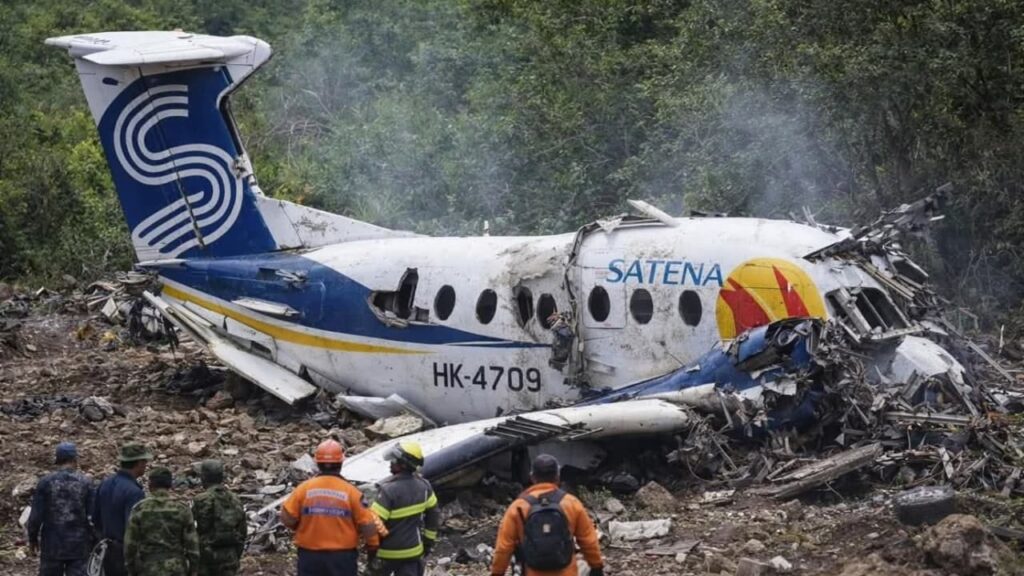
The state-owned airline Satena said the Beechcraft 1900 with registration HK-4709 was en route from Camilo Daza International Airport in Cúcuta to Aguas Claras Airport in Ocaña when contact was lost with air traffic control roughly 12 minutes after departure. The flight, typically about 40 minutes, never completed its journey, and wreckage was later found in the rural community of Curasica in the La Playa de Belén area of Norte de Santander province.
Colombia’s Transportation Ministry confirmed that search and rescue teams located the site of the crash and “regrettably confirmed that there were no survivors.” The ministry did not immediately provide a cause for the accident but said authorities would conduct a thorough investigation.
Among the dead was 36-year-old Diógenes Quintero, a member of Colombia’s House of Representatives who represented the Catatumbo region, a conflict-affected area near the border with Venezuela. Satena said 13 passengers and two crew members were on board.
Quintero was a prominent human rights advocate and a lawyer by training. He was elected in 2022 as one of 16 representatives to serve Colombia’s so-called “peace seats,” a group of legislative posts created under the 2016 peace agreement between the Colombian government and the country’s largest guerrilla organization, the Revolutionary Armed Forces of Colombia (FARC). The seats were established to give greater voice to victims of the nation’s decades-long armed conflict.
Also among the victims was Carlos Salcedo, a community leader and congressional candidate, according to passenger manifests released by the airline.
Colombia’s president, Gustavo Petro, expressed sorrow over the fatalities on social media, offering condolences to the families of those killed. “I am deeply saddened by these deaths,” Petro wrote, underscoring the national impact of the tragedy. Vice President Francia Márquez also issued a message of mourning, saying her “heartfelt condolences” went out to the grieving families.
Local authorities and aviation analysts said the mountainous terrain in the Catatumbo region, where the crash occurred, presents particular challenges for air navigation. The area’s steep hills and variable weather patterns have complicated past search and rescue efforts and could be a factor investigators will examine, though no official cause has been released.
Satena, Colombia’s state airline, primarily operates regional routes, connecting smaller cities and rural areas that larger commercial carriers do not serve. The Beechcraft 1900 turboprop, a twin-engine aircraft commonly used for short hops, has a long service history in the country, including in difficult topography.
The accident comes at a time when Colombia continues to balance economic growth and infrastructure investment with longstanding security and development challenges in its border regions. Norte de Santander, in particular, has been affected for years by illicit armed groups, including dissident factions of the FARC and other organizations seeking to control drug trafficking corridors and remote territories.
The crash has revived attention on aviation safety standards in Colombia’s regional air corridors, where terrain and weather can rapidly shift, demanding rigorous pilot training and up-to-date navigational technology. Experts caution that severe weather, combined with sudden terrain elevation changes, can create hazards even for experienced flight crews.
Colombia’s aviation authority, which will assist in the probe, has previously highlighted the importance of modernizing approach systems at smaller airports to ensure safer landings in adverse conditions. Whether technological limitations played a role in this crash is expected to be part of the ongoing inquiry.
The loss of Quintero has struck a chord nationally, as he was widely viewed as a dedicated representative for communities affected by violence and displacement. His position as a peace seat legislator made him a symbol of the country’s efforts to integrate victims into the political process, and his death is being mourned across political divides.
Colombia’s peace agreement has been a defining feature of its recent political landscape, and Quintero’s role underscored ongoing efforts to translate formal peace into tangible social and economic improvements in rural areas. His absence in the lower chamber leaves a void in the representation of those regions.
The plane crash also highlights the vulnerability of regional transportation in parts of Colombia where rugged geography intersects with underinvestment in aviation infrastructure. Local leaders have previously urged federal authorities to prioritize safety upgrades and improved weather forecasting systems at smaller airstrips to prevent similar tragedies.
Officials have pledged to release preliminary findings as the investigation progresses, though final conclusions may take months, particularly if black box data and flight records are involved. Meanwhile, the Colombian public faces the loss of a leader and the tragic reminder of the risks inherent in connecting its far-flung communities by air.
For families and local communities in Catatumbo and beyond, the crash represents not only a personal loss but also a national moment to reflect on transportation safety, rural development and the broader challenges facing Colombia’s fragile peace process.
AP/Aljazeera/Reuters




