

(Reuters/DW) — At least 17 bodies have been recovered from a migrant vessel discovered off the coast of Comoros, authorities confirmed Thursday, in a tragedy that underscores the growing dangers of irregular migration routes across the Indian Ocean.
Officials indicated the boat was carrying African migrants attempting to reach Mayotte, a French-administered island long viewed as a gateway to Europe due to its access to social services and infrastructure.
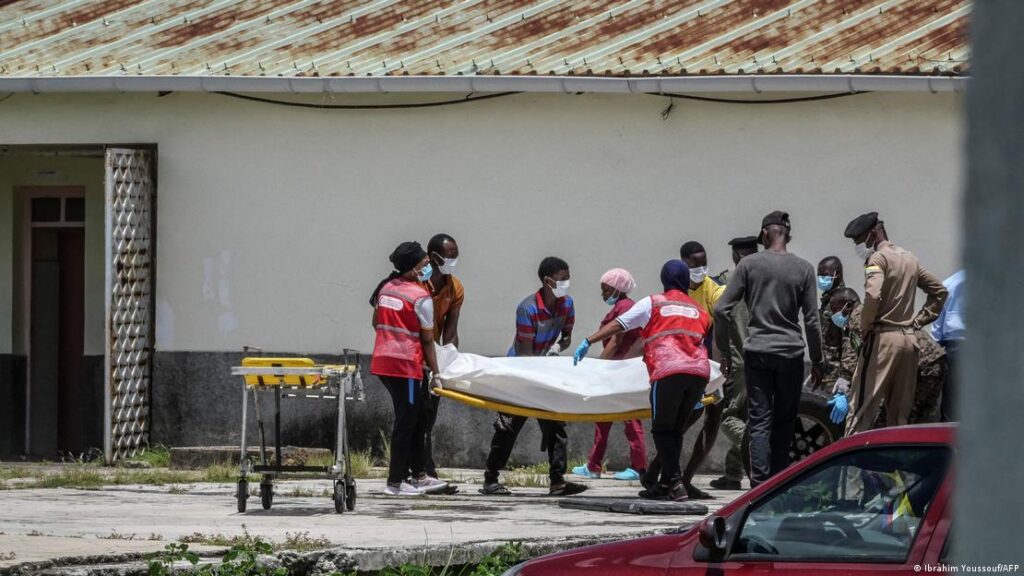
The vessel was located late Wednesday near the coastal town of Mitsamiouli after residents reported hearing cries for help from the water, prompting an emergency response.
Interior Minister Mohamed Ahamada said nine bodies were retrieved Thursday morning, adding to eight recovered overnight. Approximately 30 individuals survived the ordeal, he told reporters during a briefing.
Local medical officials, however, cited a slightly higher toll of 18 fatalities, noting that survivors reported originating primarily from the Democratic Republic of the Congo.
Authorities believe around 50 people were aboard the vessel, though the exact number remains uncertain as search operations continue. The Comorian coast guard is still attempting to locate several individuals believed missing.
Accounts from survivors and rescuers suggest that many victims were left struggling in open water after smugglers forced them off the boat before reaching shore.
Testimonies gathered by international media outlets paint a grim picture of the migrants’ journey.
One survivor, speaking to Agence France-Presse, described traveling for days through forests and across multiple countries before boarding the vessel. He said the trip lasted about a week and was plagued by uncertainty.
“Very quickly, we could tell the captain was lost,” he said. “At one point, we had no bread or water.”
Other survivors said they believed they had reached Mayotte when they were abandoned at sea, only to discover they were still nearly 200 kilometers away.
Residents in Mitsamiouli described hearing desperate screams while watching a football match, prompting them to rush to the shoreline, where they encountered men, women and children struggling in the water.
The route from the Comoros to Mayotte is among the most hazardous migration corridors in Africa. Migrants frequently rely on smugglers who use overcrowded and poorly equipped boats to attempt the crossing.
Despite being France’s poorest overseas department, Mayotte continues to attract migrants due to its perceived economic opportunities and access to public services.
Data from the International Organization for Migration indicates that thousands have died along this route over the years. In 2024 alone, at least 25 people perished near Mayotte when a smuggling vessel capsized.
Authorities in Comoros have mobilized emergency responders, including local residents and fishermen, to assist in recovery efforts.
Interior Minister Ahamada said teams are continuing to comb the waters for additional victims, with at least four people still unaccounted for.
The incident has renewed calls for stronger regional cooperation to combat human trafficking networks operating across East Africa and the Indian Ocean.
The latest tragedy highlights the persistent and complex forces driving migration toward Mayotte and similar destinations.
Economic instability, conflict and limited opportunities in parts of Central and East Africa continue to push individuals toward dangerous journeys in search of better living conditions. For many, Mayotte represents not just a destination, but a perceived entry point into the broader European system.
However, the reliance on smuggling networks exposes migrants to extreme risks. Boats are often overloaded, navigational expertise is limited, and smugglers frequently abandon passengers to avoid detection, as appears to have occurred in this case.
The incident also underscores the limitations of enforcement-only approaches to migration. While increased patrols and border controls may deter some crossings, they can also push migrants toward more dangerous routes, increasing the likelihood of fatalities.
From a policy perspective, addressing the root causes of migration — including poverty, political instability and lack of economic opportunity — remains critical. At the same time, improved search-and-rescue capabilities and legal migration pathways could help reduce reliance on traffickers.
The tragedy near Comoros is not an isolated event but part of a broader pattern seen across global migration routes, from the Mediterranean to the Atlantic and the Indian Ocean. Each incident adds to a growing humanitarian toll that continues to challenge governments and international organizations alike.
As recovery efforts continue off the coast of Mitsamiouli, the loss of life serves as a stark reminder of the human cost behind migration statistics — and the urgent need for coordinated solutions to prevent further tragedies.




